Day in the Life: First Day of School for Teachers (Post #1)

I’ve decided to chronicle this school year through my blog. It’s part of Tina Cardone’s Day in the Life book project. This is the first post in the series

5:45am | Rise and shine. I’m a morning person, always have been. I love waking up to the morning sun, birds, and fresh air. It’s usually the time when I get a good chunk of my reading and writing done. Right now I’m reading For White Folks Who Teach in the Hood…and the Rest of Ya’ll Too by Cristopher Emdin. I read for half an hour, eat some breakfast. Drink coffee. Get ready to leave.

7:15am | I’m out the door. I bike to school everyday. The ride is brief, about 12 minutes, but The Bronx is notorious hilly. I think of it as a morning workout, my version of going to the gym or running. Today, before I head to school, I make a quick loop around to the library to return a book. I love the New York Public Library.

7:35am | I arrive at school far later than I ever would during the school year, but since there are no students today, I don’t care. I lock up my bike for the first time in the school parking lot. I plan to leave my U-lock attached to the gate so I don’t have to lug it back and forth from home everyday. This is a big change for me since last year I kept my bicycle in my classroom.

Last week I was at school and found a classroom that I’ll be teaching in to store all of my teacher crap, so I go upstairs to that room. Since I’m new and know no one, I have no other logical place to go. A colleague from the math department comes in mentions that there’s breakfast down the hall. Nice. Since I already filled up at home, I snack on a few pieces of honeydew and sip some juice. As everyone mingles, I introduce myself to a few people and greet my new math department colleagues, but it’s mainly a big reunion for everyone else after a long summer. Myself and another new science teacher huddle together near the center of it all and talk for a bit. I feel isolated.

8:03am | I head to the school library to prepare for the morning festivities. The principal opens things up. He’s the founding principal and gives everything the has to the school. Super committed. He introduces the new teachers, myself included. Everyone claps. He then gets into the school’s history and why we’re all here. His talk is inspiring. It’s essentially a pep talk and serves its purpose. I love listening to people speak and this is no different. The man has a presence that is unmistakable. He also addresses the school’s performance last year and reveals the school’s goals for the year: a renewed focus on relationships, concentrated effort on the lowest-third students, and the idea of teacher as educator.

The assistant principals are up next. They do their thing and hit on lots of things from accessing email to observations. At this point it’s been over two hours with no break, so I’m fidgety and off-kilter. We take a 10-minute break at 10:30. I go back to the leftover breakfast and snag a muffin. More juice. I return to the library and the APs finish their presentation.

11:25am | Department meetings. This is the first formal meeting with all of my new colleagues. They welcome me to the team. I pitch in when they start reflecting on the goal from last year, precision of language. Specifically, the proper use of mathematics vocabulary. One way they addressed this was by using sentence starters. I mentioned that it’d possibly be good for us to have sentence starters that aren’t specific to any one concept. Things are running behind schedule, so we break for lunch.

12:00pm | The kitchen staff prepared lunch for the faculty. One word: amazing. The food itself, yeah, but the fact that they would prepare us food is incredible. Oddly, I think this is the first time I’ve ever had lunch that is usually eaten by students. It was so well-balanced and nutritious.

1:04pm | The math department reunites. We pick up where we left off and somewhere during the course of our discussion, I mention my work with facilitating the video club the last couple of years. The team seems intrigued by the idea and decided it would be something they’d want to try this year. The department chair gets pulled out which signals the unofficial close of our meeting. I briefly meet my co-teacher for my period 8 algebra 1 class.

1:40pm | The rest of the day is spent in the classroom prepping my room. I use the word “my” very loosely because I quickly learned that I’m only teaching 60% of my class load there and it’s shared with five other teachers. (So it’s not really mine, but for simplicity I’ll use the determiner “my” from here on out.) This is a drastically different experience for me because I’ve had my own room for the last seven years. Here’s to becoming a more mobile teacher!

I spend about two hours cleaning and decluttering the room. It’s a mess. There were books in there dating back to JFK’s presidency. OK, that’s a stretch, but hopefully you get my point. Next, I turned to the layout of the room. This is a high priority for me. I rearrange the desks and other furniture into something that feels much more inviting. After about 30 minutes of moving things around, I go with several “U” shaped groups around the room and moved my desk and cabinet to the rear. I also open up the shades to let more light in. A few people stop by and compliment the new look and feel that the room now has. I hope that the teachers sharing it will feel the same.

After detoxifying the desk, I organize it with some of my things. I like a tidy, organized work space. My productivity hinges on it. I hang up a few things around the room, sit a while to catch up on email, and call it a day. One more day before students.

5:37pm | I arrive home and enjoy some family time before dozing off to sleep around 10pm.

1.Teachers make a lot of decisions throughout the day. Sometimes we make so many it feels overwhelming. When you think about today, what is a decision/teacher move you made that you are proud of? What is one you are worried wasn’t ideal?

I felt really good after I arranged my classroom. When I initially walked in the room, the desks were in disarray and there was old, unused crap everywhere. It didn’t feel like a place where learning is supposed to happen. At the same time, because I share the room with others, it was terribly inconsiderate of me not to consult those teachers before situating the room. This may come back to bite me.

2. Every person’s life is full of highs and lows. Share with us some of what that is like for a teacher. What are you looking forward to? What has been a challenge for you lately?

When it comes to challenges, transitioning to a new school after a decade in my old one takes the cake. That said, I’m really looking forward to meeting the kids in a couple of days. Once I start building relationships with my students, everything else will take care of itself.

3. We are reminded constantly of how relational teaching is. As teachers we work to build relationships with our coworkers and students. Describe a relational moment you had with someone recently.

Today I spoke with a veteran teacher who joined the school last year. He and I were both reminded just how much of a risk we by leaving everything to reestablish ourselves in another school community. It was a great conversation that helped me keep things in perspective…and not feel totally alone.

4. Teachers are always working on improving, and often have specific goals for things to work on throughout a year. What is a goal you have for the year?

Here are my goals for 2016-17, there are several. I sort of prioritized, so the big ones are a strong focus on instructional routines, establishing a more culturally relevant stance as a teacher, and having my students be more interdependent via group norms.

5. What else happened this month that you would like to share?

I’ve been working on curriculum a lot during the last few weeks, particularly on the Algebra 2 side of things. I’m adopting a somewhat new course sequence, so we’ll see how it goes.

bp

Why I’m #MfAProud

#MfAProud

Two years ago I drafted a post entitled “MfA and its Impact on My Career.” I knew at the time that I had a lot to say, but I could only compose one sentence, a thesis of sorts: MfA has spurred my professional growth and connection with like-minded educators. I revisited the draft many times since then with the hopes of publishing it, but never did. In fact, I wasn’t even able to add a second sentence, let alone complete a paragraph. Every time I wanted to, it seemed far too challenging to articulate what MfA meant to my career.

Fast forward to the present. With the start of a new school year, Math for America has outlined a campaign for its corps of teachers to share why they are proud to be a MfA teacher. Given this, the time is ripe for me to finish that initial draft and showcase my relationship with MfA. Besides, I’m long overdue.

I’ve hinted at this proclamation before; other than deciding to become a teacher, MfA is hands-down the best professional decision I’ve ever made.

For many teachers, including myself, MfA is a dream come true. Seriously, I’m still waiting to wake up. When you realize the woefully complex system in which we operate and contrast it with the die-hard passion for teaching that all MfA teachers possess, MfA is a breath of fresh air. I have met MfA teachers that have cried when discussing their relationship with Math for America. I can relate. Math for America changes careers in unforgettable ways.

When I think about it, MfA’s success doesn’t hinge on anything that’s all that extraordinary. They do something simple, really well: honor teachers. Period. Positively impacting teaching and learning in today’s cutthroat educational climate isn’t like brain surgery. MfA figured this out long ago…and it’s the root of my pride in being a Math for America teacher.

On the most fundamental level, they do this by providing community, structure, and a space where teachers can exchange ideas and resources, all the while feeling valued and trusted. MfA’s teacher-organized, teacher-designed, teacher-led workshops have transformed my classroom to a risk-taking laboratory. I’m constantly working with the best STEM educators in New York City and, I would argue, the country. In addition, I’ve been called on to lead colleagues like never before, which has helped me extend the arm, and mission, of MfA to empower my colleagues. I have also been fully funded to attend a conference. I have a paid membership to NCTM. And though nowhere near an expert, I have even been asked to speak at a research-based institute.

I’m also distinctly proud of the little ways I’ve been able to give back to MfA. To contribute to such an outstanding community (the gold standard in teacher development, if you ask me), means so much to me. Over the years, a certain responsibility has surfaced within me to help maintain the integrity of what MfA stands for and help it evolve over time. Best of all, I know that I still have so much more to give.

But, most of all, my pride shines every time I walk out of a MfA workshop at 7:30pm on a school night. During these moments, I am reminded that my job is a top priority, that I make all other professions possible. I am reminded that I am not an island unto myself. I am reminded why I never want to be an administrator. I am reminded that my students’ futures depend on my continuous development. I am reminded that I am a learner first, a teacher second.

I am reminded of why I am a teacher.


bp

Write me a letter

I need to improve how I get to know my students at the beginning of the school year.

I already knew that I was weak on this front, but when Sara VanDerWerf detailed launching tasks by creating context that honors students, it really inspired me to get the ball rolling.

I already have a couple of routines that allow me to connect with my students. Namely, personal notes, Friday letters, and end of year letters that I open at the start of the next school year. But what I’m missing is something substantial at the start of the year that will help me design the class around my students (that’s not content-based).

So this year, during the first week of school, I’m going to have students write me a letter. It can be handwritten or an email and serves as an opportunity for students to personally communicate whatever it is about themselves that they think I should know. I may provide prompts for those that need guidance, but I want the letter to be somewhat open-ended. I want them to tell me what they feel is important. Some prompts I’m thinking of are:

  • What’s something about yourself that I wouldn’t know by looking at you?
  • What’s your family’s background? Do you speak any languages other than English?
  • Who do you live with? Do you have any siblings?
  • In all of your years of school, who is/was your favorite teacher? Why?
  • Who is/was your least favorite? Why?
  • Was mathematics invented or discovered? Why do you think that? (Thanks Elizabeth.)
  • If you had to be any number, which one would you be? Why? (Thanks Matt.)

What’s more, over the course of the first few weeks of school, I’ll write every student a detailed letter in reply. This way they can get to know me on a more personal level as well. It’s a significant time committment, but one that I feel will be worth it in the long run.

Speaking of Sara, she also wrote about how she uses name tents during the first week of school, which I hope to adopt this year. This is a crafty, yet simple, way of not only learning student names, but also learning all that is behind those names.


bp

End behavior of functions via Connecting Representations

As the second and final assignment for the Structured Inquiry course I’m taking with New Visions, I was asked to create a task using the Connection Representations instructional routine (#ConnectingReps). More on Instrutional Routines here.

The instructor, Kaitlin Ruggiero, mentioned that multiple choice questions are good starting points for developing these tasks. Adopting her suggestion, I used #4 from the June 2016 Algebra 2 Regents Exam. The question focuses on roots and end behavior of a function. (F.IF.8). I chose to narrow my focus to strictly end behavior.

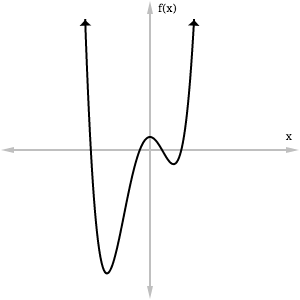
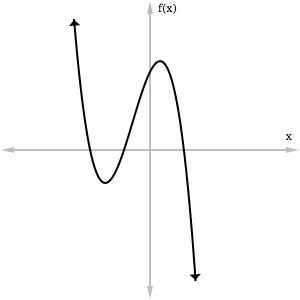
Here are the first set of representations, graphs of several polynomial functions:

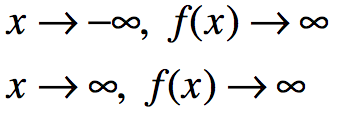
Here are the second set of representations, statements about the end behavior of each graph:

During rehearsal, I showed graphs A, B, and D and their corresponding end behavior statements. We followed the routine to match the representations. I then revealed graph C and had them come up with the statement, which is 4. Lastly, the class reflected on what they learned using meta-reflection prompts.

I don’t have a formal write-up of the activity, but here are the above images.

Reflections:

  • I designed this for my algebra 2 class. My gut is telling me that it may fit in well at the beginning of my rational and polynomial functions unit. I may also consider using it if/when we review domain and range.
  • Initial noticings about the graphs had more to do with the “inner behavior” rather than the end behavior. In other words, the class was drawn to the minima, maxima, and roots.
  • There was some blank stares when I revealed the statements. This will most likely happen with students, too. The mapping symbol (i.e. function arrow) can be confusing if you’ve never seen it before. But that was the point.
  • Most of the class chunked all of the “x approaches…” statements and realized that they were the same in each representation. Since two of the given graphs (A and B) had both ends going to either positive or negative infinity and the other graph (D) didn’t, this led them to conclude that graph D had to match with statement 2. From there they reasoned that since graph A is going up on both ends, it should match with statement 1. Similar reasoning was used to match graph C with statement 4.
  • By giving the class three graphs and three statements, the third match (C and 4) was kind of boring. I still made them justify why C and 4 matched, but it didn’t feel as meaningful.
  • In retrospect, I wouldn’t change any of the representations, but I would revise what I give the class and what I have them construct on their own in order to help them move between representations more fluidly:
    • Give only A and B and their matching statements (1 and 3). Students reason through the matches.
    • Then give graph C and have them construct the corresponding statement (which is statement 4).
    • As an extension, I would give statement 2 and have them sketch a graph that goes with it. All student graphs will be similar to graph D, but the “inner behavior” will be all over the place. Because of the infinite number of possible correct responses, we could show several graphs under the Elmo to guide this part of the routine. I could save these student-generated graphs for later analysis on other properties, including even/odd, roots, maxima/minima, etc.
  • I didn’t use the words chunk, change, or connect at any point during the rehearsal. This is somewhat disappointing since I want my students to use these terms to describe their reasoning during this routine. Mental note taken.
  • Instead of me selecting the next presenter, sometimes I should allow the student that just presented to choose. This is student-centric and I like it (when appropriate).
  • Compared to Contemplate then Calculate, I feel that Connecting Representations is a slightly more complex in nature. With that said, Connecting Representations uses matching, which is really user-friendly. Both routines emphasize mathematical structure, but it seems to me like Connecting Representations emphasizes structure between different representations while Contemplate then Calculate focuses on structure within a representation. Dylan Kane and Nicole Hansen hinted at this during TMC16.
  • Though I didn’t use Connecting Representations, this past spring I foreshadowed this work with my Sigma notation lesson. Given two representations (sigma notation and its expanded sum), students used reasoning to connect the two.
  • This in-depth experience with both of these routines will allow my students to surface and leverage mathematical structure through inquiry like never before. So exciting!


bp