Attendance Sheet

Last week, I walked into the main office and found some folks shredding old documents. This is an ongoing process. Schools are hoarders of all things paper.

On this particular morning, I wanted to be nosey. I looked down. What part of our past was being sliced into a million pieces today?

I instantly recognized them: Attendance sheets! Somehow we still use these antiquated sheets in our first period class, which marks the “official” attendance of the day. Each sheet is lined with an endless number of bubbles filled with “A” for absent and “T” for tardy.

Utterly intrigued, I looked closer at a sheet just before a staff member fed it into the shredder. It was from December 2017. I recognized my name at the top as the teacher of record.
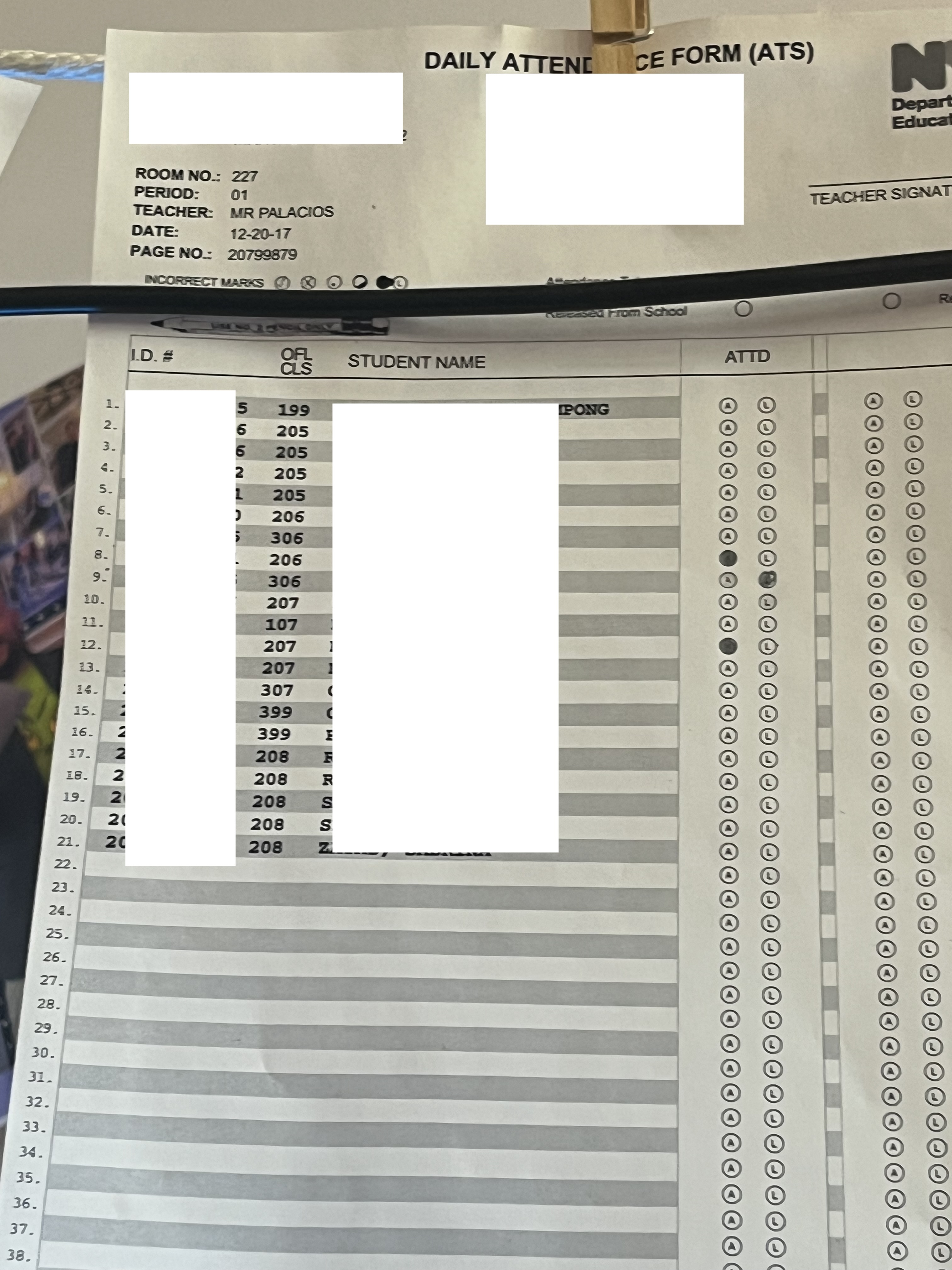

That’s when I had a moment.

I don’t remember the class itself that well, but I do remember the kids. As I read their 21 names, many of their faces and stories came roaring back to me. There was the girl who sang her life away as part of every school musical. There was the Ghanaian boy who gave me my Akan name based on the day of the week I was born. The student who came back to work in our college and career office for a year. The kid whom I struggled get to do any math, but who walked into class with a bright smile each day. There was the student I taught to ride a bike during our international trip to Denmark. The sister of one of those students on that sheet is in my class right now. The stories go on and on.

I haven’t thought about these kids in years. Teaching has trapped me in the present. There are lessons to plan, new students to meet, and a never-ending stack of papers to grade. But for a brief moment that morning in the office, I was transported back to my first period of December 2017.

Remembering those kids reminded me of the magnitude of my career. Those 21 students were my past, looking me square in the eye. Our momentary contact across time and space made me realize that, despite my best efforts to control my destiny as an educator, it is my students who have undoubtedly shaped me into the teacher I am today. Like a bank account, each of their stories has made a deposit to my pedagogy. I am rich with experience, empathy, and instructional wisdom because of them.

What I hope to stand for today is a direct result of our challenges and triumphs together. It was important for me to recall this because one day, my current students will be my past. Years from now, I might discover an attendance sheet, photo, or some other relic from 2026. What will it say about my teaching? How will it capture who I am as an educator this year? How might it show how today’s students have sharpened me for those who have yet to come?

I asked the main office if I could keep the attendance sheet. It’s hanging in my classroom. ∞


New Year’s

As a teacher, it’s hard for me to get excited about New Year’s. It’s been that way for as long as I can remember. My life is characterized by school years, not calendar years. Life events and other memorable moments unfold within the frame of my school calendar, not the one hanging on my wall. The ten months between September and June form the timeline of my life. I recall many pivotal life events by when they happened during the school year. I also schedule appointments that parallel the ebbs and flows of the school year. And let me not forget about summer! These two special months signify the end of my year. It’s a time of reflection and relaxation after a year’s worth of work. It’s my off-season.

Thus, for me, New Year’s arrives in September, when my students arrive. That is when I look back on who I was and set goals for the year ahead. That is when I am filled with a sense of renewal. Celebrating New Year’s now feels obligatory and anticlimactic.

While this time of year feels secondary, it does serve a valuable purpose for me: the end of the calendar year divides the school year almost in half. If anything, New Year’s Day marks the middle of my school year. It invites me to conduct a mid-year check-in on my teaching.

That said, I’m entering 2026 with far more hope than I did in 2025. I’ve grown from many of my shortcomings last school year. Something is opening up inside my teaching. The sun is rising again.

bp

Haiku #13

As an alternative means of capturing my thoughts and reflections, I write haiku about my teaching practice. This is the 13th post in the series.

Over the last several months, my writing has slowed. I noticed, but did nothing. So many impactful moments from inside my classroom and out have come and gone. Instead of grabbing them, holding them, and unpacking them through my writing, I let them go.

Writing here has always given me permission to slow down and uncover meaning from the constant blitz of teaching. As a result, this blog has helped make teaching sustainable. By forgoing the opportunity to reflect on the transition from last year to this year, I have created a void.

I’ll never know all that has passed me by. ∞


My hidden story
All that I failed to notice
Felt but never seen

bp

Over 22 hours

When you teach at a small high school, like I do, you where a lot of different hats. There’s a ton of stuff that needs to get done and are fewer people to do it. Naturally, everybody is asked to do a little more, especially teachers.

But what happens when your responsibilities as a content teacher take a back seat to your other commitments around school? Even worse, what happens when these commitments are handed down to you by school leadership?

Of the five math teachers at my school, I am the only one who teaches a full course load of mathematics. The four other teachers teach math, but they also have inherited a host of other teaching responsibilities, including study hall, advisory, and non-math electives. One math teacher teaches computer science and another does robotics.

This means that out of a possible 25 class periods available each day for math instruction by licensed math teachers, only 19 are dedicated to pure mathematics. With 45-minute periods, this translates to over 22 hours of math instruction that is lost per week due to programming alone.

I’m not saying that my colleagues’ current teaching responsibilities aren’t important to our school community. Advisory, when done right, is invaluable to the social and emotional well-being of stduents, which schools often neglect. Computer science and robotics are outstanding opportunities for students and we’re fortunate to offer them.

Nor am I saying that programming 30 teachers and 500 students is easy. It’s highly complex, with a lot of moving parts, especially when space is limited, as is the case at our school. If I asked around, perhaps I would discover that other core teachers function similarly and this isn’t a math-specific issue.

All of these concerns are valid. However, this doesn’t negate the reality that our students are offered far less math instruction than what is optimal. If students as a whole are doing less mathematics throughout the day, they will learn less mathematics as a result. Despite all the challenges, can’t we do better? ∞