On the intersection of being White and being a math teacher

Two of the books that I read this summer, Why are the All the Black Kids Sitting Together in the Cafeteria by Beverly Daniel Tatum and Blindspot by Mahzarin R. Banaj and Anthony G. Greenwald, utterly blew my mind. 

So while the summer winds down, I’ll leave it at the end of this month with so many concerns about my teaching and how I address racism.

A. For my entire life, just like a lot of other White people in this country, I considered myself colorblind. I claimed that I was blind to the race of the people I interacted with. And I took a lot of pride in this fact, too. If I didn’t see people’s race, I couldn’t discriminate or play favorites. I conned myself into this line of thinking. Being born and raised in the inner city, and one of the few White people in my neighborhood and school, race wasn’t a “thing” for me. This perspective continued into adulthood and pervaded my teaching. Even with students, I either claimed the colorblind stance or simply avoided conversations about race. It isn’t until now that I realize that this is, and was a huge, huge problem.

B. Most White people don’t think we live in a racist society. Most White teachers don’t either. But we do. I’m not talking about outspoken racism, like that of white nationalists. I’m referencing the systematic racism that pervades in the air we breathe here in America. In many ways, we choose to not think about it because it’s uncomfortable. White privilege is a very real thing, even if we chose to look the other way. It existent in every aspect of society. Most White people don’t see it this way because we are (myself included) inside the box — we are part of the dominant group. That inherently makes it harder to understand the advantages we have.

C. What’s especially damaging about this is that every single White teacher I know is a good person. They don’t intentionally aim to do harm to students of color. Heck, most of these teachers teach in schools with large proportions of students of color because they want to help interrupt the cycle of inequality and injustice that these kids experience. But our hidden biases, which strongly favor our culture of Whiteness, can still significantly affect our judgment in ways that we aren’t even aware of.

D. What does this mean? It means that if we teachers (and especially our school leaders) don’t develop an anti-racist stance that fosters a critical consciousness about life being more than White privilege, our schools and classrooms will be a mere reflection of the racist society in which we live. It means that if we don’t mindfully recognize the systemic racism that our students of color, and colleagues for that matter, encounter every day, how can we attempt to take a chance at interrupting it?

E. So how do we, as teachers, bring up such a sensitive topic with colleagues and administrators to help push the needle in the right direction? There’s fear, dread, and detachment in people’s eyes (not just White people, either) whenever race is brought up. I know because it used to happen to me. I have no idea how to address this, but I think open, safe conversations with one another are vitally important — like at staff and department meetings. Provocative, reflective prompts are needed (Jose and Wendy!). A simple discussion can go a long way. Norms need to be set. I would hope that administrators can be present and active. Anxiety is natural, but I like to think that if we’re sincere and honor one another, the right words will always find their way out of our mouths.

F. Self-discovery might also help. Here are various research-based tests that we can take online to help determine each of our hidden biases. They are called Implicit Association Tests. Here’s some background on them.

G. I don’t know, I don’t know. I’m at a loss here. I’m no expert on how to make this happen. Progress seems so far away, but this post is a start for me, I suppose. A grueling and uncomfortable path lay ahead.

H. One more thing that I want to add. Right now, 75% of my mathematics department at my school is White male. That bothers me. At times, I worry about the subliminal messages that this sends the 90% of students at my school who are Black or Latino — especially if we (White males) aren’t actively taking an anti-racist approach to teaching and learning mathematics.


bp

Happy third birthday, lazy0ch0. Go celebrate.

file851348626627

This blog is turning three years old in a few days. It’s still a toddler in human years and it doesn’t seem that long – until I realize that I’ve now been blogging for 27% of my teaching career.

The first thing that comes to mind is that I still write entirely for myself. Everything here, even the list of what books I’ve read, is for my own personal reference. Two years ago, I thought that I might get over writing for purely reflective purposes. I haven’t. I guess I’m selfish when it comes to writing. Once every six months, someone in real life brings up my blog to me in person. I’m always flattered, but I’m also surprised because:

  1. they actually read my blog
  2. the thrill I get from writing about my work as a teacher regularly makes me forget that everything here is public

Speaking of being public, sometimes I think that if I’m writing for me, why don’t I just do it in a journal or possibly make all my posts private? As anyone that writes publically will agree, there’s a high level of accountability that comes from clicking PUBLISH. In my case, that accountability rests on my own shoulders…and what I hope to represent as a teacher of mathematics. Because the world can read my message, by openly publishing, I’m holding myself to a pretty high standard. That’s kind of scary, but it’s also really empowering.

It’s been fun to see my writing evolve. Sometimes I look back at my early posts and realize how much I’ve changed both as a teacher and a teacher who writes. I’m a far more thoughtful and proactive teacher these days. I value my development much more and I’m certainly more socially concious. I’m also much more casual with my writing. I used to meticulously craft my posts. I used to edit heavily. Now, I’ll do a once-over, but I very much honor the informal nature of my posts. And not that I was all imagery-centric before, but I also don’t include as many photos or images as I used to.

There are truckloads of thoughts related to teaching in my head at any given time, but I usually have around 2-3 serious ideas for posts lined up. Most times they need to marinate in my head a while before I can tap them out using my keyboard. Other times, it’s more immediate. Regardless, if I haven’t published in a couple of weeks, I get an inkling to write. I get antsy. Ideas start to bottleneck. This lets me know that I need to let those ideas, no matter big or small, breathe on my blog.

Here’s to another three years of breathing.


bp

MfA Summer Think Reflections

graphic-for-website

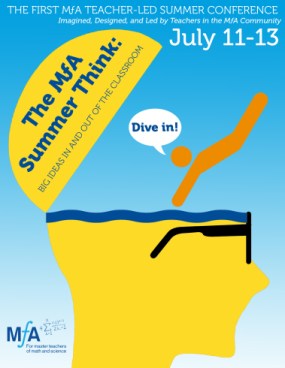
For two and a half days this week, I took part in the Math for America’s Summer Think conference. The experience was unforgettable on many levels.

Last summer, after having returned from Twitter Math Camp (which MfA funded), MfA asked me about possibly helping plan a summer conference with them for this summer. My initial reaction was Heck, yeah, let’s do this! A MfA summer conference! Woohoo! 

Reality set in on October 28. I received an email from MfA about starting the planning process. I had forgotten all about my enthusiastic reply back in July about making the conference a reality.  It was at that moment when I realized that I had no idea how to plan a conference.

I started putting out blasts trying to recruit people to help me plan. With a community of teachers like we have at MfA, it didn’t take long get lots of replies from those looking to get involved. While the average teacher wants to their summer to have nothing to do with school, the community at MfA is not full of average teachers. I knew there would be lots of interest. But 20 teachers can’t plan a conference for 75 teachers. MfA provided tons(!) of guidance, but one of the biggest hurdles was finding a core group of teachers to do the work that comes with the actual planning. Once Courtney, Matt, Carl, Diana, and Sony stood out from the crowd, it was all downhill from there.

After much deliberation, we landed on a theme of Big Ideas In and Out of the Classroom. Then came the call for proposals and ordering swag. We then sifted through proposals. (We received so many!) Next, we finalized the workshops and confirmed with facilitators. We developed a conference website and wiki. The last meaningful order of business was opening registration and watching the seats fill up with eager teachers. More here.

I must say that throughout this process, without the trust and backing of MfA (Leah and Courtney specifically) and the team I mentioned above, the conference would have only been a lofty idea that was brought up last summer after TMC. I would have never learned how to lead in this new, exciting way. I would have never learned so much about so many people. I would have never written these reflections.

For that, I’m deeply grateful.

So although I was a conference organizer, before the conference started I had full intentions of being an in-depth participant. That was always a primary goal. I wanted to be part of the conference just like everyone else, to learn and connect with others. Luckily for me, that’s exactly what happened.


Day 1 – Tuesday, July 11


  • The day begins with the planning committee making final preparations before attendees start arriving at 9am. Surprisingly, it’s not as hectic as I thought it would be. That’s all MfA right there.
  • At 9:30 we went with an icebreaker that Matt and I experienced at TMC16. It was tight spacing, but Matt pulled it off marvelously.
  • After Courtney formally welcomed everyone to the conference, I thought I would try having the attendees pass a Token of Appreciation throughout the conference. I kicked the process off by giving it to Leah from MfA for the oodles and oodles of support she gave the planning committee over last several months. Here’s a secret: this was probably the largest group of adults I had ever spoken in front of, no matter how briefly. Being rather introverted, I was deathly nervous.
  • I introduced our first featured speaker, Patrick Honner. Being a personal role model of mine, without hesitation I invited him to speak several months back. His talk centers on how he thinks about big ideas in and out of the classroom and how it has impacted his teaching. He kills it and frames the entire conference beautifully. Notes.
  • My first session is also with Patrick. It’s a follow-up to his opening talk. He provides a more detailed outline for thinking about big ideas, a template of sorts that he himself uses. I can get fairly disorganized when I begin thinking massive shifts in my teaching, so his session was exactly what I needed. Notes and handouts.
  • While randomly speaking to someone during lunch, I learn about Costa Rica’s national uniform policy and how any teacher can discipline any student at any time anywhere in the country. Mind blown.
  • The afternoon was my extended length session, what we called the “Deep Dive” session. It was focused on Design Thinking and how it can be used as an alternative means of assessment. The facilitator is great. After a while, I remember that she gave an MT^2 talk on her work with Design Challenges. After some struggles, I realize at the end of the session the goal for me is to leverage these challenges to open the door to the content I will be teaching – not to teach content outright. If I can keep that in mind, it’ll help me plan. Notes.
  • Before mingling at happy hour in the MfA lounge, I touch base with Marvin and his Designing and Teaching Scaffolds Deep Dive.  I really wanted to attend this one, but couldn’t so I pick his brain for 10 minutes about his approach to scaffolding. (The other session I loved was Winning Hearts and Minds.) Small but big takeaways: 1) scaffolding must be separate from the content and 2) I must always remember to gradually remove the scaffolding. He had a brief video of scaffolding being built (and taken down) around the Capital in Washington D.C. that hit home with me.


Day 2 – Wednesday, July 12


  • The day begins with John Ewing, the president of Math for America. He does a bunch of major things around the country around mathematics and education – and we were really fortunate for him to be able to speak to us. His talk about changing the conversation around education in America. He sees three trends in education today: teaching is viewed differently by the public than by teachers (like the double deficit model for teaching), our distrust with institutions (including schools), and our irrational belief in big data (like value added models). I feel awe-struck because in his talk he includes a quote from the post that Courtney and I wrote for MfA’s Teacher Voices. During lunch, he even comes up and personally thanks us for helping organize the conference. Unexpectedly, I think his talk inspired the direction I take my after-school commitment next year. Notes.
  • The first session of the day was the second part of the Deep Dive on Design Challenges. To start,  we move all the tables together for an opening reflection on the work we started yesterday. It helped frame the day and I really liked this. I could tell she was attuned to our struggles yesterday. I shared that I embraced the struggle from yesterday, but because I had nothing tangible yet I feared that I would forget all about Design Challenges after leaving the Summer Think. I also added that Design Challenges remind me of creating flow, a term explored in my current book Flow by Mihaly Csikszentmihalyi. After running through a protocol to explore our ideas further (mine was periodic functions since I was horrible in modeling them last year), we jump into storyboarding our Design Challenge. Mine was based on the tides and water damage to a house, but someone else presented one on tides when to best visit a beach, which I like much more. The jury is still out on the future of Design Challenges in my class, but I am in a much better place than I was yesterday.
  • After lunch, the Problem Solving Partners is up next. It opens with a great icebreaker: put your three favorite numbers on your name tag and share why you chose them with your partner. We learn about some norms for partnerships, similar to the group norms that I’ve always wanted to implement, but never really have. We go through three different protocols for problem solving with pairs of students, which were all very practical. I especially liked the Concept Attainment Protocol. In general, I was intrigued because I don’t think I’ve ever thought about using a protocol with students (they’re just something we use at teacher PDs). There is definitely stuff from this session that I’m using next year. Also, she mentioned a book where she got the problems; I should ask her about it. Handouts and notes.
  • The last formalized session of the day was Paper Folding with Gary Rubinstein. I know of Gary’s work, but I’ve never sat in one of his sessions. I’m glad I did! We used paper folding to solve quadratic equations. This is so fascinating. I definitely plan to use this next year in my mathematics elective, if not in algebra 2. He even has paper folding video tutorials. Handouts.
  • To close the day we took part in an Open Spaces session, which was powerful. The topic of the group I joined was segregation in NYC schools but branched off to talk about racism, bias, and what we can do as teachers to better the situation. The conversation was passionate and deliberate.


Day 3 – Thursday, July 13


  • We started the final day of the conference in our Deep Dives. We started with a neat reflection activity where we wrote our gains, strains, and questions on Post Its and went around the table reading them off one at a time. I would read one, then the person next to me would read one, and so on until it got back to when I would read my second one. That continued until we read all of our notes. We transitioned into the final activity, which was to create a trifold board that would share what we learned in our Deep Dive. This lead to a gallery walk with all the other Deep Dives. During the gallery walk, there was a palpable buzz in the MfA lounge. If I’m honest, at the end of this Deep Dive, I’m am uncertain whether I can see myself doing a design challenge in algebra 2. There are just too many unknowns for me right now. That said, things in my classroom rarely go the way I think they will, so I wouldn’t be surprised if I put one together for periodic functions unit.
  • We all reconvened to close out the conference. Megan Roberts, executive director of MfA, spoke and reminded us all why and how MfA does what it does. She joined MfA a couple years ago, but before that, she led at iZone, an NYCDOE outpost. A few years ago, she and I actually attended “iCamp,” a summer camp sponsored by iZone. Coincidently, during the camp, we got paired up for a design challenge and got to know each other pretty well. It was so special to reconnect with her at MfA and at the Summer Think this week. One big takeaway from her talk: the use of “PD” as noun instead of a verb.
  • After Megan’s remarks, I was asked to put a bow on the conference and close it out. I thanked everyone and briefly shared how the conference came to be and had everyone show some love to all of the workshop facilitators. I shared how hopeful I was that everyone found this conference a worthwhile investment of their well-deserved summer. It was the first one ever, so you just never know. I then went off script and decided to give some unexpected shoutouts to selected people who I met and connected with during the conference. I asked the audience clap once for each shoutout. It was a fun, lighthearted way to throw recognition back onto the attendees. They actually went for it – and I was relieved.
  • MfA graciously provides dumplings for lunch. I hang around and several folks came up and thanked me and commented how awesome the conference was. I couldn’t help but be more and more humbled with every conversation. The MfA team gives each member of the planning team a thank you gift. Just another earmark of this first-class organization. Smiles all around. We throw out some days of when we might be able to come in to review the survey results later this summer.
  • I hang around MfA until I’m the last person from the conference still there. After big events that I find exceptionally meaningful (the last day of school also comes to mind), I like to be the last one to leave. It’s cheesy, but it gives me a unique opportunity to reflect on that particular occasion that will never come again. I talk, mingle, and watch everyone head for the elevators. The planning committee says their goodbyes. Afterward, I sit in the back of the lounge, make of list of post-conference To Dos, and take it all in.


bp

Engaging tasks for students that I’ve never met

Anyone who teaches in New York City Public Schools knows that from time to time you get asked to cover a class when a teacher is absent. Personally, despite the hectic nature that is a school day, I typically enjoy these coverages mainly because I get to meet and interact with lots of students that I either don’t know or don’t teach.

Lots of times, there is an absentee lesson plan, but many times there’s not. What’s the result then? Me in front of a class of 30 adolescents for 45 minutes with nothing to offer them. Last year I realized that I was tired of this. Here is an attempted remedy.

I’m want to compile mathematics tasks meant engage students that I’ve never met before. Since I teach high school, I will assume nothing about prior knowledge or motivation besides the students being in grades 9-12. The tasks should be highly accessible. Also, in terms of materials, I’ll have nothing but a whiteboard and/or Smartboard at my disposal. I love mathematics, but since I’m not the best at coming up with stuff on the spot, this page will be a necessary resource for me. It’ll be updated regularly whenever I come across worthwhile ideas.


  • The Four 4’s. Express the numbers 1-20 using only four 4’s and any set of operations. Additional challenge: express the numbers 21-???)
  • Similar to The Four 4’s: Using each of the digits 1, 2, 3, and 4, once and only once, with the basic rules of arithmetic (+, –, x , ÷, and parentheses), express all of the integers from 1 to 25. Source.
  • Sprouts | A fun game that involves nothing but a pencil and paper. Get’s deep.
  • The password riddle | Connect the computer to Smartboard to show video. There are loads more like this from Ted-Ed.
  • What comes next? O, T, T, F, F, S, … | A clever little sequence.
  • Which One Doesn’t Belong? (Numbers and Shapes) | These give every student an opportunity to show off their mathematical perspective.
  • Add seven subtract one | A great problem to promote numeracy.
  • Are there any operations that make the equation 5   5   5   5  = 19 true? (Source)
  • Variable analysis game.
  • Find as many patterns as you can in Pascal’s Triangle.
  • Various problems from the Man Who Counted (book) by Malba Tahan

bp