Continuing the process of letting some ideas breath on the blog this summer. Here’s another.
It’s a simple activity for those few unexpected extra minutes near the end of the period…or if I just want to hit them with some quick mental stimulation. I picked it up from my fourth grade teacher: mental math.
I simply call out a sequence of operations with a pause between each operation. For example, I might say “2 plus 5 (pause)…times 8 (pause)…minus 10 (pause)…divided 13…what’s the answer?”
Students can’t allowed to say anything out loud and, obviously, any electronic device is prohibited. I don’t require that everyone plays (most do). The students must wait until I say ‘What’s the answer?’ before raising their hands. I call on a different student each time and if that person’s answer is wrong, someone else gets a chance. Because it’s a terribly simple idea, it’s always engaging. The trick is to make it challenging to the point where they get hooked and want more.
Some tidbits: I’ll usually start with one that’s pretty straightforward with long pauses – especially at the beginning of the year. Things get interesting when I start to call out the operations lightning fast or the sequence contains something like 15 operations. Make things fun by using numbers in the millions – or even billions. Also, depending on the class, the level of the math can vary from basic arithmetic to roots and exponents to evaluating trig functions. It’s endless. And fun.
I always hear about Trashketball. I thought I’d briefly share the version I play with my students.
I set up the room with 1, 2, and 3 point distances, one of each. I use duct tape and white out for this.
I post a question. Each group works on it and I randomly select one student to answer. Before answering, the chosen student can confer with their group members, but he must able to explain or justify his answer. Here are the guidelines for the game:
If a student gets the question correct, he earns three shots to make a basket. All shots must be taken from the same location.
Each group is allowed to passed earned shots to another group member once during the game.
Groups can use any resource but a non-calculator, electronic device to aid them in answering the questions.
If a student gets the question incorrect, I earn one shot to make one basket. I can earn a maximum of three shots per question. Each shot is separate from any others and can be taken from any distance.
Groups cannot communicate with other groups. If they do, I earn a bonus shot.
The game is the entire class versus me. Whoever has the most points at the end of the class period wins.
Here is what we use to shoot.
The trash basket is the typical, run-of-mill classroom trash receptacle.
My record as of today is 83-0-1. No kidding. Despite what my record may reveal about my utter dominance, my students LOVE playing. This is due in part because each class desperately wants to hand me my first loss. Hey, students need motivation, right?
Oh, and how have I amassed such an impeccable record? You’ll have to ask my students.
Suppose you ate Chinese food that was left on the kitchen counter for four days. You didn’t know, and now you’re sick. You go to the doc and get some medicine. You’re diligent and take the prescribed dosage each day, but what if you don’t? What if you take the meds one day and stop?
With help from Lois and Max that was the problem I posed to my students recently during my exponential functions unit.
What initiated it was asymptotic behavior. I no longer want this powerful constraint to be “an invisible line that a graph approaches infinitely.” In a world of NYS Regents exams, I want that line to have meaning. Note: my students have not graphed exponential functions in my class (it’s part of the algebra 1 curriculum), but they have explored function transformations.
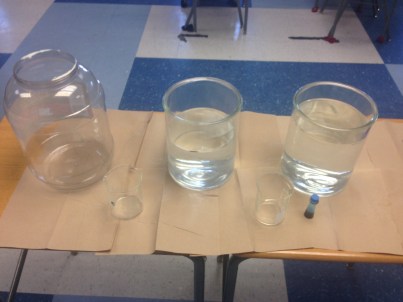
When the kids walk in, I have three containers in the front of the class. Thank you science department for the borrow.
From left to right: waste water, body water, replacement water
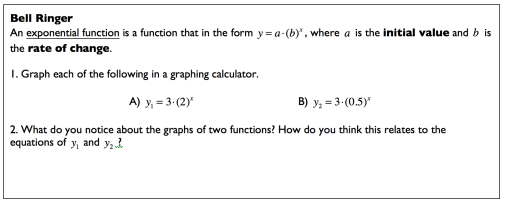
The bell ringer opens things up with an exponential functions exploration. I want them to relate the value of b with either growth or decay. This will help later with constructing a model for our medicine.
We discuss that over time the medicine gets diluted and you must consume it everyday to maintain its potency. Otherwise, you’re never going to feel better. I mention that we can model this situation with mathematics and represent it with the containers of water.
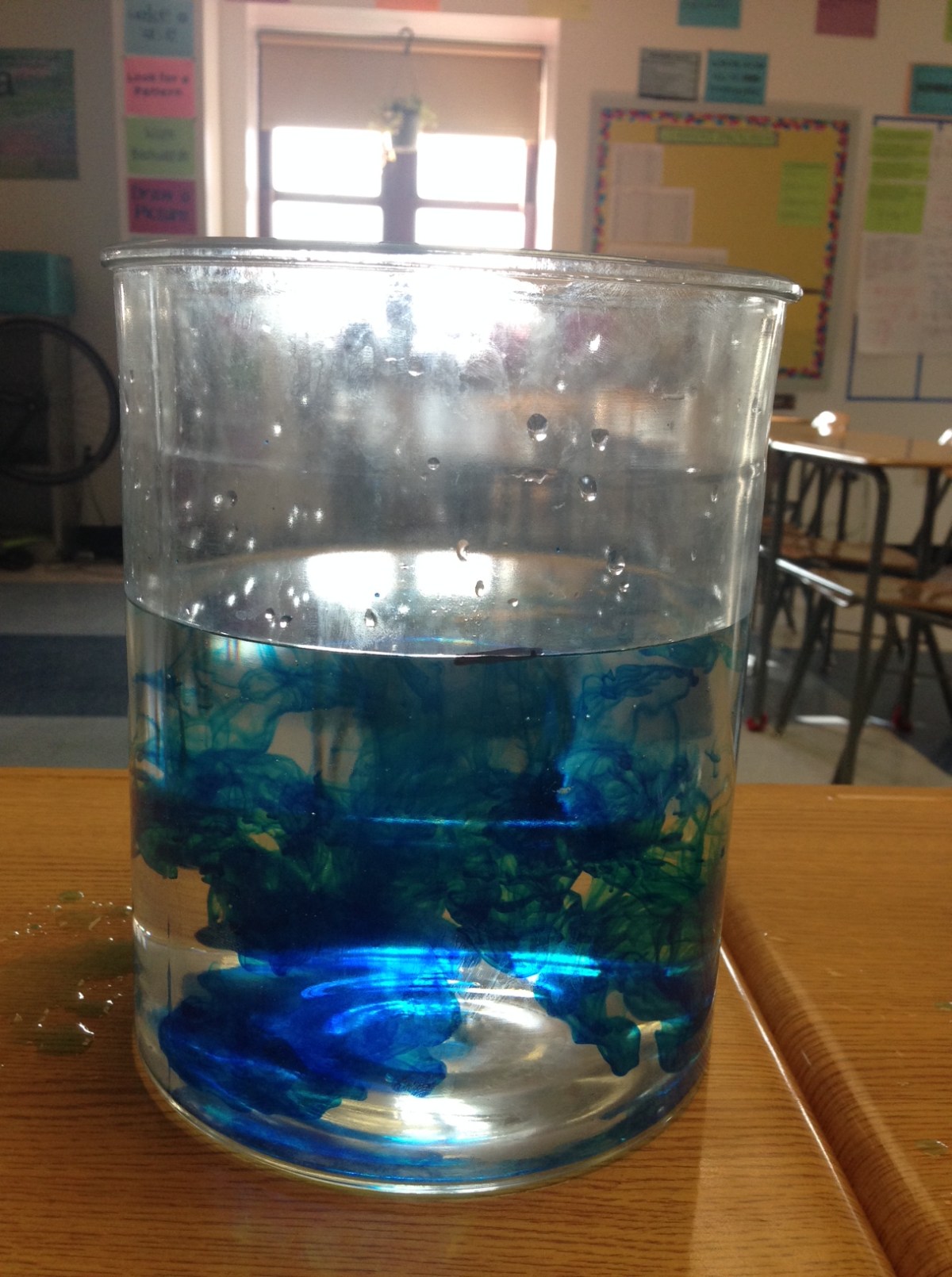
Then I put 5 drops of food coloring into the “body” container and mix it up. I originally wanted to use 5ml, but realized in preparation that this was way too much to see a difference in color for our trial. To represent the medicine leaving the body each day, I tell them that I will remove 1 cup (10%) of the body water and replace it with 1 cup of clean water. Before we start, I have them estimate, based on our fictional simulation, how much medicine would remain in their body after 2 months if they only consume one dose of meds.
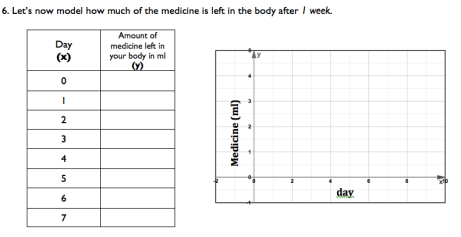
We start diluting. I do it 7 times (to represent a week) and they calculate the amount of drops remaining in the container after each day. They graph. The decreasing nature of the graph is noted and I ask them to find an exponential model for this data.
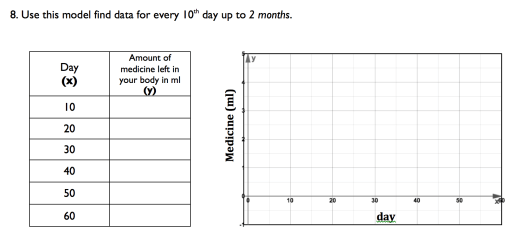
They use the model extrapolate 2 months, with one week intervals, and graph the data.
At this point a few students start to get it. Bam. The asymptote is born.
Pretty cool activity. Somewhat teacher centered, but highly engaging. The design was such that the intervals of estimation, graphing, and modeling helped to put their focus on the mathematics and not me.
My focus was asymptotes, but it also served as an introduction to exponential functions in algebra 2. I’m not sure the exponential relationship between the variables was really understood. To that end, I’m not convinced that this was the best activity for the job – at least how it’s designed right now. I should tweak things.
I was pleased with the bell ringer. There was some good debate around b being fraction and whether that’s why y2 was decreasing.
My goal after the demo was to go into graphing exponentials with transformations, so I included a series of questions that are typically found on NYS Regents exams. It tanked. I didn’t make a strong connection between the Desmos activity and this one. The 2nd class did slightly better because I bridged the two concepts a little better on day 2 (with an improved bell ringer), but for the goal I set out here, I still need to adjust my planning to better relate things like f(x) = 2^x and f(x+2) = 2^(x+2). They knew what transformation f(x+2) meant, just not how to interpret it as an exponential function.
Neither class answered the last writing prompt (stop & jot), mainly because I wasn’t feeling it during the lesson. Still thinking about how to wrap things up.
I started this on one of our shortened days, so I’m not sure if we could have done this in one day. Probably not.
I didn’t realize it until now, but this whole thing has a 3-act feel to it. I like!
The other day I did an activity that reminded me of both Kate Nowack’s Solve, Crumple, Toss game and Jon Orr’s Commit & Crumple activity, but it was slightly different.
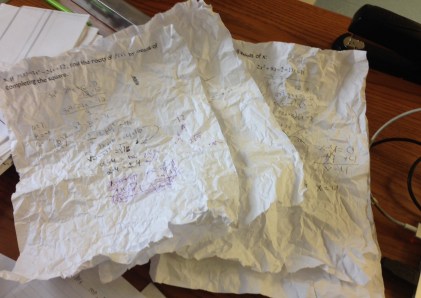
I grouped students in twos and threes and gave each group one problem on a full sheet of paper. They struggled on a few concepts that we recently tested on, so the problem stemmed from those concepts. Each group completed the first step in their problem. That’s it. After, they crumpled the paper into a ball. After all the groups crumpled, I had them throw the ball at/to another group in the room. The receiving group would uncrumple the paper, check the work that’s already been done (correct it if necessary), and complete the next step in the problem. They then crumpled and tossed the paper to another group. This process continued until every problem was completed.
I like this activity for several reasons:
Firstly, students must put focused effort into starting a problem. Teachers, and math teachers specifically, know that the first step of a problem can often make or break a student.
Secondly, the bite-size chunks that they work on after each throw make long, multi-step problems easily digestible and accessible. They’re not stuck, sometimes haphazardly, on a single problem for extended periods of time. The students, without even knowing it, scaffold one another.
From a problem solving perspective, the idea of emphasizing the completion of one step at a time could be useful. The students themselves must decipher the procedural “steps” of a problem and also relate them to a peer’s work. This may help to develop the skill of breaking down a large problem into a series of smaller ones. I’m not completely sold on my reasoning here, but I feel there’s something meaningful on this front.
This activity affords kids the time to analyze and challenge each other’s work. It’s weird, but I’ve noticed, even with other activities, that students are highly engaged when analyzing a peer’s work. Maybe this is because teenagers are so judgemental of each other already, who knows.
On the teacher side of things, it’s never a bad thing when an activity gives you the opportunity to walk around and assess all period. It was so helpful to provide loads of individualized feedback to them on concepts they previously struggled with.
Lastly: who doesn’t like to throw things?! This was by far the best aspect of the lesson.
I’m still wondering about how things ended. The exit slip did show improved understanding of the concepts, which was good, but the conclusion of the activity could have been stronger. I posted the solutions for each question (they were numbered) and groups checked to see if the problem they ended with arrived at the correct answer. Most did. I also opened up a class discussion about common mistakes that were found as they checked work. That said, there still may be something better I could have done to wrap it up. Hmm.




 lazy 0ch0