Exit here

Exit Sign

Things have slowed down for me this semester. Not teaching four preps helps (now I only have three). Because of this, I have been able to dig in and get a firmer grip on my classes.

Improving how I assess my students has been a goal of mine for a while. I have finally gotten around to using exit slips on a consistent basis. I have always given a formative assessment at the beginning of class, but not usually at the end. For a long time, exit slips were papers that would pile up on my desk. Subconsciously, I didn’t see the value in assessing my students’ understanding at the end of the class. Somewhere, deep down, I knew they were beneficial, I just didn’t embrace it. I wonder which planet I was teaching on.

Now, I must formatively assess at the end of my class. Not because an administrator told me so or that it’s a district-wide policy, but because I need to know what my students learned (or didn’t learn) each day. I must mention John Scammell and his awesome presentation on formative assessment during TMC14. He caused me to reflect on my assessment practices in a deep way. I’ve now fully realized that exit slips immediately affect my approach the following day and every other day. In other words, I now see value in exit slips.

Well. I say all that to share how I now use exit slips. Like most teachers, they usually only take a few minutes for students to complete. After class, I sit at my desk and go through the slips, categorizing students’ work – sorting them into various piles. I don’t actually use them for a grade so I’m not worried about recording scores. My only focus is student understanding.

After I identify common mistakes or other trends that need to be addressed, I must communicate these to my students. Telling them is one thing, showing them is another. But how to do this in a quick, efficient way? I simply use my laptop’s webcam to snap photos of a few exit slips and insert them into a few slides that precedes my lesson. It literally takes a few minutes to prep. Take photo. Paste. That’s it. A couple examples:

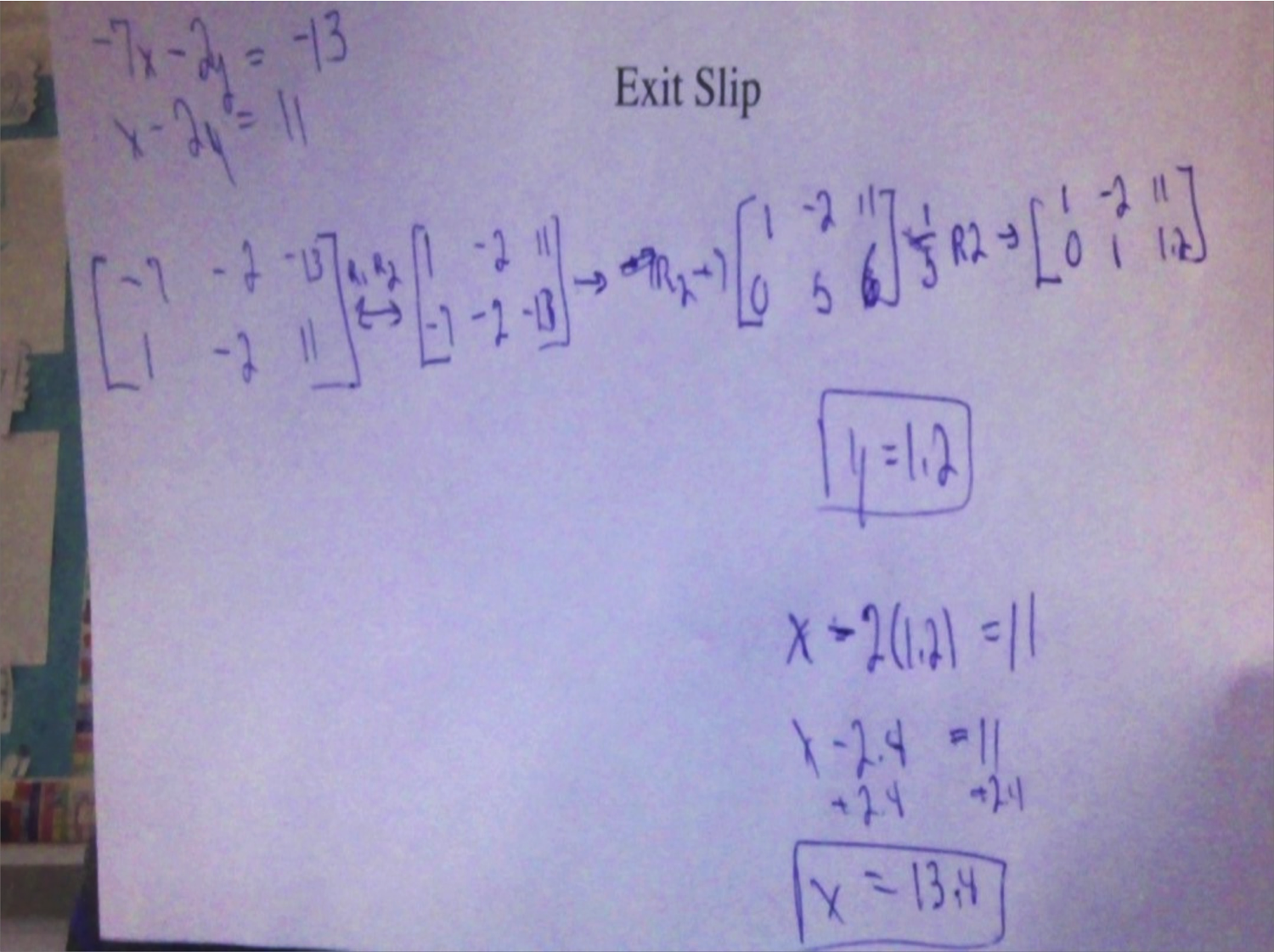
Exit Slip 1

Exit Slip 2


Upon showing the work to the class, great discussion usually follows. I ask which error(s) they see and how we can fix them. Its incredibly useful and never runs more than a couple minutes before the lesson. The idea is to show them their mistakes. The whole scene is similar to using Math Mistakes in that we’re examining real student work – but its just their work. (Of course, I remove names so no one is singled out.)

The kids are pretty receptive to seeing their mistakes. And by using the exit slips to direct their learning and analyze their work, my students have never complained about doing the exit slips. They just do them now because they are worthwhile. Sounds like me.


bp

My feeble attempt at SBG

This past week I attempted my first unit using standards based grading.

Letting SBG be the driving force of my class was one of my new year’s resolutions. I got much of my inspiration from Frank Noschese, Jonathon Claydon, Jason Buell, Shawn CornallyMichael Ziloto and many other teachers I have met in person and virtually met online.

My motto the first time around was to keep it simple. So I did. Here’s my approach.

Before I thought about SBG, I always broke down my units into distinct concepts using standards. So nothing new here. Next, to help simplify things, I decided to give two smaller exams covering 3-4 concepts instead of one larger exam that would have covered 7 concepts.

For each exam question, I went with a four point scale. Each question is assigned a value between 1-4:

4 = mastery
3 = proficient
2 = developing
1 = needs improvement

For free response questions, this is pretty straight forward. For multiple choice questions, I decided to go with 1 for an incorrect response and 3 for a correct response. There will be at least two questions for each concept and I will average the scores earned. This will provide a final measure that determines their level of understanding for each concept.

My biggest issue was deciding how in the world I was going to keep track of all this. Whatever method I finally land on must be sustainable and practical. Well here’s my system as of now. As I grade the exams, I enter each student’s score for each question into a spreadsheet. (We luckily have a scanner that does this for multiple choice questions.) There’s only 3-4 free response questions, so its not terrible. I have the spreadsheet compute the averages and spit out a final score for every student on each concept. The spreadsheet will serve as my tracking system for each student towards mastery of all the concepts we learn.

Their cumulative score for the entire term will be given by:

SBG Fraction

Now for student ownership of their knowledge. When I hand an exam back, I’ve always provided each one of my students with an individualized report that summarizes their performance. Before, the report contained their overall score, the class average score, etc.

Score Report Old

Now the focus is on what they actually understand (or don’t understand). For SBG I use a simple mail merge to print out a report for each student stating which concept(s) they achieved proficiency/mastery on and which one(s) they need to reassess on.

Score Report New

My next step, which will be a doozy, will be to decide how to maintain and organize my reassessment system. I know I will assign Friday as the one day that will serve as a “Retake Day.” This will be the only day where students are permitted to retake the concepts they need. This will help me stay sane and keep organized. Also, I need to get in the habit of creating retake material for each concept.

Of course this is a work in progress. I’m just glad one of my resolutions is coming to fruition.

bp

Reward systems? Grades? I’m not sure anymore.

I’ve started to critically reflect on all the rewards systems I’ve ever used. Including every single grade my students have ever earned.

I am currently reading Punished by Rewards by Alfie Kohn. The basic premise that Kohn makes is that “rewards” as we know them (token economies, grades, etc.) are not only ineffective, but can even be detrimental to the growth of students. Often times, teachers, including myself, use these systems because they “work” and rarely question them. (In fact, this is true for many things that we take for granted.) I have been relating this reading directly to my classroom economy that I have instituted in my class for several years, along with the many other positive reinforcement strategies that I have come across through the years. But even more drastically, I have begun to question every grade that I have ever assigned to an assignment or report card. Grades are essentially rewards for the work that students complete.

Instead of focusing on reinforcement strategies, which only focus on what students do, I could allow systems and feedback to drive my classroom practices. Instead, this would focus on who students are and what they actually understand.

bp

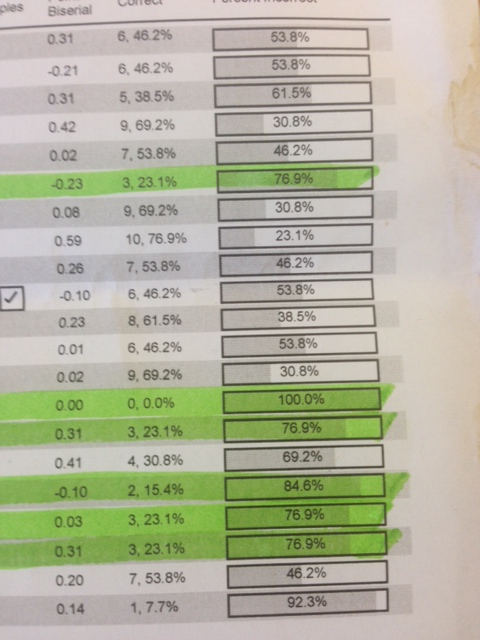
Data driven structure for exam prep

Item Analiysis

I have a Regents prep course (basically students that need to pass a New York State math exam in order to graduate) that I have been teaching all semester. These students are about six weeks away from the exam. I’ve decided to adopt a new structure to help them get over the hump of passing it. These kids are a challenging bunch, but their attendance is solid and they have good attitudes.

Every Monday, starting this past Monday, I will give them a simplified mock Regents exam. This will essentially be a diagnostic: it will not effect their final report card grade. My students usually buy into this pretty well. I will use the results of this assessment to identify which concepts we will focus on for Tuesday, Wednesday, Thursday, and Friday. During these days my co-teacher I will reteach and review these concepts, pretty much one concept a day to keep it simple and bite size. The following Monday we will repeat this process with an exam and using the rest of the week to tackle four more concepts (hopefully not needing to repeat those that we had previously relearned).

This targeted, structured, data-driven approach is something I’ve been seeking for this class for a little while. I’m consistently using data analysis for all my classes and I knew I was going to take this approach with them, I just didn’t know how it would look. Now I do.

After looking at the data from today’s exam a short time ago and mapping out the concepts for the week, I am really excited for the benefit this structure could provide my students.

Concepts for the first week:
1. Identifying trigonometric ratios from a given right triangle
2. Translating verbal statements into mathematical expressions
3. Basic operations on polynomials
4. Writing equations of lines and their graphs

Ready. Set. Go.

bp