Blogging: One Year After

One

0. I have now eclipsed one year of blogging.

1. Before I started, I never thought I would have had time to write. I also never thought I would have enough to write about.

1. Dude. I was wrong.

2. I wrote/posted 40 entries in my story this year.

3. I now find myself needing to write. If I don’t get up a post for a good amount of time, I get restless and it shows.

5. This past year, I never wrote for anyone but myself. It was a personal reflection and I like it that way. That may change, but who knows.

8. Blogging has reframed my teaching and how I view my own development. Writing has allowed me to get to know myself in a completely new and exciting way.

13. I contribute my initial blogging motivation to TMC14. Those wonderful people in Tulsa lit the fire. Too bad I couldn’t return the favor at Harvey Mudd last week.

21. I didn’t read enough MTBoS blogs this year. I’m shortchanging myself if I don’t tap into this idea-rich resource.

34. Who knows if I’ll make it another year. What I do know is that I’m a better teacher now than I was last July and I owe my blog loads of credit for that.


bp

Summer 2015: An immersive research experience

NYU Logo

This past week I began a summer-long professional development with NYU Polytechnic School of Engineering called RET (Research Experience for Teachers).

The RET program pairs up STEM teachers and engineers for a six-week collaboration experience during the summer. The engineers at NYU-Poly work hand-in-hand with K-12 teachers (like me) to conduct ongoing research in their discipline. I will write a paper summarizing my research, present my findings, and create a Teach Engineering lesson plan related to my RET experience [UPDATE 3/31/16: My lesson has been published.]. In other words, I will do everything a full-blown researcher would do (minus the lesson plan).

I haven’t finalized my research topic just yet, but I do know that I am partnering with Dr. Nikhil Gupta. He is well-known in the United States for his work with composite materials.

I’ve met Phil Cook, an awesome dude, through the program. Here’s his reflection on his experience thus far.

I’ll get another post up after RET is complete, but here are a few things that I’m most looking forward to:

  1. Can-Do. The director of the program mentioned that he is regularly inspired by what he calls the “can-do” attitude that all engineers embody as part of their ongoing work. I can relate to this. There will be countless setbacks and obstacles that arise, but the objective never changes: understand the problem, focus on solutions, learn. I’m expecting to struggle quite a bit during RET, so I hope to stay motivated and maintain a “can-do” attitude throughout. I remember my UBI experience.
  2. Research. Other than some minimal, unstructured research that was mandated for graduate school, I’ve conducted no formalized research. For this reason, I’m especially intrigued by this opportunity to not only learn about Dr. Gupta’s research, but to experience the process personally. I hear and read about research all the time, but this time I’ll actually be the one conducting it. I find that incredibly empowering. I am fully anticipating the roller coaster that will be investigation, frustration, and discovery.
  3. Impact. RET is actually intimidating and even scary on a certain level. The workload will be serious. The hours long. But I feel like this is what professional development should be. It should push me out of my comfort zone. How else will I improve? The breadth and depth of this immersive experience promises to provide high levels of enrichment, of which I’ve never experienced before. It will be interesting to see how all this work manifests itself in my career and what I do with my students.

With all that said, there is a bigger picture.

Before I was accepted into RET, I have taken more and more interest in research. I realized this because I have so many questions. Those questions cause me to want answers, even if they’re partial or incomplete. Research is a structured, unbiased way to do that. Anyways, I have a lofty goal to be part of a team of teachers and/or educational team that researches teaching, learning, and/or schools. It’s just a dream at this point and I have the slightest idea of how I would make it happen. I’m sure I’ll pick up some cues from this experience with NYU. Maybe I can use MfA as an outlet for this? Maybe I can find a some sort of RET related to education?

To be continued…


bp

End of the 2014-15 school year

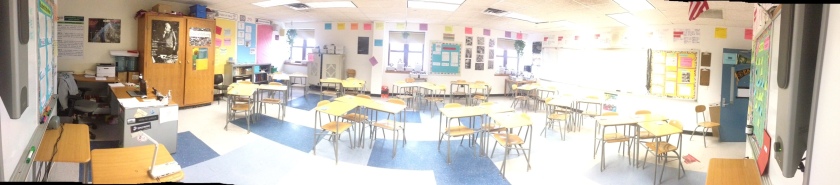
Classroom Spring 2015

-1. Several weeks ago I began thinking about the end of the school year. I suddenly realized the startlingly amount of reflection that awaited me. Today is the last day of school and the only way for me to systematically get it all out is in a list. Here goes.

0. Leading up to this year, my school had a solid four-year stretch of low-turnover and highly stable school atmosphere. 2014-15 not only broke that streak…it was shattered and thrown it under a bus. Things were quite eventful.

1. With any change in leadership, one should expect adjustment in the day-to-day happenings. I found that I had grown too comfortable under previous leadership. Things and people change and I need to evolve with these changes so my productivity doesn’t stagger.

2. During and after vast transformations this year, my optimism was put to the test several times and, in some cases, folded. After scarring disappointments early on, it took a good amount of time to rededicate myself to the school’s mission. I let my frustration get the best of me at times – which I don’t regret. Live and learn.

3. What kept me going? What kept me from completely disconnecting from my school community?

4. The incredibly inspirational people around me. My students. My colleagues (in and out of my school). People I’ve never met. My family.

5. Teachers at my school are an awesome bunch. Despite the disarray abound, somehow they found a way to use their collective strength to keep us moving forward.

6. This was also my first school year blogging, which had a great deal to do with my naturally reflective nature this year. It framed my teaching like nothing I’ve ever experienced. I gained serious perspective by reflecting on my own practices via my blog.

7. I implemented standards-based grading. In terms of assessment, it’s one of the best moves I’ve ever made. I committed to it mid-year, which was tough, but it worked pretty much as planned. I had students assess their own retake exams, which was great, but I need to make a stronger push for retakes next year.

8. I helped plan weekly district-mandated professional development sessions for colleagues at my school. I found it both more engaging and challenging than I imagined before the year began. Professionally, this was an area of growth I didn’t expect. Thanks to MfA, I’ll be taking that a step further next year with my video club.

9. I absolutely struggled with four preps in the fall. The quality of my teaching was stretched thin and my students were shortchanged immensely.

10. I was entitled department chair in the spring. The math department had a tough year and we have a long journey ahead. I hope I am able to provide whatever leadership we need. That said, I passionately hate titles and the connotation that often comes along with them. They are hollow and irrelevant. I just want my work to be meaningful, collaborate, and help all of us reach another level.

11. Our robotics team made progress this year. We performed noticeably better than during the last two years of the program. Next year I hope to use class time (versus after-school) for competition preparation. This should afford the kids more time to build and tweak the robot. My robotics class expanded to include introductory arduinos along with the usual Lego Mindstorms.

12. My students did rather poorly on state exams. This is very disappointing given the amount of work both the students and myself have put in this year. So much so that I began questioning myself. How can I adjust to improve this result?

13. A woman leading a PD once told me “When my students don’t succeed, I look in the mirror and ask What could I have done differently?” This has stuck with me all year. It’s not about all the issues, setbacks, and lack of prerequisite skills that students bring into the classroom that hinders their learning. Instead, all that matters is what I do to meet their needs and get them to succeed. It’s a hard pill to swallow. But this perspective is key for me in my hopes of one day becoming a great teacher.

14. I could have been a better mentor. Despite many shortcomings, I have experience and insight that is conducive to the growth of colleagues new to this profession. I did a poor job this year mentoring a new teacher. She is wonderful and would never tell me so, but inside I know I could have had a much better impact on her.

15. I tried many new approaches this year to teach my kids. Just as importantly, I also implemented new ways to reach them. Whether it was friday letterspersonal notestwo stage exams, plickers, speed dating, problem-based learning, exit slips, or others, I can say that I have definitely made an effort to improve the happenings in my classroom.

16. Following up on a new year’s resolutionintervisitations played a significant role in my development this year. I discovered the need to not only get outside my classroom, but outside of my building, and explore the work of others. It helped motivate a colleague and me to apply for the 2015-16 NYCDOE Learning Partners program, which we were accepted. More to come!

17. I relearned how to be patient with my students. Big ups to my AP for pushing me to slow down the pace of the class and remind me to provide more scaffolding.

18. Goal for 2015-16: highly effective. Focus for 2015-16: to be better than I was in 2014-15.

20. Every school year seems to fly by when you’re at the end of it. This one was no different. It was a bumpy flight, but it was over before I knew it. Another one in the books.

Until June 2016.


bp

Observe. Think. Share. Connect.

observing something greater

One day during a class exam a couple months back I paused to look around at my students. They paid me no mind. They were working diligently, finding their way through the problems, struggling, succeeding, you know, the usual.  During exams, I’m usually keeping an eye out to make sure the kids don’t feel the need to take a peek at their neighbor’s work. But this time was different.

I thought about who they are. I thought about who they’ll become in ten years. Will they be engineers? Marketers? Electricians? Marines? Teachers? Fathers? Mothers? I thought  about their interests and hobbies: beat-boxing, track and field, repairing computers, TV, basketball, music. I thought about how they’ve grown and how they’ve struggled in my class. I thought about their personalities and insecurities. I thought about their families. It goes on and on.

In that moment, I felt deeply connected to them in a weird sort of way and wanted to share this with them. As a teacher, I’ve always cherished being able to share the human experience with my kids. Beyond teaching, beyond learning, beyond report cards, beyond learning objectives, beyond school. That’s how I’ve always tried to relate to my students.

So with all this racing through my mind, what did I do?

I wrote to them.

Besides, I couldn’t just blurt out all of these thoughts in the middle of the exam. Plus, even if I did, this would initiate a conversation – which I didn’t really want. Not only did they need to focus on their exam, but I wanted to share my thoughts in a one-sided manner. I wanted to express how I felt and not have them feel the need to respond.

I looked around and began writing short notes to an array of students. I placed the notes face-down on their desks while they worked. I wrote down things concerning their effort, how much they’ve grown, how I appreciate them, why I believe they’re awesome, and where I think they’ll be in the years to come, among other things.

Some students read the notes immediately while others waited until the end of the period. (Some didn’t even realize I put it on their desk.) Afterward, I didn’t get much reaction from those students I wrote, nor was I expecting it. One student passively said “thanks” while others simply smiled as they walked out.

After class, I felt whole. I conveyed my thoughts and feelings to my students in a way that was personal and direct. And writing allowed me to express everything in a way that I could never do by speaking to them either as a class or individually. I felt connected.

I didn’t get a note to every student that day, but during subsequent exams I have made sure to reach out to other students. Has it become a “thing”? I think so.

Writing these short notes has been analogous to Friday Letters. It’s all about connection. Connecting not for the sole purpose of bettering their grade or getting them to work harder, although those things can result from writing my students. Instead, it’s about sharing the human experience and connecting with someone else that just so happens to be my student.

bp