Internalizing feedback without seeing it

Feedback on exam in spanish

I’ve found that students all too often overlook, or simply ignore, the feedback I give them on assessments. For whatever reason they just don’t use it. This is a problem.

I value reassessment and see feedback as crucial in that process. If a student struggles on an exam, I need them to learn from their misconceptions. My feedback reflects this. I’ve always provided fairly detailed feedback, but this year I’ve stepped it up significantly. In fact, all I do now is give feedback. I provide no scores or grades on exams. This helps, but I still need to find ways for students to grow from the feedback they receive.

I have experimented with kids relearning concepts the day after an exam without seeing their actual exam. The day after the exam, I give a copy of the SBG results to each group. Each student uses the data to identify the specific concepts that they need to relearn or review. The groups are a mix of proficiency levels (based on the exam results) so if a student needs help with a particular standard, there’s someone in their group that understands it and can help them. I also give them blank copies of the exam to work on and discuss.

After about 15-20 minutes of peer tutoring, I give them their exams back. Based on their newfound understanding, at least some of their misconceptions should be alleviated. They now spend 15-20 minutes correcting their mistakes on a separate sheet of paper while directly responding to the feedback I’ve given them on the exam.

Ideally, this means that they are using feedback from their peers to understand and respond to the feedback I’ve given them. It serves as relearning/remediation before they retake the exam. What I’m missing, though, is a reflection piece that ties into the feedback as well.

A colleague conjured up a different spin on this. After an exam, he informs students which standards they didn’t earn proficiency on. (He doesn’t hand back their actual exam either.) He allows one week (more or less) of relearning/remediation on those standards – either on their own, or with you. He actually uses an online resource for this. Then, when they feel ready to retake, he returns their exam and asks them to self-assess and correct their original mistakes. If they can, he allows them to retake. If not, they continue relearning. It may not focus on feedback, but I like this.

Closing thoughts: what if I do get my students to internalize my feedback? Are they just going to be doing it to satisfy the requirements that I ask of them? When they leave my classroom, will they view feedback as a necessary component of success? Will my feedback really make a difference? How else could I get them to value it?


bp

Quadrants for assigned seats

I meant to do a write up about this during the year, but forgot. So here’s a short, but long overdue post about how I assign seats. Surprisingly, before this year I never assigned seats (gasp), so I really felt the need to post about this strategy. Oh, and I can’t take credit for this…John Scammel put me on to it during his session at TMC14. Awesome dude.

It’s a pretty simple technique that goes a long way at efficiently grouping students in diverse ways. During the first month of school or so, I assign each student four different seats. Each seat is assigned based on academic ability, group dynamics, proximity to me, students that can’t see the board, etc. These four seats are their assigned seats for the semester. I call each of the four seating arrangements a “quadrant”.

When students arrive for class each day, the day’s quadrant is posted on the bulletin board by the door. They walk in, check out the day’s quadrant, and go to their seat that corresponds to that quadrant.

Quadrant for Seating

Because I strategically place students in each quadrant, I select the quadrant based on that day’s activity. Some days require Quadrant I while on other days Quadrant III may provide a better set up. Each seating arrangement provides strengths and weaknesses to the class dynamic, so I vary the quadrant day to day. There were even a couple days during the middle of class I had students change quadrants based on how the lesson was going.

It worked well last year. It afforded me another layer of differentiation and flexible grouping, which was nice. Plus, the majority of the students enjoyed having a variety of seats around the room. The only hiccup I came across was students not remembering where they sat. Crazy. I guess they weren’t accustomed to remembering four different assigned seats. I probably should have posted up the seating arrangement for each quadrant somewhere in the room, but I was lazy and expected them to just know. Next year, I’ll post them.

bp

Speed dating, revised & reloaded

I love speed dating.

With students, of course. The type of speed dating that serves to reinforce, promote peer tutoring, and review.

But I always found the initial assigning of problems to be tricky and inefficient. Desks would be set up facing each other. I give kids handouts on their way into the class that have the practice problems on them. I would then walk around and assign each student a specific problem from the handout. I always did this strategically; I would assign higher level questions to higher level students. This way, the higher level concepts would get facilitated effectively to other students who may not initially understand those concepts. Because they needed to wait for me to “give” them their question, this caused some off-task, downtime for the kids…which was not good. They would also spend less time speed dating (and doing math) because they were dependent on me at the beginning. Bottom line: I wasted a bunch of class time assigning questions.

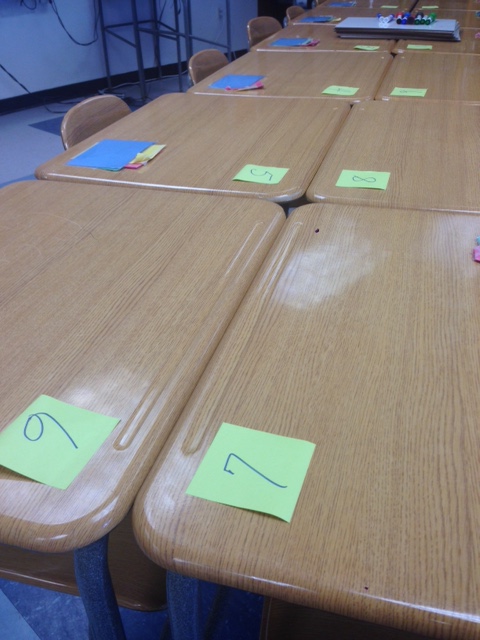
Today, I tried another technique and I liked it. I placed numbers on the desks and wrote numbers on the handouts. I gave the students the handouts as they entered (randomly), and instead of wading around assigning questions to students, the kids just sat at a desk whose number matched the number on their handout. And that number was their assigned question they needed to master. They didn’t need me to assign them a problem because they already had one. Here are the desks with the numbers.

Numbered Seats for Speed Dating

The result: a much more fluid, efficient start to the activity. The students came in and knew exactly where to sit and which question they were responsible for. They ultimately spent more time working on math – which is the whole point.

Speed Dating Revised

I randomly assigned the questions as they walked in – so I got away from assigning higher level questions to certain students. It was fine. I just walked around and helped students with their problems – which I would have done anyway. Even if I wanted a specific student (or students) to be in charge of a specific problem, I could simply ensure that I gave them the number of that problem when they walked into the room. I would only need to do this for one or two questions, so it wouldn’t be terribly difficult. It is a lot better than students sitting around while I manually assign problems at the beginning of class.

3/18/15 UPDATE:

Love it.

bp

Review Days?

Math Test Easy or Wrong

I was having a discussion with a few of my colleagues today about our upcoming quarterly exams. They’re basically our midterms – we just give them a fancier name. We were talking about the amount of review days (or class periods) that are necessary for students to prepare for these types of summative assessments.

It made me think. I don’t really “review” before big exams. I don’t even regularly review before a unit exam. I definitely have days where students aren’t learning new material. Maybe they’re reinforcing things they have learned previously. Or maybe it’s an extension of a previous lesson. Those aren’t the days I’m thinking of. I’m thinking of traditional review days that aim to refresh students minds before a significant assessment.

Whenever it’s necessary or if I feel the moment is right, sure, I’ll whip out a game to review or have the students speed date to catch each other up. I do these sorts of activities from time to time, but this is infrequent and rarely happens right before an exam.

So why don’t I review before exams?

I want raw, unfiltered data on my students’ understanding. By reviewing just before an exam, I am giving my kids a mental cheat sheet that they can use on the day of the exam. Did they understand the content before we reviewed or because we reviewed? My data is inherently skewed because of our review. But if I test them on a concept that we studied two months ago, yes, I want data on their understanding of that concept without refreshing their memories. I want them to forget a step or two. Or for that matter, I don’t mind if they completely forgot how to start a problem. This is precisely the information that will drive my future planning. Also, those misconceptions are exactly the sorts of things that will help my students do better in the future.

But don’t students want review? I mean, they want to increase the odds of performing well on the assessment and therefore increasing their overall grade in the class, right? I answer that question in two ways. First, there are plenty of instances where I don’t even count an exam towards their overall grade. Yes, I said that. I treat it as a diagnostic and the kids buy into it. I find out where they’re at and they get a (potentially poor) exam that doesn’t count against them. We all win. Second, students will adapt to the no-review-before-an-exam policy. They will meet our expectations. If they know I don’t review before exams, then over time they will prepare/study accordingly. And if at first they don’t, they may complain, but eventually they will come around.

So what to do with that extra time not spent reviewing? I spend that day or two (or three) after a big exam to reteach and reassess what my students had trouble with. It just makes sense. Now, because I looked at the data, I have a pretty good understanding of what they know and don’t know. I can pinpoint how I reteach a particular set of concepts. Often times, I even immediately reassess them on concepts they struggled with. This almost always results in improvement, which only helps to establish a growth mindset. It also helps them understand the method behind the madness of no review days.

I guess all this may count as “review after the test” and I’m good with that. Reviewing before an exam is overrated. Intuitively, as teachers, it makes sense to review before. But I think the more effective strategy is to do so after.

I’m really curious about what others believe about this. How do you incorporate review into your class structure?

bp