Anticipating student responses 

IMG_0423

A colleague and I recently planned a lesson on developing a need for factoring when solving quadratic equations. It was totally unexpected. He walked into my room after school and we started talking. Two hours later, we had the framework of a lesson.

Two teachers. Two hours. One lesson (sort of).

What struck me was that the bulk of the time was spent anticipating student responses to questions we wanted to ask during the course of the lesson. We went back and forth about the roles of the distributive and zero product properties and how students might interpret these ideas in context. How could we use their responses to bridge an understanding of solving linear equations to solving quadratic equations? We didn’t want to shape how they answered, but simply craft questions that would naturally guide them to worthwhile discussions and new understandings. Whatever question we toyed with throughout the two hours, it always came back to the same criteria.

How might the kids answer? How will their response draw them nearer to the goal? How can their thinking help the lesson tell a story? 

Subconsciously, I think I do this. Just not enough. This experience connected well with the principles of my current book as well as providing me a nice reminder to plan the critical points of a lesson so that they pivot on student thinking.


bp

Summation notation, but way more

I’ve been rethinking all of my lessons this year. My hope has been to get my students to reason more. To think independently. To not be sponges. I’d like to think it’s been working. Here’s a recent lesson on summation notation that showcases this shift.

To open things up, I gave them this.

Screen Shot 2016-03-05 at 9.28.09 PM

Super accessible and relevant to summation notation. In the past, I would have chosen a bell ringer that was closely connected to a prior lesson (i.e. review) than the current one. I wanted to provide remediation. I’ve learned this year that a relevant bell ringer is pivotal to any lesson.

Here’s what came next.
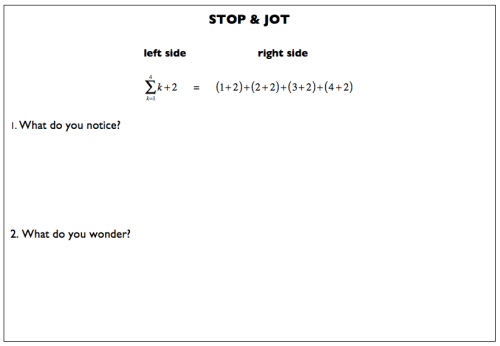
Screen Shot 2016-03-05 at 9.32.40 PM

Again, very accessible. Last year Jennifer Preissel mentioned the “Stop & Jot” idea as a simple way of getting kids to write and reflect more during a lesson. Here, I gave them five minutes to express, on their own, what they wondered and noticed about the expression. After, they shared with their groups and we discussed as a class. By including “left side” and “right side,” I wanted to focus student responses. There were comments like “the +2 happens in every parenthesis” and “the number next to the +2 is going up by one.” Their observations led us to the brink of directly relating sigma notation to its expanded sum. In the past, I would jump right into defining sigma, the upper and lower limits, argument, etc. There would have been no exploring or thinking on their own.

Next, I ask them to move on to another example with the hope of finding a relationship.

Screen Shot 2016-03-05 at 10.10.51 PM

It worked like magic. They see the same pattern from the Stop & Jot and they start to generalize. They have no idea what the “E thing” is, but it’s beginning to settle in how the left and right sides relate to one another. They discuss all of this in their groups. I float around. Observing. Listening. In the past, I would show them how to find this sum and answer their questions. Again, no self-exploration and making meaning of what they see.

Now they are to dissect and interpret.

Screen Shot 2016-03-05 at 10.16.14 PM

This lacks clarity. Some students knew to write their interpretation next to the arrows, but many did not. As a checkpoint, we came back together and discussed.

Next: remove the right side.

Screen Shot 2016-03-05 at 10.21.48 PM

Things are flowing now. The scaffolds are working. They know the relationship and successfully express the sum. In the past: The students would probably be completing this problem, but instead of using their own insight to drive the work, they’d be following what I said was the correct procedure.

Finish it off.

Screen Shot 2016-03-05 at 10.34.12 PM

We come back together one more time to debrief and to address any questions the groups haven’t already. To bring things full circle, I mention the task from the bell ringer. “Ohhh!”

Lastly, on the next page, the proper names are reveled.
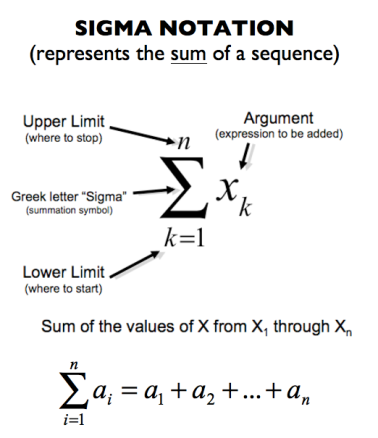
Screen Shot 2016-03-05 at 10.40.09 PM

We then have just enough time for an exit slip.

This lesson is heavy on notation and I didn’t want to bog them down with symbols. The goal was to find meaning first, then discuss representation. It succeeded. What I miss out on is working in reverse. Namely, using sigma notation to represent a given sum.

What I love most about this lesson has little to do with summation notation. It’s much bigger. It stems from the approach. Bottom up. Using their own insights to help them find meaning. Doing less and allowing them to put the pieces of the puzzle together. This lesson is a microcosm of how I try to teach nowadays, which is much different than in the past. It symbolizes my growth as a teacher, as a learner.

Here is the handout.


bp

Lesson reflections using the comment feature in Word

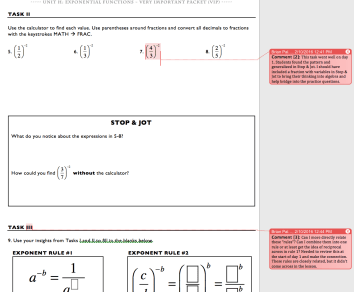
Screen Shot 2016-02-10 at 1.20.02 PM

Today I realized an incredibly simple and efficient way to reflect on a lesson: the comment feature in Microsoft Word.

I’ve been meaning to do something like this for years. Capturing a lesson immediately after teaching it is so useful – and blogging about it isn’t always feasible or necessary. Sometimes a few lines about how things went can help immensely when looking at the lesson in a year. I’ve tried using Evernote, but I always need to go back to Evernote to read my reflection the next year…this is totally inconvenient and I always forget.

By using comments, I can seamlessly integrate my reflection into the lesson/handout. On the front end, it’s not quite as convenient as Evernote since Evernote can be accessed basically anywhere, but it’s much more efficient on the back end since all my notes are waiting for me when I open up the lesson the following year.  

Here’s to making improvement easier. 
bp

“You need to have your aim posted”

What impact does posting the aim, or central question of a lesson, have on teaching and learning? What purpose does it serve?

I’ve heard throughout my career that “you need to have your aim posted” at the start of every lesson. @stoodle got at this idea recently and made me realize that I myself have been pondering this for quite some time.

A year ago someone at a PD mentioned that they never post the day’s aim. Nor do they “announce” it at the beginning of class. Instead, the aim is elicited from students during the learning process. The essential question is built upon their prerequisite knowledge and pulled from their comprehension of what they learn from the lesson. It is never given, but rather discovered by the students.

When I heard this, I had an ah-ha moment. It made complete sense. Other than in the classroom, how often are we informed of what we’re going to learn before we actually learn it? Sure, you may have a goal you want to accomplish (e.g. complete yard work before 1 pm), but what you actually learn in the process (e.g. how to mow my lawn as efficiently as possible) is often unknown at the onset. We notice, strategize, experiment, learn, and then realize what we’ve learned.

Recently, I didn’t post the aim of a lesson on arithmetic sequences. I required my students, as part of their exit slip, to write what they thought the aim was for the lesson. Not only did 90% of the kids nail it, but one was even better, and more creative, than what I originally intended for the lesson.

Aim

(This is directly related to the overarching problem from the lesson)

This made me think. Whatever a student feels the aim is (during or at the end of a lesson), provides remarkable feedback as to the effectiveness of the lesson.

Another thing. I’m a firm believer that lessons should be based purely on questions. One question should lead to another, and then another, and then another. Ultimately, the central question – the heart of any lesson – should eventually be provoked. Because of this, I want my students to need the central question of a lesson to accomplish a task or goal. They can’t need it if I openly post it.

I’m left with many questions about this widely-adopted practice of aim-posting. What are the consequences of openly telling students the aim of a lesson? Conversely, what are the consequences of structured learning that promotes the discovery of the aim? If I don’t tell my students the aim, how do I frame a lesson from the onset? Does explicitly stating the aim perpetuate a top-down approach to learning? How can we use student-generated aims to inform our teaching?


bp