A teacher’s dilemma: taking risks beyond the elimination answer choice C

test-986769_960_720

We ask teachers to embrace change, and the pressure on teachers is not to take risks but to march whatever children they can, lockstep, toward higher standardized test scores. – Robert P Moses, Radical Equations (p. 126)

Thanks to a recent conversation, once again I’m confronted with the heavy hand of high-stakes exams.

How can a teacher, like myself, establish and maintain a classroom centered on inquiry, contemplation, and sense making within a system that rises and fails on the scaled scores of New York State Regents exams? How can a teacher move a classroom of students beyond a no. 2 pencil and bubbles containing A, B, C, and D?

I guess this is nothing new. I’m simply reiterating a concern that most teachers have.

I find myself more entrenched in this battle than ever before. The more I teach, the more I realize how oppressive these exams are. I am forced to get kids “through” by whatever means necessary. Schools get recognized and accolades given out for producing students that are “college ready,” which is a reflection of students’ performance on Regents exams. This sort of verbiage gets everyone on the same page. The result is an unspoken, politically correct pressure placed on me and my students to conform to these narrow measures of mathematical fluency. This pressure results in anxiety and dramatically affects the quality of my instruction.

As someone in the classroom everyday doing this work, I’m so wrapped up in these damn exams that I don’t even have time to prepare my students to be “college ready.” Maybe I’m doing something wrong.

I’m essentially a Regents-driven machine whose sole job is to produce other machines who can generate positive results on these exams. Please, forget about the genuine, messy learning of mathematics that I desire.

Furthermore, in a society obsessed with test scores, obtaining a 65 (or 95) can indeed be the ticket to success. Students are only as good as the score they produce. They themselves know this, so their motivations often rise and fall on these exams as well. This is the cherry on top.

Despite this downward spiral, there is hope.

Patrick Honner’s Regents Recaps help me keep things in perspective. His reflections are thoughtful, full of mathematical insight, and shed light just how much of a joke these exams are. Without knowing it, he compels me to teach beautiful mathematics far beyond the expectations of a Regents exam.

And then there are educators like Jose Luis Vilson, Christopher EmdinRobert P. Moses, and Monique W. Morris. Through their writing, they’ve cautioned me that earning a 65 on a Regents exam for many of my students is the least of their worries, despite what school and New York State may tell them. They motivate me to bring often-ignored social issues to the fore.

There are many others who I have met either in person or online who have provided similar inspirations. There are far too many to name.

This leaves me torn.

On one hand, I’m fortunate enough to have a fairly high level of autonomy in my classroom. What my students and I accomplish in the 45 minutes we’re allotted each day is up to us. There’s relatively low oversight. Despite the immense pressures to bubble our lives away, I aim to spend time asking big questions, sharing the joy of mathematical discovery and learning, and enjoying the ride. This is empowering. Hell, I don’t even call my class exams “exams” anymore.

On the other, I am confused. And worried. The fear of a low passing rate has left me paralyzed in the midst of students who desperately need me to be fully aligned with their needs. But if I cannot afford to take meaningful risks in my classroom that go beyond eliminating answer choice C, if I can’t be bold in the face of oppression and conformity, what does this mean for my teaching? More importantly, what does this mean for my students?


bp


Be careful what you ask for

It’s the beginning of the year and Jimmy is a student in your algebra 2 class. Your colleague down the hall, Mr. Math, taught Jimmy geometry last year. At some point during the beginning of the year, you and Mr. Math begin discussing students on your algebra 2 roster. Jimmy’s name comes up. What’s the natural thing to do? Of course, you ask him for insight into Jimmy. What to look out for, how to best reach him, what to expect.

I see the obvious value in sharing information about students. Teachers are essentially transferring prior knowledge about students to better serve those same students. But part of me has always felt that knowledge gained through a situation like this can actually do more harm than good.

When I ask a colleague for details about a student’s tendencies, regardless how they respond, my understanding of the student becomes immediately biased. In other words, the moment Mr. Math tells me all about Jimmy’s strengths and weaknesses, I suddenly have expectations of Jimmy. Whether I like it or not, Jimmy is not just Jimmy anymore to me. On a subconscious level, my approach towards Jimmy is no longer organic.

Maybe this isn’t necessarily a bad thing, but it is a thing.

While in the past I have openly turned to colleagues to gain details about current students, I am questioning myself these days. Is it worth it?


bp

New year, new school, new me

69f6d960f24f8a438ae0938c6c0c3511

The next chapter of my career begins next week.

I’ll be teaching at a new school.

After a rewarding ten year tenure at my previous school, I made the decision to start anew. The move needed to happen for several reasons, both personal and professional. Moving on wasn’t something that hit me one day when I woke up. It was a slow, revealing process that took me over a year to fully accept. For anyone that’s been at a school for that long, you understand how bittersweet it can be to relocate. I left home.

I figured I would take some time to reflect in my transition. It might not happen again for a long time. First, the interview process.

I underestimated how much I would learn about myself. Over the course of four interviews and three demo lessons, I actually became a better teacher. I was presented with questions that I, being on several interview teams, was accustomed to asking candidates. I was asked to respond to the question all math teachers face. I was asked to share the percentage of my lessons that I consider to have a low floor and high ceiling. I was prompted about the nonnegotiable aspects of my classroom. I even experienced a progressive interview that consisted of pitching a course Shark Tank style, round robin meetings with several teachers, and a written reflection of the whole process. This really opened my eyes to what an interview can be.

All of the interviews put me in a position to think deeply about myself and my core values as a teacher. I do this regularly, but not in a way that forces me to formally present it to a stranger. In the moment, I discovered personal feelings and ideas about teaching that I wasn’t aware that I had. Who I am kidding, it was only my fourth job interview…ever.

I was fairly picky about my new school. Jokingly, a member of the interview team at my new school mentioned that it seemed like I was interviewing them. Well, I knew what I wanted. I knew that once I was in, I was in for the long term. I understood the level of commitment that I was making to myself and my new school – and I didn’t take that lightly. I wanted to be sure that my new home was the best place for my abilities and future contributions.

I wore so many different hats at my previous school (it was a small school by traditional standards). I created and maintained our GAFE suite and school website while supervising many after school activities including the intramural sports program, bicycle club, robotics team, tech team, among others. I was on several professional development committees and the LPP team. Not to mention the many other short-term commitments that came up that I volunteered to spearhead. All and all, I was considered a lead member of the staff, I played a central role.

Why do I bring all this up? What does it mean? It means that after securing my position in the spring, I’ve spent a considerable amount of time this summer pondering the rare opportunity that I now have. I’ve been coming to grips with the overwhelming idea of reestablishing myself as a teacher, teacher leader, and stakeholder. No one knows me. I don’t know the systems and structures to which I’ll be adapting. I don’t have seniority. No one cares about my history. I’m at zero. I’m just the new guy that teaches math.

And that is precisely why this dramatic change will elevate my career. I have the rare opportunity to rethink my practice from a rookie’s perspective. Surely there will be a period of adjustment. — the transition has already proved to be challenging in many ways. But, at the same time, my classroom will be as fresh as it’s ever going to be. I can reevaluate my assumptions. The bonds I make with students, colleagues, and the overall school community will be rooted in how I build my new reputation. I’m painting on an blank canvas.

Looked at in a certain light, I’m a new teacher again…except one with 10 years of experience to guide me. This blank slate provides me with a unique advantage over my development – one that I hope allows me to contribute greatly to my new settings. I hope this perspective enables me to invigorate to my classroom and my school. Plus — talk about timing — because luckily I’m going to be chronicling the first year of my adventures at my new school for the day in the life of a teacher book project.

Here’s to writing the next chapter.

bp

Note: My new school referenced my blog. I am led to believe that it played a role in the hiring process.

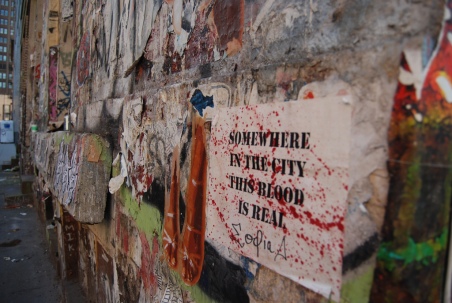
The concrete jungle

3714235795_66d70a8478_b

I recently finished This is Not a Test by Jose Luis Vilson. It resonated with me on several levels and got me thinking about my place as a teacher of underserved, inner-city youth.

I haven’t given the notion a lot of concentrated thought throughout my career – as the New York City Department of Education has a perverted way of distancing you from your core beliefs. The system is a monster. It’ll swallow you whole if you’re not careful.

Nevertheless, teaching at an urban school is a calling that has roots in my own childhood. Being born and raised in inner-city Cleveland, attending public schools, I can relate deeply to the daily grind of my students. Things like the reliance on public transportation, overbearing congestion anywhere you go, blaring sirens at all hours of the night, a single-parent household, gangs, bodegas, and the negative stereotype of inner-city youth were all a reality for me growing up. Interestingly, as a white male, I was the overwhelming minority in classrooms and in the neighborhood in which I lived growing up. Today, I still am.

This is not to say that I’ve been through everything that my students have, because I haven’t. My students face struggles that no teenager should ever have to deal with and are well beyond what I’ve experienced. But I do have a great deal of empathy and respect for their culture – our culture – and the circumstances that come along with it. I identify with them. It’s foundational to who I am as a man. And this helps me reach them through mathematics. As Vilson states:

“These are the variables that determine the type of teacher you become. And of course, the teacher you become is an extension of the person you are at that moment. It is also an extension of your own time as a student.”

This relationship I have with the urban lifestyle has been the backbone of my teaching since my preservice days. Thinking back, all of my peers in college preferred to teach in the suburbs. I get why. And I’m not judging anyone for their preferences. But it disturbed me, even as a 22-year-old, naive, no-nothing, that these aspiring educators readily dismissed this demographic of students because of the unique set of challenges associated with them. Did they not understand that these students needed them the most? Did they not understand that life-altering inequities persist because of these types of decisions? Indeed, they had their heart set on what they thought was the path of least resistance. Not ironically, it was around this time in my life that I decided who and where I wanted to serve as a teacher. I’ve never looked back.

What does this mean? It means that teaching at an urban public school that serves unscreened students from low-status neighborhoods is the most natural thing I can do as an educator. My entire teaching philosophy is centered on this fact. It drives where and how I teach. I’m responsible for recycling the gifts that I’ve been given back through the concrete jungle to students that desperately need them. Besides, it’s home.

Am I claiming the stereotypical white teacher role from movies that “saves” students from the inner-city? Hell no. The idea that inner-city kids need to be saved or fixed is ludicrous and makes me cringe. It only feeds the fire of negative generalities and is damaging for everyone involved. The passion I have for my students was born by experiencing the same demanding conditions that they live through every day. I also believe this demographic and their parents deserve teachers that are learners first, obsessed with getting better. They need someone that isn’t going to pass the buck. I claim nothing else.

Furthermore, being a white male, I’m keenly aware that my status as a role model at a school that is 91% Black and Latino is inherently limited. My positive influence is strong, but my students desperately need more teachers of color. That’s a troubling issue that I’ll save for another post.


bp