I had an unforgettable 7th period class today

I had an unforgettable 7th period class today. And it had nothing to do with mathematics.

The kids walk in. I assign seats every Monday using popcicle sticks, so they each grab one and make their way to their new seat. The late bell rings and I move to start class.

Out of nowhere someone lets out a curse. I think is was the f-word. Now let it be known, I have always been downright annoyed and refuse to accept any profanity in my classroom. This class knows it and every other class I’ve ever taught knows it too. (It’s a losing battle, but this is one of my nonnegotiables.)

Hearing a curse from a student in this class isn’t unusual. In fact, it’s relatively normal. I’ve accepted this, but I still firmly correct each and every curse I hear. They’ve actually gotten better about it. This particular curse gets my usual response of  “watch your mouth.

Out of sheer curiosity, I publically ask the girl who committed the verbal crime whether she’s had teachers who don’t care if she uses that type of language in their classroom. I didn’t know it at the time, but that question changed the course of the entire period.

After she responded that yes, she’s had teachers who don’t care (and even use profanity while teaching), many of the other students chimed in on the matter. Their experiences were mixed and led to a discussion around whether or not profanity has a place in schools. I mentioned that the way you speak can sometimes open the door for others to place unfounded judgements on you — and that those judgements can have lasting impacts. This drew strong reaction from the students and several more spoke up. Some said that they refused to change who they were no matter what others thought. Some referenced siblings who have offered similar words of advice.

Keep in mind that at this point we’re about 20 minutes into the period. But the fire had been lit and I was determined to get out the way. It felt like the right thing to do.

The conversation took up a mind of its own. It was morphing, changing, adapting to the needs of the students. I didn’t talk much. Things twisted and turned through religion, race, parents, and stereotypes. A few students admitted to being bullied in middle school. One girl started crying because of rumors that she was a bully. I brought her tissue and a classmate gave her a hug. Respect was inherit in everyone’s tone.

So yeah, we spent the entire 45-minute period talking…and airing out some deeply rooted emotions. We did no mathematics. Heck, we didn’t even get past the Bell Ringer.

Normally, I would consider a class period like this to be an utter failure. A huge no-no. A cause to reflect very differently on this here blog. But not today. Life happened, and I’m ok with that.

bp

VNPS, VRG, and creating flow

Last summer at TMC16, I learned about vertical non-permanent surfaces (VNPS) and visible random groupings (VRG) from Alex Overwijk, which is based on the work of Peter Liljedahl. Despite the explosion of ideas that I came across at the conference, I knew that I had to implement these two.

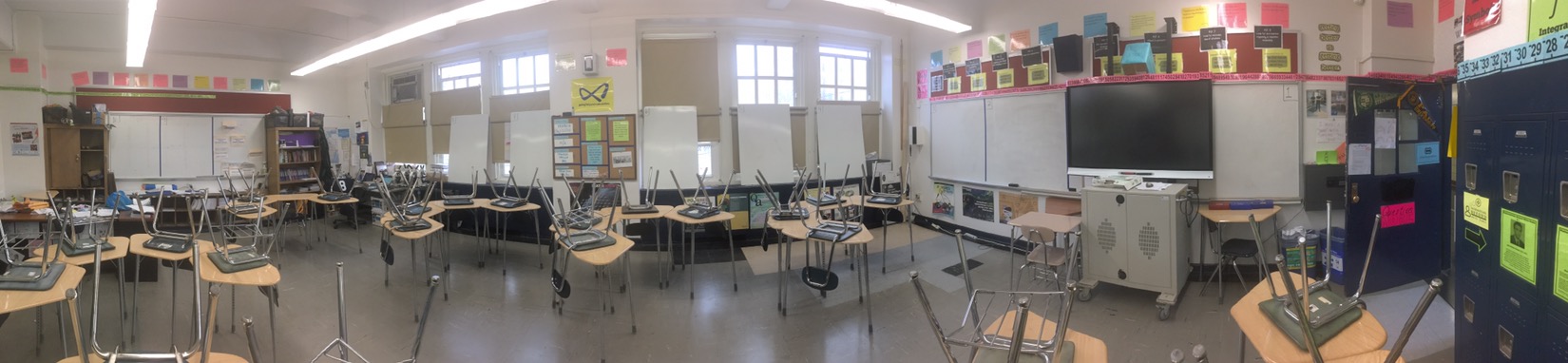
So after the conference I visited my new school to poke around the classrooms where I was to teach to see what the whiteboard situation was like. I was discouraged. My school is a converted elementary school with gigantic windows, lots of cubbies, and lockers that take up half of the walls. Disappointed, my hopes for VNPS and VRG slowly faded away.

Fast forward to last week. We were studying advanced factoring and the pains of heavy algebraic manipulation and computation lurked. I’m not sure what triggered me to rekindle my excitement, but I reread Alex’s post and slides from TMC and decided dive in.

Each of the rooms I teach in have some whiteboard space already, but I still needed several large whiteboards. I had no time to get to Home Depot. Then I remembered seeing the physics teacher having some. He’s probably the kindest teacher in the building. He let me borrow them with open arms.

I found some guidelines from Laura Wheeler (more here) and away I went into the world of VNPS and VRG.

I randomly assigned 2-3 students to each board. I displayed the expressions that I wanted them to factor on the board and the groups immediately jumped in. The level of complexity grew slowly with each expression, some of which they had never seen before.

The clearly visible work allowed me to efficiently assess everyone in the room. I gave some hints, but I wasn’t needed much. When I felt a group was hitting a wall, I outwardly moved someone to their group who could help. With their knowledge now mobile, their insights spread throughout the room like wildfire. And despite calling out “switch” periodically to keep the marker bouncing between group members, I also moved students who looked to be disengaged in their group.

This was all to maintain optimal levels of engagement, or flow. It worked like a charm.

At the end of each period, rather than looking finished, my students looked recharged. They wanted more. I couldn’t count the number of students that declared how much they loved the structure. They were doing like never before, completely lost in the work for over 30 minutes.

I can say the same for me. I felt my senses heighten as I feverishly assessed the students. I was completely in sync with their thinking. As 30 students openly crisscrossed the room to collaborate and build on each other’s ideas, I knew that my classroom would never be the same again. It was like magic. What Alex described as flow back at TMC16 is exactly what my students and I experienced.

That was Tuesday. Thrilled, I’ve used VNPS and VRG every day since with no plans to slow down.
bp

Day in the Life: March 24, 2017 (Post #9)

I’ve decided to chronicle this school year through my blog. It’s part of Tina Cardone’s Day in the Life book project. This is the ninth post in the series.

5:15am | I wake up, make some coffee, and put my lunch together.

I sip coffee and read for half an hour. I started The Classroom Chef yesterday and it left me wanting more…so I hold off on finishing How to Bake Pi until this weekend. Reading two books that relate mathematics and mathematics education to cooking and eating  just isn’t right. I’m hungry all the time now!

6:00am | I draft this post, turn on the radio. On any given day, I listen to either sports talk or NPR. Today it’s ESPN radio. I’m a lifelong sports fan, yeah, but I also really enjoy the fact that sports talk radio removes me from all the dark holes of the world. They’re not going to talk politics or hollywood gossip. Other than books and writing, sports and sports talk is my quick getaway.

I eat breakfast and shower. I grab the bike and I’m on my way to school by 7am.

7:15am | I walk in the building, move my timecard over and see a colleague from the math department. He’s making copies in the main office. I think: how crazy is it that my school only has one commercial grade copy machine? That’s not a new thought by any means, but it always crosses my mind when I see someone making copies. Anyhow, we greet one another briefly and I head up to my classroom.

I thought I left my school keys in my classroom yesterday, so I ask another teacher to unlock my classroom door. Inside, I realize the keys were in my bag all along. Nice.

Today is parent-teacher conferences. In NYC public schools, parent-teacher conferences happen on back-to-back days in the fall and spring. The first of each back-to-back is always on a Thursday evening, which runs from 5pm-8pm. That was yesterday. Today is the second day (Friday), which runs in the afternoon from 11:35pm to 2:35pm. School is let out early; I will only see my first period students today.

I finish up some paperwork left from yesterday and plan a quick review RISK game for finding a trigonometric ratio, given one. On top of parent-teacher conferences, my school is having our quarterly awards event. It’s pretty cool and all student run. The show starts in the middle of period 2. The seniors are organizing and hosting today’s show. Guess who primarily makes up my first period class? Yep, seniors. My my first period is going to be small.

9:05am | First period was quiet and the game sort of fell apart, but that’s ok. Sometimes its just great to have the opportunity to talk to students, get inside their head. That’s kind of what happened. Anyhow, I’m back at my desk and finalize more paperwork (see a trend?) before I have a few minutes to begin thinking about my next unit that’ll start on Monday, quadratic functions. At 9:15, everyone’s called down to the auditorium.

10:30am | The awards finish. I’ve only experienced a few of these things, but the show is pretty good this go around. The seniors do their thing. One interesting tidbit: the awards themselves focus on strictly academics (e.g. most improved in science), but the seniors elected to also hand out awards recognizing non-academic attributes. I really, really liked this. Too often my school stresses academics to the point that every other aspect of a student’s life gets bypassed. They highlighted this with class and the whole school appreciated it.

11:35amParent-teacher conferences start. It’s pretty straightforward, but with some interesting takeaways this year. More on this below.

2:00pmThe traffic of parents slows to a trickle. The Friday of parent-teacher conferences is usually pretty mellow…and today is no different.

Between parents I find some time to continue pinning down my quadratic functions unit. As things wind down, my assistant principal and I have a great, impromptu conversation in my classroom about a variety of things. We speak of our pasts, our journeys through teaching, and next week. Our relationship this year has really taken off and I’m so proud of the bond I’ve created with her. Her support has been just what I’ve needed to offset my new-school struggles.

2:35pmThe conferences officially end. As everyone rushes off for their weekend, I stay behind to polish off my planning and to make copies. I’ve never been the type to hurry out on a Friday. Actually, I love when everyone else does because its quiet and gives me time to be in my thoughts, uninterrupted.

While my copies are running, I manage to finish grading some exams. I also manage to post the next person in my “Mathematicians Beyond White Dudes” project in all three classrooms in which I teach.

5:00pmI leave school. I make it home in fifteen minutes, bypassing all the drivers stuck in Friday evening traffic. (Mindfully not owning an automobile is one decision I take great pride in.) During the ride home I consume myself with what I hope to accomplish during my Big Apple Award visit next Thursday.

9:00pmI hit the sheets. Goodnight.

1. Teachers make a lot of decisions throughout the day. Sometimes we make so many it feels overwhelming. When you think about today, what is a decision/teacher move you made that you are proud of? What is one you are worried wasn’t ideal?

On Wednesday and Thursday of this week our school restructured both days to mimic the Regents exams. Students were scheduled for two- or three-hour blocks for Mock Regents exams in each of the four major content areas. I decided early on that:

  1. I wasn’t going to spend class time reviewing for the exam.
  2. I wasn’t going count the exams towards students’ overall class grades.

Based on who I spoke to, this was not what others at my school were planning on doing. This did make me feel a certain way, but I wasn’t going to budge on my philosophy. Why force an low-stakes exam to be high-stakes? Why review? By cramming the day or two before the exam, wouldn’t that give me an even less representation of what my kids actually know? Why not use the exam strictly for feedback? Why does everything need a grade? Isn’t the goal to learn and grow from the experience? If I tag their performance with a grade aren’t I just reinforcing a system that is failing them already?

2. Every person’s life is full of highs and lows. Share with us some of what that is like for a teacher. What are you looking forward to? What has been a challenge for you lately?

There was a crucial moment during yesterday’s conferences that I know will stay with me for a while, for both good and bad reasons.

I was speaking with a student from my first period class and her mother. She’s quiet, respectful, but struggles to grasp some of what we do in class. I’d like to think we have a decent student-teacher relationship, but the dynamics of her class have prevented me from connecting with her on any significant level.

With this in the back of my mind, I open by asking her how things are going for her in class. I never really get to speak with her, so I’m really interested in her answer. She says in a very simple, straightforward way, “It’s alright. Alright. I’ve never been good in math. I just never have. That’s ok.” 

I’m shocked. Maybe shocked is the wrong word. More like disappointed. I told her that I didn’t believe whatsoever that she wasn’t good at math. I told her that she was very insightful and her mathematical perspective was worthwhile. I told her that I valued her. I also let her and her mom know that I haven’t done the best job at putting her in a place to feel successful and valuable in our class. To her, I’m sure this all probably sounded like blah, blah, blah. Actions speak much louder than words.

I know that I’ve heard this from a student in the past. But this time was different. A lot of things feel different these days.

I was humbled. I realized in that moment that I have so much more work to do when it comes to building meaningful mathematical mindsets in my class, something that I’ve been increasingly aware of this year.

3. We are reminded constantly of how relational teaching is. As teachers we work to build relationships with our coworkers and students. Describe a relational moment you had with someone recently.

Something really cool happened today. During the conferences, a brother of one of my students noticed my Mathematicians Beyond White Dudes posters and pulled out his phone to snap a photo of them. We talked a little bit about the motivation behind the project. He sincerely appreciated the fact that I was showcasing underrepresented mathematicians. It was a great moment.

4. Teachers are always working on improving, and often have specific goals for things to work on throughout a year. What is a goal you have for the year?

I’m slowly realizing that my goals for the 2016-17 year are coming to fruition, just not how I originally expected. Not all is lost.

5. What else happened this month that you would like to share?

Since today was parent-teacher conferences, I’ll close by saying how different I feel about the interactions that take place on days like today. I have a completely different perspective on these conferences now compared to earlier in my career…even up to just a couple of years ago.

A lot of this is related to how my teaching philosophy has evolved. The fulfillment I get from PT conferences goes beyond meeting and speaking to the parents of students who are knuckleheads or who aren’t living up to their true potential in my class. My fulfillment comes from somewhere far more intense, far more wholesome. It’s comes from a place only a parent can truly understand.

bp

PD with Dan, creating intellectual need

This past week was workshop #2 with Dan Meyer, who was invited by the NYCDOE to conduct a three-part PD series. It’s not every day that you get to attend a workshop with him, so I’ve decided to capture each of my experiences. More on workshop #1.

Too make a long story short, it was another outstanding experience. Dan Meyer never ceases to be thought-provoking. He presents the sort of stuff that stays with you long after you get back to your classroom. Here are the details.

The focus of the session was creating intellectual need in our classrooms. He’s advocating for the learning of mathematics that doesn’t need to real world, job world, or even related to student interest. His argument was based on the work of Guershon Harel (article here). Dan believes, and I do too, that we can meaningfully engage our students by creating headaches in our classroom for our students. We shouldn’t be in the business of imposing mathematics where it isn’t wanted or welcomed. I’ve read his headache-inspired posts from his blog, so it was really cool to get to experience first hand his thoughts on the matter.

He hooked us by running through a series of small activities that are examples of creating intellectual need.

  • Little expressions. This creates a need for combining like terms and efficient calculation techniques.
  • Controversy. This creates a need a need for how we communicate and represent mathematics a series of operations.
  • Memory Game. He flashed first a 9-digit number and then a 16-digit number and asked us to remember as many digits as possible. Created a need for scientific notation, an efficient means of mathematical communication.
  • The $20 Bet. He wrote down a number and gave a volunteer ten attempts as guessing what it was. If they could guess his number, he’d give them $20 (he only had $5 though). After each guess, he let the volunteer know if their guess was too high or too low. His number ended up being 87.21! This creates a need for different number families and their relevance.
  • Parallel Lines. Creates a need for precision when calculating and representing two parallel lines. The coordinate plane rescues us.

We then explored two of Guershon Harel’s five components of intellectual need: the need for computation and the need for communication. These two needs were directly tied to the five activities that Dan shared. More on the five intellectual needs here.

Dan mentioned that there are three questions that he asks himself when he attempts to design experiences that create intellectual need.

  1. If [x] is the aspirin, then what’s the headache?
  2. Why did mathematicians invent [x]? Can I put students in that place even for a moment?
  3. How can I help students view [x] as powerful, not punishment?

A common theme throughout the day was how we should get into the habit of turning up the dial slowly. You can always give more information to your class, but you can never take it away. SO TRUE. This connected well with session 1, specifically the use of the white rectangle to remove information and increase access. The introduction to a lesson (the Do Now) was emphasized as a critical phase of creating intellectual need – students must be able access the content however inefficient their means may be.

The afternoon began with an activity creating a need for proper labeling and name-giving in geometry. Dan had a bunch of random points on the screen and had two volunteers each choose one and attempt to describe which point they’d chosen to the other person. Another headache ensued. For the 2nd person, he labeled the points with A, B, C, … and the aspirin was given.

We then were broken up into groups and were given a scenario. They all showcased the opposite of what a needs-based classroom looks like. We were asked perform a makeover. We jigsawed it back together, read the summary of each prescribed remedy from Harel, and everyone in our original group shared. What stemmed from the conversation was awesome: developing a need for the algebraic form of a function. The Points Desmos activity followed, emphasizing the usefulness of inequalities when representing all points that satisfy a given set of conditions.

Lastly, we explored Polygraph as a way of creating a need for math-specific language related parabolas. This was great.

Other interesting bits:

  • The word student means “to take pain” in some language (can’t remember which)
  • Whenever students laugh during an activity, you know their pain has been relieved
  • Algebra is sophisticated version of trial and error
  • Math pedagogy aside, I’m always find it compelling how Dan manages his audience. He greets everyone at the door. His warm use of “friends” and “colleagues” whenever referencing the audience makes everyone feel a sense of togetherness despite being strangers. I also liked his use of the phrase “For those of you that have the answer, say it out loud.”
  • After discussing the need for the algebraic representation of a function, Dan referred to algebra is “a more sophisticated form of trial and error.”

Dan’s Google Doc of the session.

bp