As an alternative means of capturing my thoughts and reflections, I write haiku about my teaching practice.This is the fifth post in the series.
As my teaching has slowed through the years, I’ve been paying more attention to the furious pace with which new teachers experience their students, their pedagogy, and their practice. My awareness of these early-career teachers has matured a lot lately. And maybe I’m just getting old and doing what old people do, but I am feeling more responsible for these teachers these days — even those of whom I don’t work with directly. I love listening to them.
I had a recent conversation with a first-year teacher that struck me for a lot of reasons. It inspired this Haiku.
The other day I caught myself thinking about the phrase “my students.”
We say it all the time. I quizzed my students twice last week. My students and I are going on a field trip. A few of my students always seem to come late to class. It’s ordinary and plain. We don’t even think twice about it. But this time I did.
Spurred by seeing former students in the hallway, who have a new math teacher this year, coupled with the fact that I now have 100 new students myself, the possessive pronoun “my” stood out to me.
These students are mine. Not literally, of course. But these young people who were once strangers are no longer distinct from me. Our paths have crossed and I am now responsible for them. In the spirit of knowledge and personal growth, they are bound to me. They always will be. We will both change as a direct result of our transactions — both mathematically and otherwise — and this is worth thinking about.
Being critical about this possessiveness is empowering. For me, it represents an extension of myself through my students. Who I am as a teacher — and as a person — will be duly represented in what we build together. This is weighty. I can ignore it, but I cannot escape the relational ownership I’ve inherited when they walked into my classroom. Whether I like it or not, who I am will be reflected in our shared successes and failures. They are me.
As their teacher, to think about this gives me great pride. But it also affects me when it comes to non-teaching matters like how I speak to them, think about them, and work to relate to them. It has everything to do with teaching and nothing to do with teaching. Rethinking the word “my” when it comes to the students I teach contributes to a greater, more attentive investment in them and myself. It draws me closer.
For the last two years, I’ve adopted a problem-based, discussed-based approach for algebra 2. The whole curriculum is interleaved, meaning that big ideas are parsed and revisited over long periods of time (weeks or months) to improve retention. At any given time, students are learning small parts of a few different units. This allows for extended exposure to the topics that my kids learn. This is not how a curriculum is commonly viewed because, with this model, there are no traditional units. By “traditional” I mean thematic (e.g. Unit 6: Logarithmic Functions). Instead, these thematic units are broken down and served piecemeal to students over long stretches — mainly through problems. The sequencing of this model is indiscrete and quite messy.
As evidenced by that bewildering opening paragraph, I find all this terribly hard to communicate with others. I made my best effort to describe it here. It is often referred to as spiraling. I think Henri Picciotto does a good job of articulating it.
Thematic units have the advantage of being simpler…and easier too, I think. They are a slow-moving mass of closely-related topics that stays for a little while and then leaves when the next one comes along. Everything in them is directly linked and, therefore, these units make it easier for students to draw connections between mathematical concepts. At the same time, they encourage the isolation of facts and skills. Because related ideas are all lumped together, these units offer an easier pathway to a deep understanding in a short amount of time. Or at least the illusion of deep understanding.
These units make everything easier for the teacher, too. Thematic units and their associated lessons are far easier to plan and execute. The whole process linear; the focus of each lesson is based on the previous. There’s no untidy looping in and out of concepts, no systematic revisiting of big ideas over time. The concepts march in a clean, single-file line.
This is my guess as to why textbooks and traditional forms of curriculum have adopted thematic units. Seen in this way, they make the most sense both for the student and teacher.
But easier doesn’t make it better, right? When learning is hard, when it places a higher cognitive demand on the learner, isn’t it more meaningful? By helping students learn something small, then forget it, and then recall it after a reasonable amount of time — and iterating this process again and again over the course of the school year — can’t we help ideas cement? By not blocking out content, and instead spacing out practice and frequently assessing on the same topics at greater depth, do we help students better retain it? There’s research that says yes. Make it Stick by Paul Brown really helped me understand this.
There’s no denying the challenge that this creates for teachers. Tracing how concepts mature over the course of weeks or months is not easy. Adjustments to the sequencing can be tricky, too, because concepts are so tightly intertwined. I’ve been personally building the lessons and sequencing for two years and its still not right. Granted, I only work on it during the school year — and pretty much on the fly. Nonetheless, at least compared to traditional units, I’ve found it far more demanding and unusual to plan. And I haven’t even mentioned the loneliness — I have met no teachers during this time who are doing similar work with their curriculum. Who knows, maybe one day I’ll be disciplined enough to sit down and formally document my sequencing for other teachers to understand — and to start a conversation — but, I’m not worried about that.
I begin another school year in two weeks. I have realized that coupled with the fact my students retaining more information than ever, the messiness of interleaving has awakened and excited me these last few years. (I could do without the loneliness, though.) After years of marching in a single-file line, interleaving has made my curriculum work more of a dance. It’s interesting and lively. It moves. It sways. Fortunately, I work under an assistant principal and principal that given me the autonomy to do this. They decided to accept the consequences of the risks that I inherently took on when I decided to throw my units out the window. They trusted me even though none of us fully knew what I was doing. I think that I was at the right place at the right time because I’m not sure many other schools or departments would be on board with such a break from the norm of traditional units. My students and I have learned so much.
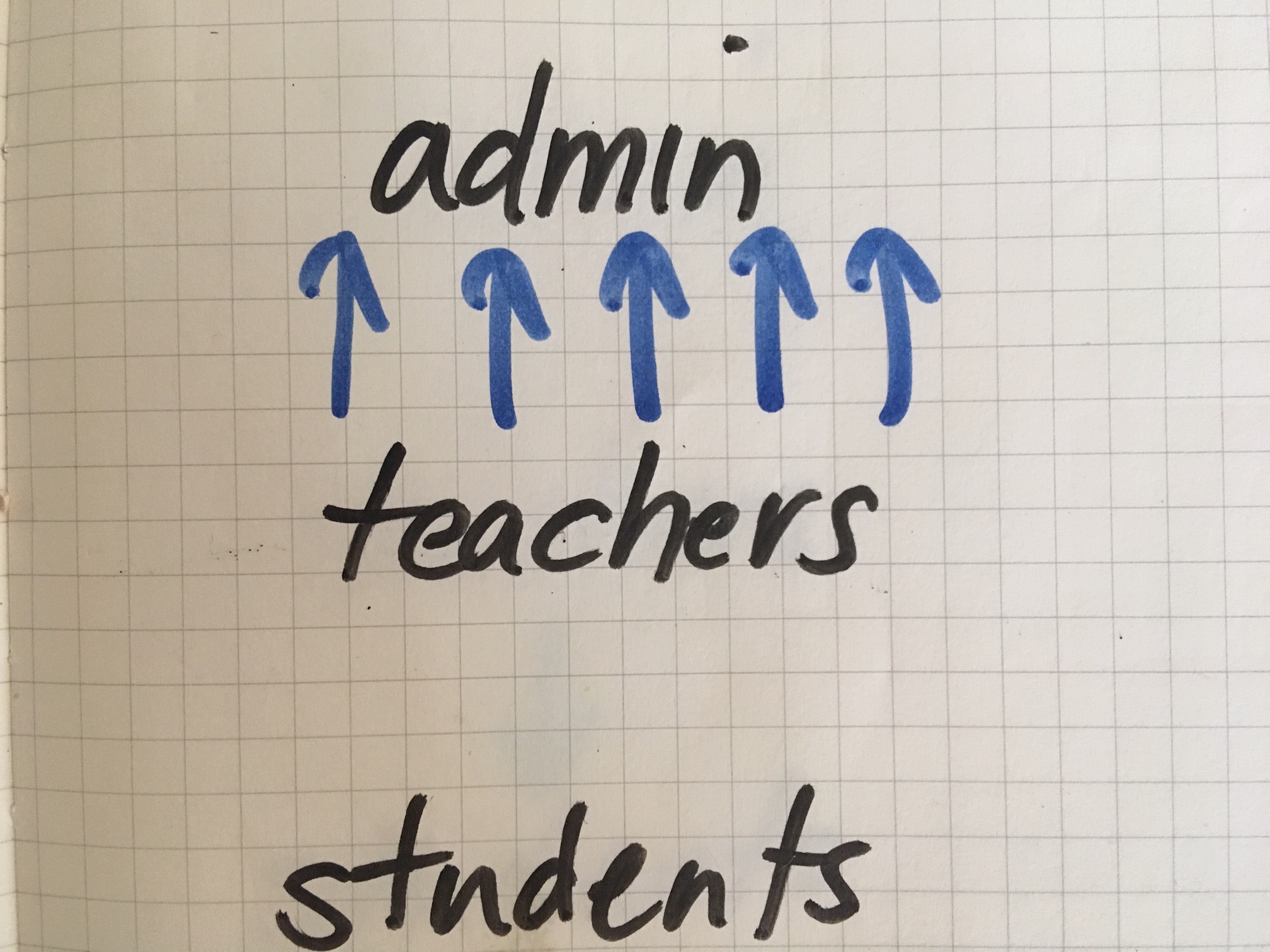
As their careers progress, most teachers find themselves moving up. I have moved down. More here:
At the last faculty meeting of the year, my principal honored a few teachers who were moving on from our school to become administrators. They were becoming assistant principals at other schools. It was joyous. There were reflective speeches, congratulatory hugs, and bittersweet goodbyes. These people had spent years and years in the classroom, one was even a co-teacher of mine for three years. But now, in the name of school leadership, they were leaving the classroom to serve students on a broader scale.
This is natural. We teachers often find ourselves so well-versed in classroom affairs that our influence expands. Our impact seeps out of the walls of our classroom and into the larger community. Or, if this hasn’t happened, we know that it can with some persistence. Often our principals make us believe, too. We then spend lots of money to go back to school, suffer through long nights of rewording essays, all to earn a piece of paper that says that we’re fit to lead a school.
This is commonplace and part of the gravitational pull that exists on teachers. It’s a force works to drive us out of our classrooms. We’re promoted, but we become one step removed from our students. We move up.
Now I’ve known for a long time that I’m a classroom lifer. I have no ambitions of becoming an assistant principal or principal. A progression up the educational food chain is natural, but never something that interested me.
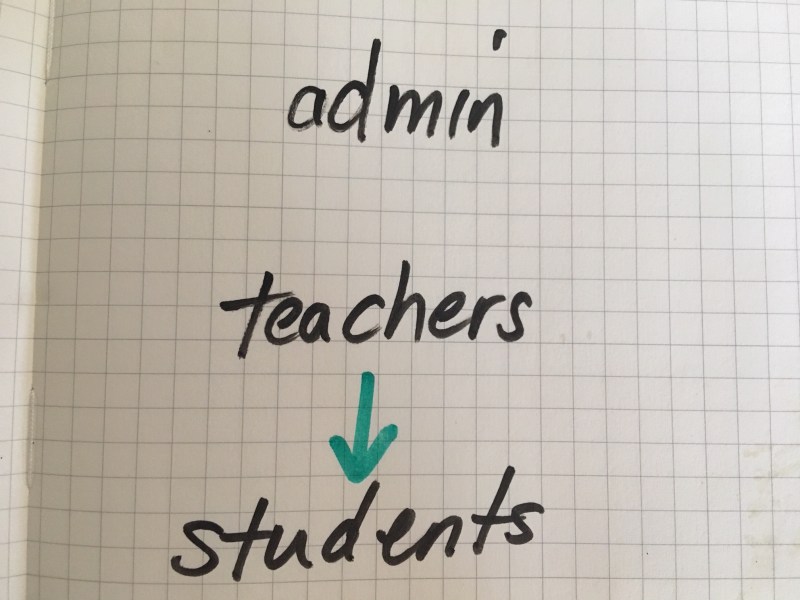
So as I sat there during the faculty meeting thinking about how my colleagues were moving further away from students, my own career flashed before me — especially these few years. While the pathway of these people had taken them up, away from students, mine had actually brought me down, closer to students.
I don’t think this downward movement is the norm — at least it wasn’t for me. I had to really work to move down. I’ve had to reflect, find myself, and then change my entire approach to teaching. I had to learn to be aware of my kids in ways that were foreign to me. And attending to my students’ lives in a personal way — to, paradoxically, not see them as students at all — is what has pulled me down to them. I’ve grown as an educator to affirm my students as sons, daughters, brothers, step-sisters, nieces, and nephews — as young people, as confused young adults, as budding leaders. This mindset is fueled by emotion and it’s not encouraged by the state, nor by the tests, nor by the curriculum. But it’s the single biggest reason why there’s a distinctive oneness that I feel when I’m with my students.
Just like it takes years to move up towards administration, it took my whole career for me to move down towards my students. It’s not a depth that I would have been prepared for early in my career, just like no new teacher is ready to be an assistant principal.
I get now that my career hasn’t been about reaching as far out as I can, despite all that has been fed to me all these years about success and impact. Instead, it has been about appreciating that my career will probably never extend beyond the walls of my classroom; it has been about understanding and tending to the depth of my students. It’s been about moving down.

 lazy 0ch0