Why versus what (Murdock Letter #3)

My school colleague Stephanie Murdock and I are writing letters to each other this summer and publishing them on our blogs. We are both white math teachers leaning on one another to improve the anti-racist stance that we take in our lives, classrooms, and school. This is the third post in the series.

Murd,

Thanks for getting back to me so fast! I was caught off guard by quickly you responded. The truth is, when you sent your response, I was actually still processing what I wrote; I was still trying to figure out what I discovered about myself through those 1,151 words. This normal for me. Even beyond our letters, I often do not know what I know nor feel what I feel until I find the words to capture it. This process of self-discovery causes me to reflect on what I write long after I write it.

Looking back on my last letter, I find it tantalizingly interesting that I shared my enthusiasm for abolitionist teaching with you…on the eve of the day that our nation celebrates its independence. The timing!

I’m so happy you’re making progress with your reading list! There is so much being thrown at us these days, it can be hard to dedicate time to some form of anti-racist work and not feel like we’re missing out on something else. Hats off to you. When you get around to reading We Want to do More than Survive, please let me know. And speaking of Crest of the Peacock, I’m about halfway through it. It’s super dope! Can’t wait to talk to you about both.

I really appreciated your thoughts on “fighting while we learn” and being “slow and measured.” Similar to you, I don’t think the two are mutually exclusive ideals. True learning, when done honestly and openly, is in itself an action. You’re changing yourself, and this takes time. In Me and White Supremacy, Layla F. Saad talks about exploring and unpacking white supremacy on the individual level and allowing this personal work to cause “a ripple effect of actionable change of how white supremacy is upheld out there.” She goes on to say that white supremacy is “a system that has been designed to keep you asleep and unaware of what having that privilege, protection, and power has meant for people who do not look like you.” Dismantling white supremacy requires action, no doubt, but it must be done “from the inside out, one person, one family, one business, and one community at a time.”

In case you’re wondering, Me and White Supremacy is marked as “Always Available” as an NYPL ebook. Maybe later this summer we read it together and check in with each other on the writing aspect of the book? I don’t think we have to finish it by the end of summer — maybe we use it as an excuse to continue writing each other after the school year begins? :-)

On a related note, earlier today I was reading a recent statement from TODOS on antiracist mathematics. Near the end, it talks about math teachers rushing to find lessons and activities that focus on matters of racial justice, like those found in Rethinking Mathematics. It emphasizes the importance of these types of actions, but also states that “if we as teachers simply take an activity and implement it in our classrooms without first doing the self-reflective work to understand how we all are impacted by racial trauma, then we may not be able to engage with the lesson in ways that are positively impactful for students.”

I have found that I’ve only been able to take meaningful anti-racist action in my classroom after I’ve done a considerable amount of racial soul searching and personal research. Of course, there came a time when I had to dive in, like I did with the graph of incarcerated Americans, but that happened only after I confronted my own racist patterns through reading, writing, and learning from other teachers (like Wendy Menard and Jose Vilson). Hell, these outward-facing letters I’m writing you are in themselves anti-racist actions that are the direct result of the personal work that I’ve done and continue to do. I would have never felt the need to write these public letters had I not first started seriously interrogating my whiteness.

Come to think of it, all of my racial soul searching enables me to continually discover my why when it comes to anti-racist action. And knowing my why makes my what (the actions I take) more clear and more impactful. Whatever anti-racist actions I do end up taking undoubtably then lead to more racial soul searching, more revision of my why, which then informs more anti-racist action. And so it goes.

Taking action is surely doable — I can implement anti-racist lessons all I want, for example — but without identifying my why, these actions can actually do more harm than good. In a sense, without doing the dirty work of reckoning with my purpose, my actions are hollow. This is akin to being an ally versus being a coconspirator in the fight for racial justice. It takes time to get to the heart of the matter, but when you do, you don’t have to push yourself to act. You are pulled. I would do good to remember this.

You mentioned your (lack of) transformation as a teacher. Sometimes I think about the end of my teaching career. I wonder about the moment that I step away from the classroom. Will I have regrets? Will I have closure? Will I look back and wonder what it would have been like to _______? (fill in the blank) Did I do right by my students or did I do what the system said I had to? What drives my work in and out of the classroom are those questions. Whatever school I’m at, whoever my students are, I want to make sure that I have left everything on the table during the previous 30 years. If there’s a big idea that I’ve been toying with, if there’s a way to reimagine my teaching, if there’s something that others think is crazy, I want to ensure that I try it. I may fail, but at least I tried and can look back and smile at my efforts. (And probably learn something important about myself in the process.)

Blowing up my teaching or going after a radical idea every few years involves huge risks — especially when you’re part of a school system that is constantly changing. But with the end in mind, I find those risks are absolutely worth taking. With that being said, I wonder what the next “big” thing is for you. I guess we’ll see.

Talk soon.

Finding my why,
Brian
The resiliency of white supremacy, abolitionist teaching, some personal history, and more (Murdock Letter #2)

My school colleague Stephanie Murdock and I are writing letters to each other this summer and publishing them on our blogs. We are both white math teachers leaning on one another to improve the anti-racist stance that we take in our lives, classrooms, and school. This is the second post in the series.

Hey Murd-

Straight up, I want to tell you that your last letter empowered me. The quote at the end was an arrow piercing my white shield. It helped me see that my hesitancy to offend our white colleagues was just my white privilege showing itself in a new way; the quote revealed the latent white supremacy that drove my feelings. It reminded me that I must stay vigilant if I’m ever going to have the opportunity to undo the work of my white ancestors. It let me know that this moment — and every moment — is a matter of life and death. It’s urgent. That I can’t hesitate to right this wrong anymore. Realizing all this made me grateful to be on this journey with you, write these letters, and work to understand — and interrupt — our white privilege.

Come to think of it, I’m realizing a lot about white supremacy lately. Like how it will do everything to preserve itself. That’s what it was doing when I was hesitant about offending our white colleagues. Just like the air we breathe, white supremacy will find a way back into us. It’s incredibly resilient. It certainly has a stranglehold on me. In the near future, just like we’re writing each other, I want to write a letter (or letters) to my whiteness. There are a lot of things it needs to hear.

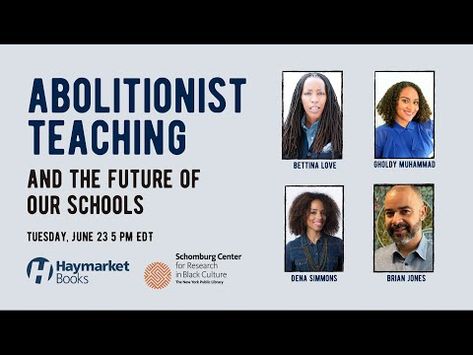
Anyways…I would have written you sooner, but I have spent the good part of the last few weeks learning about abolitionist teaching. If you don’t already know, abolitionist teaching is a model that calls for teachers to fight for the educational freedom of black and brown students in ways that mirror the work of nineteenth-century abolitionists. It’s a call to radicalize teachers with freedom dreaming and grassroots action to create classrooms and schools that enable students of color to thrive — not just survive. I learned about this concept from reading We Want to do More Than Survive: Abolitionist Teaching and the Pursuit of Educational Freedom by Bettina Love. Recently, Love was part of a panel discussion that focused on abolitionist teaching.

You know, every few years something hits me that changes everything I do and why do it. Ten years ago it was flipping (and unflipping) my classroom. Four years after that it was standards-based grading. Three years after that is was non-thematic units and problem-based learning. Now, it’s abolitionist teaching. Learning to adopt this anti-racist model of teaching while leaning into the perspectives of black queer women is going to cause a major shift in my practice in the years ahead. It’s going to change everything for me, I just know it.

Reading about your past made me think of mine. Racially, we have had somewhat different upbringings. I was born and raised in Cleveland, Ohio and was surrounded by black and brown kids my whole life. I had tons of cross-racial relationships and all of my best friends growing up were black or latinx. Despite this, my mom (I never knew my father), who was an incredible parent, was silent when it came to race. Naturally, I followed suit. Coming up, outside of being called “white boy” and “blanco” by friends, race never crossed my mind. She grew up in the city, too, and we were surrounded by all of the incredible black and latinx culture, yet I was raised to be colorblind; my mom implicitly taught me not to acknowledge our racialized society. Maybe my schools tried to do a better job, but I don’t remember. But had mostly white teachers anyway, so I doubt it. This all resulted in my never being aware of the unearned privileges that came with being born white, privileges that my black and brown friends would never have despite their best efforts. This stings because this mindset stayed with me well into adulthood and for a good part of my teaching career. I wonder who I would be today had things been different. I wonder if I would have done anything about it. I’m not confident that I would have.

In terms of the mission statement for RSJ, I’m not sure. I think I made something up in the moment because we were being forced to. It didn’t feel natural coming up with a statement because there were — and still are — so many unasked questions for the members of our group. One of my biggest fears is that we rush to find solutions that are answering the wrong questions. We teachers are conditioned to be results-driven and want answers fast, but because of the deep-seated biases we carry into this work, prudence and self-reflection is crucial. Not that I should be the one to designate what they are, but I think that certain readings should be mandatory for white people in RSJ (not unlike what the 1619 Project + Math initiative does). It’ll help norm expectations for our group. I’d rather work slowly and methodically to abolish our racist, sexist, ableist structures than to rush and slap a fresh coat of anti-racist, anti-sexist, anti-ableist paint on them. In fact, I don’t think developing a mission statement for RSJ should be a goal at all. When it does come time to formalize this work, instead of developing a mission statement for RSJ, we need to rethink the mission statement of our school. This work is all-encompassing. I know that is easier said than done, and there will be many who roll their eyes and insist on its good intentions, but our mission statement wasn’t developed through an anti-racist lens. In my eyes, that makes it inherently racist. It must go.

No, you’re not steamrolling. You’re being anti-racist. In a world steeped in racist ideas and policies, anti-racism is going to stand out. It’s definitely showing and I appreciate your insistence on change. You have inspired me. With that being said, as your partner in crime, I’m trying to be mindful of how often I center myself and my whiteness on this journey. Besides, that’s whole point: for us to get out of the way. This includes how much I care about being viewed as anti-racist. For it’s not about me, it’s about understanding the black experience and dismantling racist structures. In being a white male with an ego, checking myself is especially important, and something I’m constantly working on. I want no sympathy.

I feel like I’ve already traveled so far with these letters, yet this is only the second one. That makes me smile. There’s so much more to be said, but I’ll stop here. Till next time.


Freedom Dreaming,
Brian

Uncovering Abolitionist Teaching 2 of 2: Watching Abolitionist Teaching and the Future of our Schools

I recently discovered abolitionist teaching, which has been pioneered by Bettina Love, and have dedicated two posts to unpacking my learnings of it. In my first post, I focused on Bettina’s book We Want to do More than Survive: Abolitionist Teaching and the Pursuit of Educational Freedom. In this post, I reflect on the panel discussion she was on recently with Gholdy Muhammad and Dena Simmons called Abolitionist Teaching and the Future of our Schools.

It may be needless to say, but it’s absolutely worth the hour and a half time commitment. These ladies put the US education on blast. There were several things that stood out to me and, for the sake of simplicity and my own future reference, I will bullet them.

  • At 21:10, Gholdy calls for us to change our hiring practices and to have an explicit anti-racist and black-oriented focus during teacher interviews. This will help us gauge a teacher’s ability to interrupt white supremacy and properly serve our students — especially black and brown students. During an interview, for example, instead of asking, “Why do you want to work here?” or “Describe a challenge you overcame?,” we should be asking questions like, “How does anti-racism show up in your math class?”
  • At 23:55, Bettina mentions the idea of how schools “manage inequality” as opposed to eradicate it. We have tons of positions in our school systems — positions that black educators are often given — that are designed to help schools and districts overcome classism, racism, and sexism instead of working to remove those barriers for students. My school is guilty of this. Mind blown.
  • At 26:30, Dena goes into how social-emotional learning (or any curriculum) is merely “white supremacy with a hug” without an anti-racist or abolitionist lens attached to it. If we’re not direct, if the teacher hasn’t done the anti-racist work themselves, if the context isn’t explicitly anti-racist, our curriculum and our good intentions make no difference; they will still promote white supremacy and turn our efforts into weapons that harm dark children.
  • During 35:45-36:25, the host, Brian Jones, asks Bettina to talk about the parallel between the abolitionists from the 19th century and educator abolitionists today. Her response during 36:25-39:08 was the most brilliant, most beautiful, most inspirational monologue of the whole recording. Rewatching this segment is an absolute must for me.
  • At 49:11, Dena addresses the question that many white folks have: “What can I do with my white privilege?” She pointedly remarks that the question in and of itself is offensive. It assumes that the white person asking it wishes to keep their privilege instead of giving it up, that they inherently wish to maintain the racial status quo. Thank you, Dena.
  • At 50:10, Bettina elaborates on the idea that, as a society, we should center black women and their experiences when it comes to social justice because of the world view that they have. Black women — and black queer women especially — have been marginalized on many different levels (race, gender, class, sex), if not every level, and that this intersectional oppression has allowed them to see the world more inclusively than any other group. Both Gholdy and Dena also chime in and the whole segment gives me a wealth of perspective about black women that I never had before. The gripping Kimberly Jones speech was mentioned. At 54:40, Dena drops a bomb when she discusses how black women can teach the world emotional intelligence. Between 55:20-56:44, Gholdy struck a chord with me with her compelling argument that Black Americans, given all the beauty they’ve created from all the oppression they’ve endured, should be the next models for humanity.
  • During 57:45-1:01:17, Bettina rocks my world again. She talks about remote learning, the closing of schools, and how — all of a sudden, out of nowhere — so much was possible. In the span of a month, everything changed: no standardized testing, free laptops, overflowing trust in teachers and parents, tech companies giving away resources. In Bettina’s words, the system has played its hand and we cannot go back. We must maintain the expectation of compassion over compliance.
  • Throughout the discussion, Gholdy constantly refers back to notion that to achieve equity and an anti-oppressive society, teachers cannot and should not be exclusively focused on skills. In her research about abolitionist readers, writers, and thinkers, she uncovered that these revolutionaries also taught themselves identity development, intellectual development, and criticality into order to help move themselves and everyone else to a racially-just world. Her book was noted.
  • At 1:05:14, Bettina: anti-racist, abolitionist teaching belongs in WHITE SCHOOLS. Period.
  • During 1:12:34-1:14:40 Bettina shoots off many books and organizations to plug into abolitionist and social teaching, including her own project, The Abolitionist Teaching Network. It will launch in the coming weeks. There’s a welcome webinar that I no doubt will be attending on July 13.


bp

Uncovering Abolitionist Teaching 1 of 2: Reading We Want to do More Than Survive by Bettina Love

To even begin to attack our destructive and punitive educational system, pedagogies that promote social justice must have teeth.

Bettina Love

I recently discovered abolitionist teaching, which has been pioneered by Bettina Love, and have dedicated two posts to unpacking my learnings of it. The first post, this one, focuses on Bettina’s book We Want to do More than Survive: Abolitionist Teaching and the Pursuit of Educational Freedom. In the second post, I reflected on the panel discussion she was on recently, Abolitionist Teaching and the Future of our Schools.

Before I read We Want to do More than Survive, I had never heard of abolitionist teaching. Bettina has pioneered the term to represent a radical approach to teaching and schooling, an approach where teachers draw on the imagination, ingenuity, rebellious spirit, healing, determination, and subversiveness of abolitionists to provide educational freedom for our black and brown students.

Pointed and an unapologetic call to action, Bettina packed a lot into 200 pages. She went straight for the jugular. At its heart, the book is a call to action. It was about understanding and embracing the sweet struggle that comes with abolishing an educational system that is steeped in white supremacy. A system that is inherently racist and sexist. Leaning into the history of slavery, she draws parallels to the US school system and current events to push us not to reform schools, but to reimagine them and, in many instances, burn them down and start over completely.

I found her juxtaposition between slavery and schooling incredibly powerful. It’s exactly what I needed. The truth is, as I read and found myself highlighting passage after passage after passage, I felt her book changing me. As a white, heterosexual male, Bettina was helping me peel back my thick, resistant layers of privilege and understand how this privilege reveals itself in my classroom and school…and triggered an urge in me to begin dismantling it. I’ve been doing work to understand (my) whiteness for while, but Bettina somehow struck a chord that no other book, professional development, or conversation had before. For the first time in my career, she encouraged me to freedom dream.

It was a truly outstanding book — something I know will be a resource for me in the years ahead. To keep myself accountable as well as documenting how I’m evolving, I combed through my many highlights and decided to post some here. It also seems fitting to post direct quotes from Bettina instead summarizing and paraphrasing them because of the impact they had on me. She found the precise words to match my thoughts and feelings on educational justice, some of which I never knew I had.

  • Education is one of the primary tools used to maintain White supremacy and anti-immigrant hate. Teachers entering the field of education must know this history, acknowledge this history, and understand why it matters in the present-day context of education, White rage, and dark suffering. (p. 23)
  • Schools are mirrors of our society; educational justice cannot and will not happen in a vacuum or with pedagogies that undergird the educational survival complex. We need pedagogies that support social movements. I hear teachers say all the time, “I close my classroom door and teach.” This strategy helps teachers survive the disempowering and stressful environment, irrelevant curriculums, and bureaucratic mess of education, but it does not change the field or the context in which youth are being disposed of; it may just prolong the inevitable. (p. 40)
  • [On her first Black teacher, Mrs. Johnson] Mrs. Johnson did not just love her students, she fundamentally believed that we mattered. She made us believe that our lives were entangled with hers and that caring for us meant caring for herself….Mrs. Johnson taught as if the fate of her and her children was tied to ours. (pp. 47-48)
  • The writer bell hooks argues that loving Blackness is an act of political resistance because we all have internalized racism, regardless of the color of our skin, which operates to devalue Blackness, but she argues that Black people need to love themselves not in spite of their Blackness but because of their Blackness. (pp. 49-50)
  • Too often we think the work of fighting oppression is just intellectual. The real work is personal, emotional, spiritual, and communal. It is explicit, with a deep and intense understanding that loving Blackness is an act of political resistance, and therefore it is the fundamental aspect to teaching dark kids. (p. 51)
  • I had to learn despite school, not because of it. School mattered because it provided the testing ground in which I learned ways to resist and navigate racism, the low expectations, the stereotypes, the spirit-murdering, all the forms of dark suffering, gender suffering, queer suffering, religious suffering, and class suffering. (p. 52)
  • Antiracist teaching is not just about acknowledging that racism exists but about consciously committing to the struggle of fighting for racial justice, and it is fundamental to abolitionist teaching. Antiracist educators seek to understand the everyday experiences of dark people living, enduring, and resisting White supremacy and White rage. (p. 53)
  • Measuring dark students’ grit while removing no institutional barriers is education’s version of The Hunger Games. It is adults overseeing which dark children can beat the odds, odds put in place and maintained by an oppressive system. (p. 73)
  • Teachers need to be taught how to question Whiteness and White supremacy, how to check and deal with their White emotions of guilt and anger, and how these all impact their classrooms. Only after unpacking and interrogating Whiteness, White teachers—and, really, all teachers—must unpack how Whiteness functions in their lives; then they can stand in solidarity with their students’ communities for social change. (p. 75)
  • Abolitionist teaching is not sustainable without joy. Dark students have to enter the classroom knowing that their full selves are celebrated. Not just their culture, language, sexuality, or current circumstances but their entire selves, past, present, and future. Their ancestors, their family members, their friends, their religion, their music, their dress, their language, the ways they express their gender and sexuality, and their communities must all be embraced and loved….Teachers who understand Black joy enter the classroom knowing that dark students knowing their history, falling in love with their history, and finding their voice are more important than grades. Good grades do not equal joy. (pp. 120-121)
  • White folx can also embrace Black joy by helping, advocating for, and wanting Black folx to win. Recognizing and acknowledging White privilege is cute, but what does it mean without action? Dismantling White privilege is giving something up so Black folx can win….By winning, I mean White folx ensuring that people of color are being paid equally or more than their White peers. White teachers demanding that schools hire more teachers of color. Silencing your White voice so dark folx’ voices can be heard. White folx bringing dark folx in on all decision-making and dark folx having equal or more weight, and not just on issues about injustice or education but on issues that impact all of us, regardless of the color of our skin. (p.121)
  • The great Audre Lorde said, “The true focus of revolutionary change is never merely the oppressive situations which we seek to escape, but that piece of the oppressor which is planted deep within each of us.” Abolitionist teaching asks us to question the piece of the oppressor that lives in all of us. (p. 122)
  • My goal as an educator, teaching overwhelmingly White students, is to get White students to question how they are going to teach children of color with a limited understanding of who these children are, where these children come from, their history, why and how they matter to the world, who loves them, why they should love Blackness, why they should want to see dark children win, how to support their quest to thrive, and how it is intentional that future teachers know so little about dark students. (p. 126)
  • Few teacher education programs require their students to take classes in African studies, African American studies, Latinx studies, Caribbean studies, Chicana/o studies, American studies, and/or Native American studies. Teachers of all backgrounds walk into classrooms never studying the history or the culture of the children they are going to teach. So, how can teachers be culturally relevant when they have not studied culture? (p.128)
  • If teachers studied and understood Black culture, per se, they would know that the culture is filled with self-expression, complex language shifting abilities, creativity, self-advocacy, focus play (i.e., hand clap games), memory, and improvisation. Let me stop here to say: Black folx improv not because we do not understand the structure, but because we know the structure so well….Without examining culture, educators will turn to stereotypes instead of rich examples that explain dark life and provide context to their lived realities. (pp. 128-129)
  • Another facet of the teacher education gap is White students’ limited interactions with people of color, which perpetuates the myths about people of color. Many White students believe that their hard work is one of the major reasons they landed at a top university; or that their parents’ decision to live in an all-White neighborhood had nothing to do with race, racism, or enclaves established by White rage; and that their privilege—if they recognize it—will not have any impact on their students, because they “love kids,” “want to make a difference,” and/or “have wanted to be a teacher since they were little girls playing school with their dolls.” How can you love something you know so little about? (p. 130)
  • To be a Black mother is to be America’s punching bag, as you morph into a shield and take every blow for your family, especially your Black children, that will be thrown by America’s White rage. (p. 150)
  • Being an abolitionist means you are ready to lose something, you are ready to let go of your privilege, you are ready to be in solidarity with dark people by recognizing your Whiteness in dark spaces, recognizing how it can take up space if unchecked, using your Whiteness in White spaces to advocate for and with dark people. And you understand that your White privilege allows you to take risks that dark people cannot take in the fight for educational justice. (p. 159)

bp