My 2021 in Books

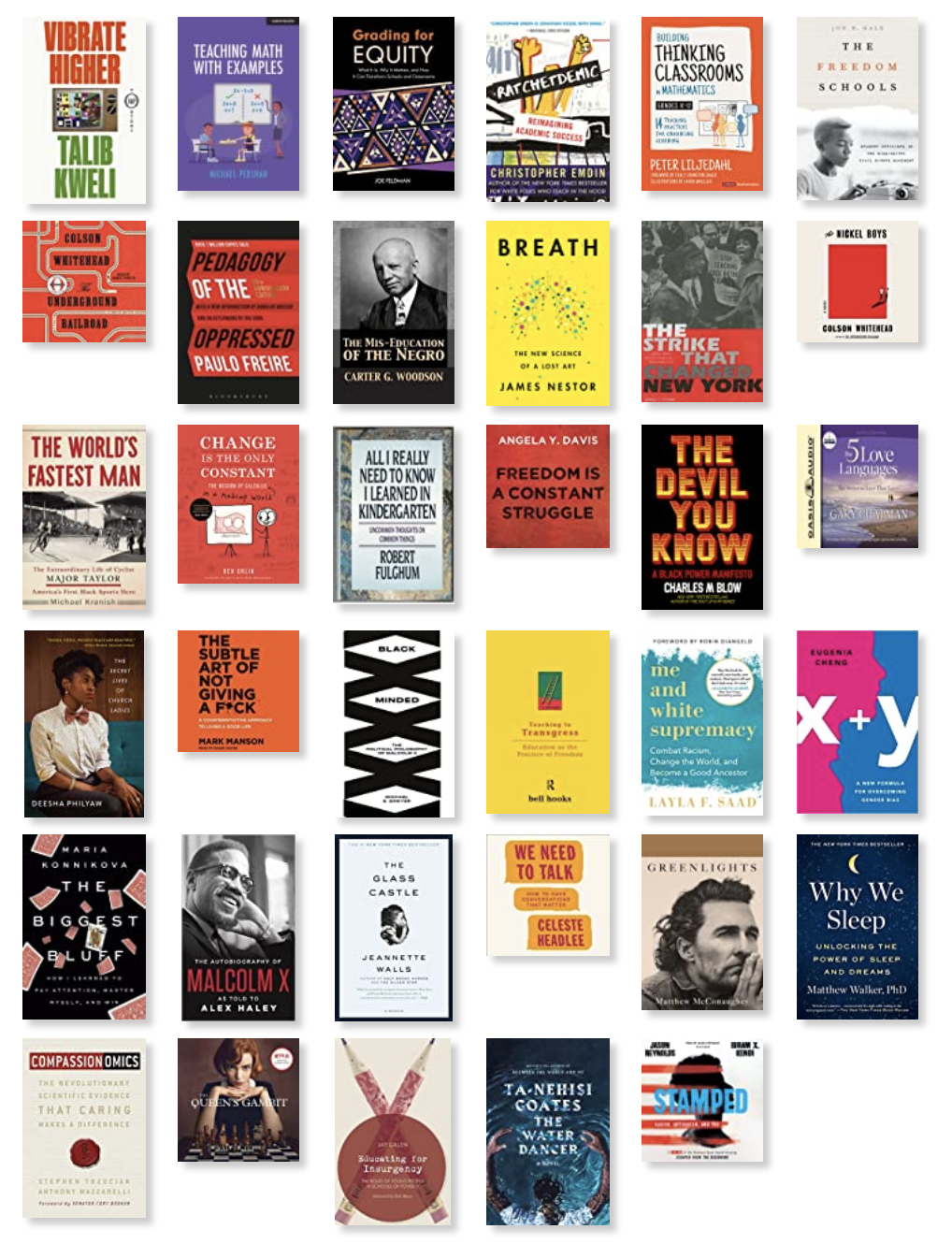
While still trapped in a pandemic this year, I was able to mentally and emotionally escape it with some wonderful books. I began 2021 on a reading tear, way ahead of my goal of 33 books, but my pace slowed in the fall as I found myself producing more writing than I was consuming through books. I finished the year with 35. Here’s my attempt to look back on and capture my journey through books.

Book clubs and rereading
I owe gratitude to two book clubs that I joined in 2021. The first, the “Continuing the Conversation” group at my school, was a socially-minded book club of 10-ish staff members at my school who gathered on Zoom to discuss books, podcasts, and thought-provoking articles. In the spring we discussed two juggernauts: The Autobiography of Malcolm X and The Mis-Education of the Negro by Carter G. Woodson. Both were amazing and the perfect books to discuss in the company of other educators. I found myself referencing The Autobiography of Malcolm X many times after reading it. It even moved my colleagues and me to visit Malcolm’s gravesite to pay homage to him on his birthday. As a white teacher, Mis-Education got me questioning all sorts of things — including the appropriateness of a bunch of white folks reading it in the presence of a Black person. Both books moved me to learn more about Malcolm and Woodson, so I read Black Minded by Michael Sawyer and Fugitive Pedagogy by Jarvis R. Givens.

The other book club that I was a part of was organized by two teachers at MƒA and focused on Pedagogy of the Oppressed by Paulo Freire. I read Pedagogy of the Oppressed in 2020, but found most of it so dense that I needed to reread it this year to better understand Freire’s message. Let’s just say I think I need another reading! I’m slow.

Speaking of rereading, I reread four other books this year: The 5 Love Languages by Gary Chapman, Teaching to Transgress by bell hooks, The Subtle Art of Not Giving a F*ck by Mark Manson, and Why We Sleep by Matthew Walker. I loved each of these books the first time I read them on paper, but this year elected to listen to them as audiobooks. Appealing to my growing love for the spoken word, this was a refreshing experience and offered me new takeaways.

Education
I don’t often read books about education — like pedagogy — mainly because they can feel textbook-y and make me feel like I’m back in college. That said, I was pulled to read these five: Building Thinking Classrooms in Mathematics by Peter Liljedahl, Grading for Equity by Joe Feldman, Ratchetdemic by Christopher Emdin, Educating for Insurgency by Jay Gillen, and Teaching Math with Examples by my friend Michael Pershan. I’m grateful that I picked them up because they were all great. In their own unique way, each got me rethinking my practice and experimenting with what I do every day. Emdin and Gillen were more big picture — more theoretical — nudging me to reevaluate some of my assumptions. Liljedahl, Pershan, and Feldman piled on the research, but were more practical. Liljedahl and Pershan even compelled me to write blog posts about their books (here and here).

Recommendations
In an interesting twist, two books found me by way of recommendation. The first was All I Really Need to Know I Learned in Kindergarten by Robert Fulghum, which was gifted to me in June by a history teacher at my school. The book was more endearing than I expected and filled my heart. If I’m ever in need of a good pick-me-up, I’m reaching for it.

The second recommendation was from a student. Last year — as miserable as it was — I often used class time to discuss all sorts of things with my kids. One day, a student and I got to discussing books and I asked her if she had a favorite. Without hesitation, she introduced me to The Glass Castle by Jeannette Walls. Based on her enthusiasm, I vowed to read it and eventually did two months later. It was a superb book that made me angry, made me laugh, and made me want to cry all on the same page. In a unique turn of events, she invited me and two colleagues (who also read the book upon her recommendation) to a Zoom chat to discuss the book over spring break. Our unforgettable talk lasted an hour and was one of a few bright moments during what was a somber school year.

Fiction
My growing appreciation for storytelling permitted five works of fiction to meander their way onto my reading list this year. Three of them, in particular, were excellent: The Queens Gambit by Walter Tevis, The Nickel Boys by Colson Whitehead, and The Underground Railroad also by Colson Whitehead. I was inspired to read The Queens Gambit and The Underground Railroad partly because I wanted to watch the novels play out on TV while I read them (each has its own series on Netflix and Amazon, respectively). I would read a few chapters and then watch an episode or two of the series and continue doing this until it was finished. It was captivating to have an image of a book in my mind and then see it recreated on TV a few days later. This experience reinforced the story and its message and I found myself more invested in it than I would have been otherwise.

History
At some point this year I realized that I was reading a lot of history. First, there was the audiobook of Stamped by Jason Reynolds and Ibram X. Kendi, which was lively and highly engaging. Then there was The World’s Fastest Man by Michael Kranish, a stellar biography of cyclist Major Taylor which I read while watching this year’s Tour de France. After a trip to the Schomburg Center in early summer, I was encouraged to learn more about the Mississippi Freedom Schools from 1964, so I read The Freedom Schools by Jon N. Hale, which I loved. Another was The Strike That Changed New York by Jerald Podair, which struck close to home and revealed an important side of New York City and the UFT that I didn’t know about. It also compelled me to listen to the School Colors podcast, which was outstanding.

Honorable Mentions
There are four books that I read that don’t fall into any of the above categories, but deserve to be highlighted. The first is Freedom is a Constant Struggle by Angela Davis. I’ve seen this book on so many reading lists through the years, how have I avoided it for this long? Stirring and unafraid, Davis speaks truth to power. She makes plain how our struggles in the US around justice are necessarily situated in the global struggle for freedom. The next is The Devil You Know by Charles M. Blow. Astute and persuasive as hell, this one was hard to put down. In addition to jibing with his call to action for Black folks living in America, I really appreciated Blow’s writing. He packed a punch with style.

The third honorable mention is The Biggest Bluff by Maria Konnikova, which was utterly fascinating. Having never played poker before, she vividly shares her grassroots training and attempt to conquer the World Series of Poker. She took me into the game from a psychologists’ perspective and on the way showed me how poker is a perfect model for the messiness of life. I’m not a poker player in the least bit but fell hard for her book. The last book I have to lift up is Conpassionomics by physicians Stephen Trzeciak and Anthony Mazzarelli. Although centered on the important role compassion has in the medical field, this book had a significant impact on my pedagogy and how I think about my students. Not only that, but it galvanized colleagues at my school to reflect on how and why compassion shows up in our practice. The experience was so uplifting that it led me to facilitate a one-hour workshop on compassion at MfA’s Summer Think conference in July.

Here’s to another year of reading — and escaping.

bp

My 2021 in books

While still trapped in a pandemic this year, I was able to mentally and emotionally escape it with some wonderful books. I began 2021 on a reading tear, way ahead of my goal of 33 books, but my pace slowed in the fall as I found myself producing more writing than I was consuming through books. I finished the year with 35. Here’s my attempt to look back on and capture my journey through books.

Book clubs and rereading
I owe gratitude to two book clubs that I joined in 2021. The first, the “Continuing the Conversation” group at my school, was a socially-minded book club of 10-ish staff members at my school who gathered on Zoom to discuss books, podcasts, and thought-provoking articles. In the spring we discussed two juggernauts: The Autobiography of Malcolm X and The Mis-Education of the Negro by Carter G. Woodson. Both were amazing and the perfect books to discuss in the company of other educators. I found myself referencing The Autobiography of Malcolm X many times after reading it. It even moved my colleagues and me to visit Malcolm’s gravesite to pay homage to him on his birthday. As a white teacher, Mis-Education got me questioning all sorts of things — including the appropriateness of a bunch of white folks reading it in the presence of a Black person. Both books moved me to learn more about Malcolm and Woodson, so I read Black Minded by Michael Sawyer and Fugitive Pedagogy by Jarvis R. Givens.

The other book club that I was a part of was organized by two teachers at MƒA and focused on Pedagogy of the Oppressed by Paulo Freire. I read Pedagogy of the Oppressed in 2020, but found most of it so dense that I needed to reread it this year to better understand Freire’s message. Let’s just say I think I need another reading! I’m slow.

Speaking of rereading, I reread four other books this year: The 5 Love Languages by Gary Chapman, Teaching to Transgress by bell hooks, The Subtle Art of Not Giving a F*ck by Mark Manson, and Why We Sleep by Matthew Walker. I loved each of these books the first time I read them on paper, but this year elected to listen to them as audiobooks. Appealing to my growing love for the spoken word, this was a refreshing experience and offered me new takeaways.

Education
I don’t often read books about education — like pedagogy — mainly because they can feel textbook-y and make me feel like I’m back in college. That said, I was pulled to read these five: Building Thinking Classrooms in Mathematics by Peter Liljedahl, Grading for Equity by Joe Feldman, Ratchetdemic by Christopher Emdin, Educating for Insurgency by Jay Gillen, and Teaching Math with Examples by my friend Michael Pershan. I’m grateful that I picked them up because they were all great. In their own unique way, each got me rethinking my practice and experimenting with what I do every day. Emdin and Gillen were more big picture — more theoretical — nudging me to reevaluate some of my assumptions. Liljedahl, Pershan, and Feldman piled on the research, but were more practical. Liljedahl and Pershan even compelled me to write blog posts about their books (here and here).

Recommendations
In an interesting twist, two books found me by way of recommendation. The first was All I Really Need to Know I Learned in Kindergarten by Robert Fulghum, which was gifted to me in June by a history teacher at my school. The book was more endearing than I expected and filled my heart. If I’m ever in need of a good pick-me-up, I’m reaching for it.

The second recommendation was from a student. Last year — as miserable as it was — I often used class time to discuss all sorts of things with my kids. One day, a student and I got to discussing books and I asked her if she had a favorite. Without hesitation, she introduced me to The Glass Castle by Jeannette Walls. Based on her enthusiasm, I vowed to read it and eventually did two months later. It was a superb book that made me angry, made me laugh, and made me want to cry all on the same page. In a unique turn of events, she invited me and two colleagues (who also read the book upon her recommendation) to a Zoom chat to discuss the book over spring break. Our unforgettable talk lasted an hour and was one of a few bright moments during what was a somber school year.

Fiction
My growing appreciation for storytelling permitted five works of fiction to meander their way onto my reading list this year. Three of them, in particular, were excellent: The Queens Gambit by Walter Tevis, The Nickel Boys by Colson Whitehead, and The Underground Railroad also by Colson Whitehead. I was inspired to read The Queens Gambit and The Underground Railroad partly because I wanted to watch the novels play out on TV while I read them (each has its own series on Netflix and Amazon, respectively). I would read a few chapters and then watch an episode or two of the series and continue doing this until it was finished. It was captivating to have an image of a book in my mind and then see it recreated on TV a few days later. This experience reinforced the story and its message and I found myself more invested in it than I would have been otherwise.

History
At some point this year I realized that I was reading a lot of history. First, there was the audiobook of Stamped by Jason Reynolds and Ibram X. Kendi, which was lively and highly engaging. Then there was The World’s Fastest Man by Michael Kranish, a stellar biography of cyclist Major Taylor which I read while watching this year’s Tour de France. After a trip to the Schomburg Center in early summer, I was encouraged to learn more about the Mississippi Freedom Schools from 1964, so I read The Freedom Schools by Jon N. Hale, which I loved. Another was The Strike That Changed New York by Jerald Podair, which struck close to home and revealed an important side of New York City and the UFT that I didn’t know about. It also compelled me to listen to the School Colors podcast, which was outstanding.

Honorable Mentions
There are four books that I read that don’t fall into any of the above categories, but deserve to be highlighted. The first is Freedom is a Constant Struggle by Angela Davis. I’ve seen this book on so many reading lists through the years, how have I avoided it for this long? Stirring and unafraid, Davis speaks truth to power. She makes plain how our struggles in the US around justice are necessarily situated in the global struggle for freedom. The next is The Devil You Know by Charles M. Blow. Astute and persuasive as hell, this one was hard to put down. In addition to jibing with his call to action for Black folks living in America, I really appreciated Blow’s writing. He packed a punch with style.

The third honorable mention is The Biggest Bluff by Maria Konnikova, which was utterly fascinating. Having never played poker before, she vividly shares her grassroots training and attempt to conquer the World Series of Poker. She took me into the game from a psychologists’ perspective and on the way showed me how poker is a perfect model for the messiness of life. I’m not a poker player in the least bit but fell hard for her book. The last book I have to lift up is Conpassionomics by physicians Stephen Trzeciak and Anthony Mazzarelli. Although centered on the important role compassion has in the medical field, this book had a significant impact on my pedagogy and how I think about my students. Not only that, but it galvanized colleagues at my school to reflect on how and why compassion shows up in our practice. The experience was so uplifting that it led me to facilitate a one-hour workshop on compassion at MfA’s Summer Think conference in July.

Here’s to another of reading — and escaping.

bp

Meditations on a Cogen (No. 10) • Wednesday, December 22, 2021

During the 2021-22 school year, I’m having weekly co-generative dialogues (or cogens) with my students. In an effort to help me process these talks and document progress, I summarize and write reflections after each cogen. This is the tenth post in the series.

Back to Zoom
The last week has been chaotic. After having few students in class on both Friday and Monday because of Covid protocols, it was decided that we transition to remote learning for the three days leading up to winter break. Like anyone else at my school with a pulse, I anticipated this and last week asked my cogen students if they were good to meet on Zoom. I emailed them yesterday and 4 out of 6 confirmed that they could make it. We were on.

So, this afternoon, after a wild couple of days, my cogen found itself back on Zoom. I say “back” on Zoom because the memories of last year’s all-online cogens showed up immediately in my mind when I logged in today. I held 24 cogens last year, all of which were on Zoom. Participating in a cogen online triggered mixed emotions for me. Obviously, I’d much rather be in person. The conversation is more dynamic and nuanced. Not to mention the snacks! At the same time, last year’s cogens were my first and made me an adamant believer in them. In this sense, holding them online today felt strangely natural and, dare I say, homey.

I opened Zoom ten minutes early and caught up with a student who showed up before our scheduled meeting time of 2:45 p.m. I asked him how the transition has been for him these last few days. Like a lot of students, he lamented about his boredom and yearning to get back into school. We chatted about our upcoming break. He was going to Rhode Island to spend time with family. At one point he asked me for advice on a personal matter that I vowed to follow-up on.

Our non-academic chatter served as a reminder for me that cogens aren’t just a place for teachers and students discuss classroom matters. They’re for getting to know each other, too. At cogens, teacher-student relations can be nourished without the demands of curricula and instruction.

When the other three cogen students arrived, he and I were in the middle of a playful discussion around the ethics of napping (smile). Feeling encouraged by our banter, I invited the rest of the crew to give their two cents on the napping debate. It was fun. I mentioned that I took a 10-minute power nap before 7th period today and the kids were rendered speechless. How is that possible? Why would you even want to do such a thing to your body? The only naps they know of are the multiple-hour variety and those that result in unintentionally waking up the next morning wondering what happened. One student, speaking as if it were part of his religion, said point-blankly, “Mister, I don’t believe in 10-naps.” I laughed harder than I did all week.

In Limbo
Given the whirlwind of this week, I was curious how classes were going for them. How are their teachers going about things? What have my colleagues done so far that the students have liked? I was transparent about my desire to steal ideas and adapt them for our class. I also wondered if the students could give me any advice on how to approach our new in-person/remote dilemma. If we remain in limbo — teetering between the classroom and Zoom based on Covid numbers — what are some tips they can offer me?

Above all else, the kids stressed the importance of checking in with my students. Many teachers, from their perspective, have a singular focus: work getting done. This was true of the last two years, but also this week. Disappointingly, the students struggled to offer me examples of things they enjoyed from their class over the last few days. The lone highlight came from a teacher who played Christmas songs for the class and did fun trivia based on them. I appreciated their honesty, but I was left wanting more examples of what the students saw as exemplary teaching moves. Maybe I need to be more specific? Perhaps next time I ask something like, What’s something you did in Chemistry this week that you liked? What about ELA?

Curious what “checking in” meant to them, I asked the students if they could illustrate their point with some examples. What does it look like when a teacher checks in? I did a few Zoom polls today in class to catch the mood of the room and the kids were in agreement that those were a great example of how to do it. One student commented that ours was one of her liveliest classes because of the polls. They also liked how I used the chatbox to refocus the class and grab their attention. I did this by asking 10 students, say, to respond to a given question. Both the polls and the call-and-response in the chat added an interactive component to our time together that they enjoyed.

In terms of the big picture, one student suggested that on certain days I assign the class independent work and use my time to conference with individual students. I liked this because it could work whether we’re online or in person. An idea that added more structure to it was to have a 4-day work week. The students said that the 5th day could be used for more intensive check ins and independent work. This made me think of Shraddha Shirude and how she modified her curriculum to make this structure work for her.

Dreaming and thank you
Wishing I had spent more time discussing this, I closed today’s talk by asking the group to complete the upcoming math journal assignment with a critical eye. I co-created this assignment with the first cohort of cogen students back in November and formally assigned this week. It’s due January 7. I told the cogen that after we come back from break I’m going to need their feedback on it. I want to use their experience completing it to make it better and more relevant for all of my students. I asked the cogen that they dream big, as all recommendations on editing it will be welcomed.

Asking the students to dream got me thinking of my own: How great would it be if I co-designed an assignment with each cohort of cogen students? If it’s not an original assignment, maybe we co-design a new version of a past assignment? If we can pull something like that off, each cohort would be in a position to critique their predecessors’ assignment and then go on to make their own.

Before we left, I profusely thanked the students for their time. Part of me can’t believe we actually made this week’s cogen happen. All I can say is that I’m seriously blessed with some amazing students.

bp

Last year remote learning broke me, what will happen this time?

The text arrived yesterday at 7pm. It was from my department chair. He was informing the math department that school was closed for the next ten days. The “Situation Room” at the New York City Department of Education decided that their Covid threshold had been met and we needed to shut our doors. Remote learning was back.

Initially — within the first few minutes of reading his message — my reaction was indifferent. Closing our school was inevitable. Covid was spreading like wildfire and this was a necessary step for everyone’s safety. What had to be done had to be done.

Over the next half hour, there was a frenzy of emails and texts asking teachers to create Zoom links, notify their students, and jump headfirst back into a harsh world that caused me so much harm. As my phone rattled and binged displaying texts from colleagues wishing each other well, dread swept over me. I was hesitant, but decided to open my laptop. As I did, an unsightly number of emails filled the screen. After 10 minutes of gazing at an unwanted reality, my body felt heavy. The heartache from last year was resurfacing. I grew somber. My eyes watered.

Naively, when the year began, I figured I was done with remote learning. Years from now I saw myself looking back at the 2020-21 school year with terror, grateful that I never had to experience anything like it again. I see now that I was wrong.

Despite knowing our return to remote learning was inevitable, I couldn’t bring myself to reply to my department chair’s text message. Nor could I gather the courage to reply to any of the emails from school leadership about prepping Zoom links. I left them all unanswered. If I did respond, I knew I would be complicit in accepting our return to remote learning. I wasn’t prepared to do that. I ignored every message and request.

Feeling that remote learning was dragging me back to its dark lair, I spent the next hour reading some of my recent blogposts about the experience (here, here, and here). Though satisfying, I think this made my mental state worse because the posts find me relishing the freedoms that in-person learning has granted to me this year. It’s like what happens when you guilt eat a bunch of chocolate after a breakup. It feels great in the moment, but afterward you feel horrible. After I gorge on my posts, I look at the clock. It’s 8:30. I go to bed.

This morning, still unable to fully accept that remote learning has made a comeback, I wait until the last minute to create Zoom links for my classes. Deep inside, something in me believed that all of this would just go away if I refused to acknowledge it. I know this is foolish, but I couldn’t help it. Ten minutes before the start of 1st period, I create the damned links and add them to our school’s shared spreadsheet. Doing it felt like an out-of-body experience.

And how did today go? It was a struggle. The kids were all over the place. I had no significant plans and spent each period meekly checking in with students, asking about the transition back to Zoom and what they’re hoping for during our shut down. Some students joined sick and from quarantine, receiving their essentials like food and water from family members in isolation. Others were in an empty home, bored out of their minds. Many were angry that we were once again resorting to Zoom links and communicating through a chatbox. Just like me, the flashbacks to last year came without warning for these students. In 3rd period, a girl cried pleaded, “I feel robbed. When are we ever going to get to have a normal school year?” A few hours into remote and worry had already taken hold. And this was from the students that were actually present today. There were so many I didn’t even see. I’m concerned even more for them.

As for me? How did I hold up? My morning classes — which I teach alone — were a nightmare. Feeding off last night’s energy, I had little motivation. I was fully present, but empty. My students sensed my dreariness and this made things worse. It was evident to them and me that my light — which radiated during the last four months — dimed and went out today. Behind a turned-off camera, I teared up during 3rd period. I was afraid.

As the day progressed, I tried to fully own and understand the shadowy figure that remote learning turned me into this morning by finding myself in the stories my students shared during class. My co-teacher in 5th period helped as she joked and lifted up silly moments that I failed to notice because I was trapped by my own feelings. In my other classes, I worked to show appreciation for the students who unmuted themselves. One student in 7th period had her camera on for the entire period and another in 9th showed her baby sister on camera, whom we talk about often. I showered both with public gratitude.

A year ago today I wrote, “My crusade for student engagement resulted in many minutes of silence today in both 1st and 9th periods. I get frustrated as hell, but, right now, who can blame them for wanting to hide…” The symmetry between then and now is absolute.

In my students’ reflections in class today, I was reminded several times that remote learning is temporary this time around. Ten days, that’s it. We’re scheduled to be back January 3. This is supposed to console me, to give me solace, but hasn’t. When I see cases spiking, nothing communicates that remote learning is going anywhere. Ten days can easily turn into 20 which can quickly turn into 30. This concerns me because, well, like all teachers, I’ve felt the grip of remote learning. It’s strong, unrelenting, and unsustainable. Last year it broke me. What will happen this time?


bp