Cogens for Social Justice • Part 3

This is the third post of a four-part series where I explore planning and implementing a social justice-themed activity in Algebra 2. In addition to traditional collaboration with colleagues, my use of three cogenerative dialogues to develop and reflect on the activity were critical to its design and execution.

Part 3: Post-Activity Reflections

The activity
After my second cogen with the students, I gave my activity a facelift. I transformed what was a straightforward, task-oriented activity exposing injustice in the farming industry into an immersive and celebratory experience that turned my students into farmers of color and me into U.S. Secretary of Agriculture Tom Vilsack.

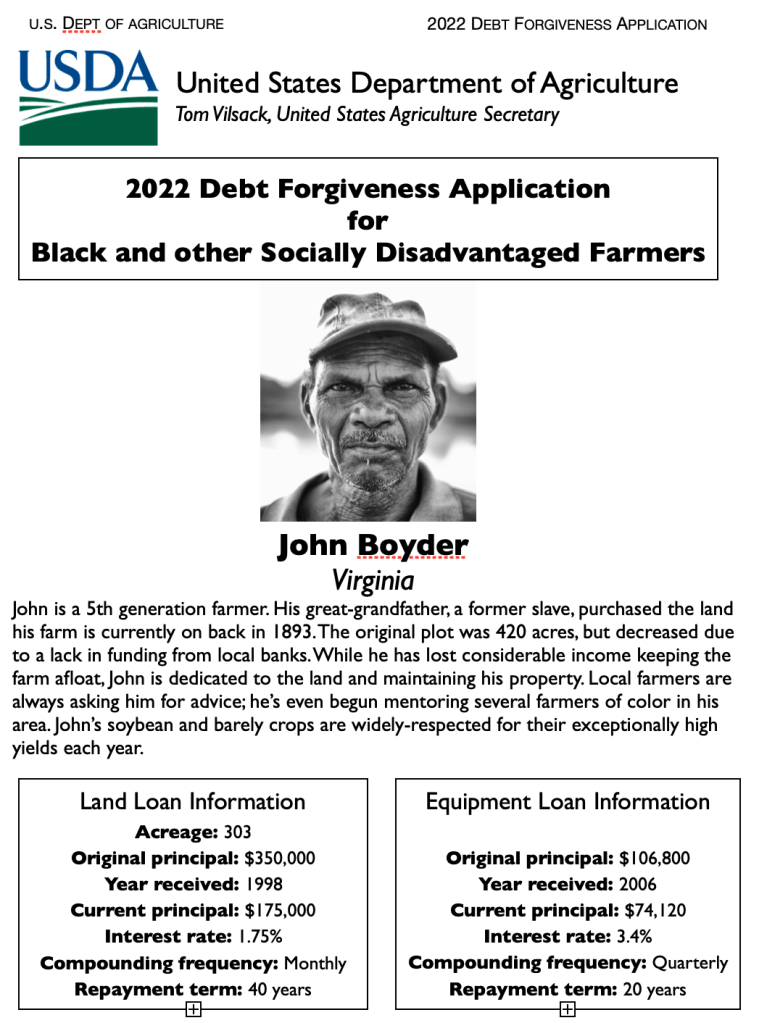
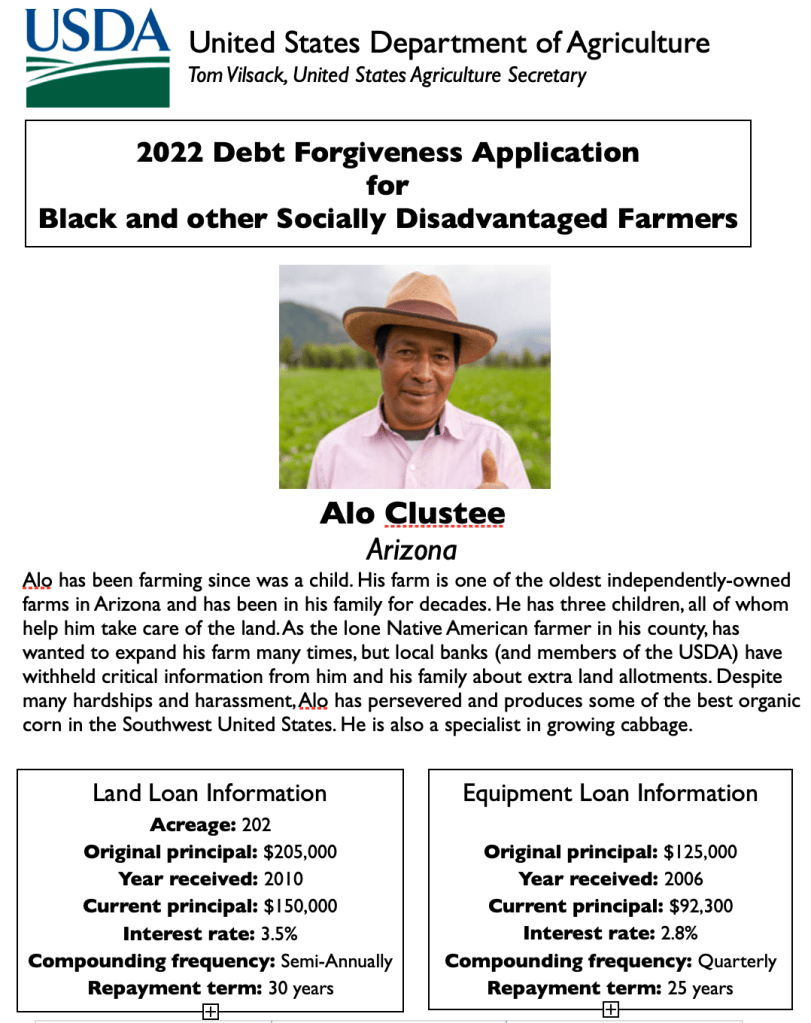
The farmers had been “invited” to Washington D.C. to complete a USDA debt-relief application. I wore a suit and tie, just like Secretary Vilsak would, and explained everything to them on day 1, which included summarizing several recent NYTimes articles on the issue and showing a video from ABC News. Groups of 3-4 students were assigned to one of seven fictional farmers of color. To get to know each other and add context, each farmer read their profile out loud to the class right before they started their applications.

I allotted a week for the students/farmers to complete their debt-relief application. The application itself hinged on what we’ve learned about compound interest and exponential regressions, but I also mixed in average rate of change. I owe the math department at my school lots of credit for helping me get all the math straightened out!

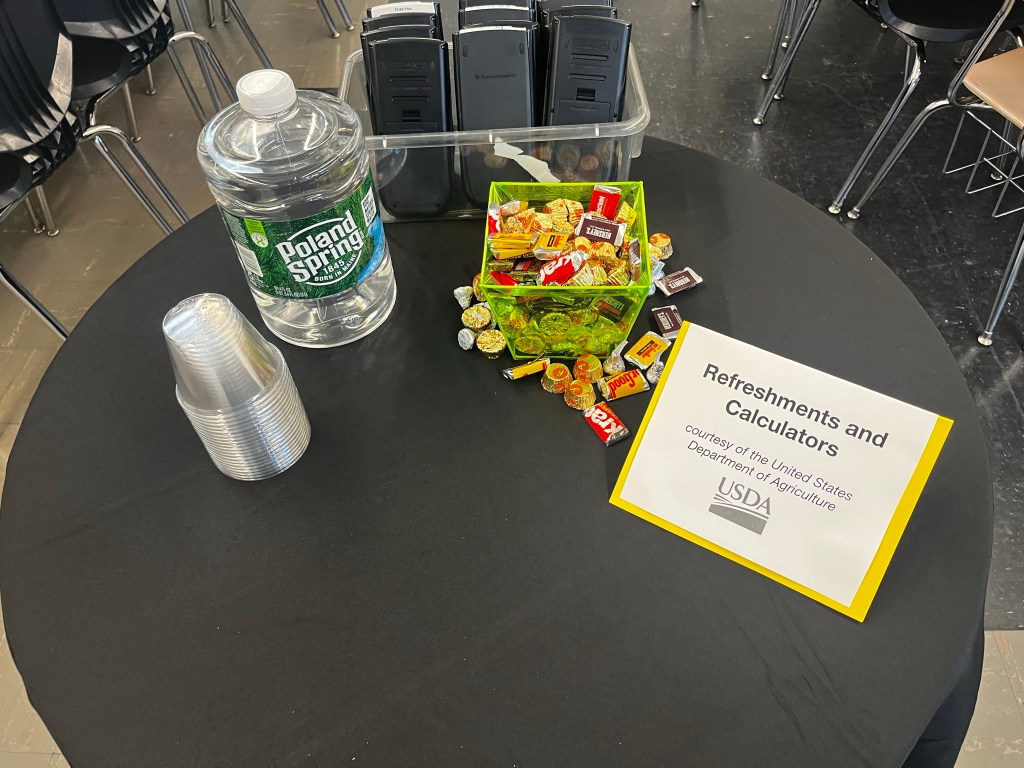
Embracing the performative nature of the activity, I asked the farmers/students to wear name tags each day and added a refreshments table that I kept stocked throughout the week with snacks and water.

Name tags that my students wore each day to identify them as one of seven fictional farmers of color
My USDA refreshments table, positioned in the middle of the room

In the end, the activity worked out pretty much how I envisioned it. The students/farmers spent a solid four days working through the application. As they worked, I walked around with an “APPROVED ✅” stamp to certify the various parts of their application as they got them correct. It felt official! The fifth and final day took on a more casual, celebratory tone, which included me giving each farmer/student a laminated check in the amount of their outstanding loan balances that they computed in their application. This was the cherry on top.

Laminated checks that each of my students/farmers received when they completed their debt-relief application

The only part that didn’t work out as I had planned was the final act: watching I’m Just a Layman in Pursuit of Justice: Black Farmers Fight Against the USDA. We watched 10 minutes of it on day 4 and another 30 minutes a week later on the day before spring break, but I wish the film could have played a bigger role in our work. This was bittersweet. Next year, I hope we can watch (at least portions) of the film earlier in order to bring in details of the featured farmers into the problems. This way, the film can be an integral part of the activity instead of a supplement. A huge shoutout goes out to filmmakers Shoun A. White and Waymon Hinson for giving me access to the film. It is awesome and speaks directly to the activity.

The complete set of handouts can be found here.

The feedback
On the last day of the activity (today), I gathered the students together for one last cogen to reflect on it. Excluding my regular cogen who also helped me reflect on it, I met with a total of 9 students in two separate groups. All but one of the original 10 students were able to make it. Below is a synthesis of the students’ feedback from the cogen and a whole class survey I gave on day 5.

  • The group work worked. The students appreciated the size of the groups and how each group (and group member) werey all working on the same thing. My frequent check-ins and small group instruction enabled students to get their questions answered and helped keep their learning flowing. This made everything go better.
  • There was a nice balance between math and social justice. Both during the cogen and in the survey, the students reported that the math and social issue complemented each other well; each section of the application revealed a different aspect of the injustice and paired it with a different math concept. Several students said that they liked the variety of math topics the application required. Interestingly, one student told me that there was more math than she expected going in and that she appreciated this.
  • Isolating race allowed for a better understanding of the discrimination farmers faced. Students mentioned that because their Geometry project on farmers focused on so many factors (race, gender, education level, marital status, etc.), it become overly complicated and eventually took away from their understanding of the mistreatment of socially disadvantaged farmers. Because this activity took a simpler approach, students felt they learned more about the issue. Just 52% of students reported a connection between this activity and that one.
  • Choosing an alternative launching-off point was effective. Initially, I was going to use the Geometry project as a starting point for this activity (vertical alignment, yay!), but decided against it after the first cogen in the series. For these students (next year might be different), I’m convinced that this made a huge difference in how it landed with them. On day 5, when I did bring up what they did in Geometry, there were groans.
  • Role playing sparked joy and increased engagement. The lack of excitement during my second cogen caused me to find a dramatically new way of framing the activity: role playing. And it paid off! The students loved “being” the farmers and getting their loans paid off. Refreshingly, the cogen students sighed and grumbled when thinking about partaking in this activity any other way.
  • Students had a strong understanding of the mathematics and systemic discrimination in the farming industry. Before the activity, students feared that not knowing the math would prevent them from engaging with the social issue in a meaningful way. Both during the cogen and on the survey, students reported high levels of understanding of the math and the inequitable treatment of the farmers of color. Quiz scores on day 5 confirmed this. Teaching the required mathematics before starting the activity (as was recommended in the first cogen) was an important factor.
  • The problems could have been more clearly written. Students felt that several of the problems should be revised to elicit a clearer pathway of what they needed to do mathematically. Though the mathematics wasn’t new to them, it wasn’t clear when and how they had to apply it to the problems. The small group instruction helped me get over this hurdle, but students recommended doing an opening example at the start of class also.
  • Studying the farmers was worthwhile. Overwhelmingly, the students felt that studying the farmers in this way was an interesting and worthwhile use of class time. This was a pleasant surprise as I had serious concerns about the relevance the activity would have to urban youth. To elevate the activity and make it more relevant, one cogen student suggested that I find a local issue and integrate it with the farmers.

The takeaways

  1. Curriculum change. Over the course of my career, I’ve tried to tackle issues of race, gender, and other forms of discrimination in several ways, but I’ve always failed at interrogating and modifying my curriculum. As the bedrock of my instruction, it has been the hardest to modify. How could I teach to the Regents and make the curriculum antiracist? This activity was a personal challenge to find that intersection and one of the biggest reasons why its success is so important for my growth as an educator.
  2. Cultivating Genius. Gholdy Muhammad’s equity framework, as detailed in her book Cultivating Genius, was a driving force in how I designed this activity. Considering I never did it before, working through and applying the five pursuits of her framework, Identity, Skills, Intellect, Criticality, and Joy, was extremely valuable. My reflections on this dimension of the assignment deserve a separate post, which I hope to write soon.
  3. Cogen impact. I knew the cogens would be important to the development of the activity, but I think I underestimated how much I would need them. The students provided guidance both by what they said and what they didn’t say. Employing cogens in this context (before and after a particular lesson/activity) provided me with another model for how they can used to improve the classroom.
  4. Personal learning. I didn’t feel comfortable engaging with the systemic mistreatment of farmers of color without doing mounds of research beforehand. Like, a lot. Naturally, I learned so much about the issue. In this way, my students and I were at the edge of knowledge together for this activity. How refreshing.
  5. Simulating Justice. When my planning began, I saw this activity as being entirely informative. I wanted it to expose my students (and our school community) to a particular form of inequity. As my planning unfolded, however, my stance changed to be oriented more around justice. Instead of simply uncovering systemic racism, I wanted the activity to simulate justice and fairness. Though it transpired in a small corner of the universe located in a humble school in the Bronx, I wanted the activity to honor the love that farmers of color have for the land. Above all else, it had to celebrate their agricultural excellence and perseverance.

bp

Meditations on a Cogen (No. 22) • Thursday, April 7, 2022

During the 2021-22 school year, I’m having weekly co-generative dialogues (or cogens) with my students. In an effort to help me process these talks and document progress, I summarize and write reflections after each cogen. This is the 22nd post in the series.

Two Additions
Two new members (one from period 1 and one from period 3) join today and complete cohort 4. The group feels complete. I give my opening spiel to the new members, get them caught up on what we discussed last week, and then jump right in.

Reflections on the farmers
This week I ran an activity celebrating farmers of color and exploring the injustices they’ve faced for generations in our country. The activity hinged on compound interest, average rate of change, and exponential regression. I have had a series of separate cogens (here and here) dedicated to its analysis and development, but I want to make space for my regular cogen to reflect on it. I open the floor.

Overall, the students liked the activity a lot. They appreciated the effort I put into its design and the role-playing aspect that it had. It afforded them an opportunity to study a “real world” application and issue. They also liked working in groups and how the group work was structured. The “we liked working in groups” comment caught me off-guard because I don’t think I did anything special with its structure, but I’ll happily take the positive feedback.

Interestingly, two weeks ago, when I was still planning the activity, I showed it to one of the cogen students and she flat out told me that it sounded boring. Today, during our talk, she admitted that she had fun doing it. After she says this, I get all excited and immediately pivot away from her to ask the group about being urban youth studying the farming industry. Looking back, this was a missed opportunity to ask her why her feelings about the activity changed. (I didn’t realize this misstep until after post-cogen when I listened to the recording of our talk. Even worse: I think she was in the midst of explaining why when I cut her off.)

I rush to ask the group about it because, living in New York City, farming isn’t exactly the most relevant issue for my students. In fact, this dichotomy gave me pause while planning it and made me second guess if I even wanted to do it. If I wanted to study social justice, couldn’t I find a more meaningful issue?

We discuss this. One student confirms my suspicions and says that she would have preferred to study a subject more relevant to her life, perhaps something job-related. But three other students offer alternative perspectives, saying they thought the topic was interesting. One says that because she knows nothing about farming and the systemic discrimination that farmers of color have faced, the activity helped expose her to a world she would have otherwise not known about. Another student comments that he actually has ancestors who were farmers and that he was able to draw parallels between his family and those I featured in the activity.

Next, the students give me some feedback on the mathematics of the activity. They explain how the math got more challenging the deeper we got into the activity, but they were OK with the gradual increase in difficulty, especially since I was walking around helping them and they had their groups to rely on. They point out that some of the farm-related vocabulary in the problems (e.g. yield, acreage) made it hard to get to the math.

They offer up several suggestions to improve the activity for next year. First, I should open each day with a brief mini-lesson overviewing some aspects of what students will encounter that day. Ideally, the mini-lesson would include me showing them an example (or, even better, a worked example) using farming terminology. I made one attempt at this over the course of the four days, but my timing of it was off by two days. I definitely see opportunities for more modeling next year. They also offer a sensible recommendation that I condense the average rate of change part of the activity, which got redundant. Since the activity had four sections, one student wonders whether each day could correspond to a different section (I took an asynchronous approach this week). This could help everyone be on the same page and subsequently help with understanding the math. To help students who don’t complete a particular day’s section, I could post a short video that students must watch before coming to class the next day.

The dialogue is flowing and before I know it, it’s 3:10pm. My last question concerns tomorrow. Do they want to watch a documentary on Black farmers and their struggle with the USDA or be given more time to complete the last section of the activity (instead of doing it on their own)? They unanimously vote for more time. That was an easy decision.

Their feedback carries me over the time I wanted to allot to reflecting on the activity, but I’m incredibly grateful for their suggestions.

Our lesson
With the five minutes we have left, I want to update the kids on our lesson. Last week I promised to identify a topic so we can begin brainstorming ideas for how the lesson would look. We don’t have time to brainstorm today, but I inform them of the topic: converting radicals to fractional exponents (and vice versa). We’re about 4-5 weeks out from learning it, so this will provide ample time for (a) me to teach it to the cogen students and (b) us to plan the lesson together. Coincidently, I have a short video clip of me overviewing the topic from remote learning. I ask the students to watch it before next week.

We’re off.

bp

Meditations on a Cogen (No. 21) • Thursday, March 31, 2022

During the 2021-22 school year, I’m having weekly co-generative dialogues (or cogens) with my students. In an effort to help me process these talks and document progress, I summarize and write reflections after each cogen. This is the 21st post in the series.

Cohort 4
My cogen didn’t meet last week because of parent-teacher conferences, so this week is the first official gathering of the new cohort. This was their first meeting together, so I provided reminders yesterday. Thankfully, they all remembered. One seat from period 3 is unfilled (with a prospect in sight) and one of my period 1 students couldn’t make it today because of an appointment. She ran up to me during lunch earlier today apologizing for not being able to make it, which was super kind of her — and reassuring.

Despite the many cogens I’ve held this year, transitions are always tricky. I remember the first cogen changeover back in November and the anxiety I felt back then. The cyclical question of “Will the new students care as much as the old ones?” hasn’t gone away each time new students rotate in. In this way, new cohort kickoffs have first-day-of-school vibes. The students may have heard of the cogen from other students, but do not arrive convinced of its value. Trust and community aren’t inherent; the conditions need to be created for students to buy into this unusual space. This newness is exciting, but it takes work to help it all come alive.

Post-exam
I drape the tablecloth over the table and dump snacks out. I have a few items on my mind, but, on a limb, I ask the students about this week’s exam. It was yesterday. I haven’t finished grading them all yet, but I’m interested in how it went for them. This unexpectedly takes up the bulk of our time together.

Three of the students admit struggling, but the general consensus is that the exam was fair. One aspect of a problem on writing exponential functions using two points is criticized by the group because we only indirectly discussed it during class. I appreciated their honesty, because they’re right. When I probe students about their struggles, we get to talking about pre-exam review. What advice can they give me to help them feel better prepared for exams?

We first chat about about how I’ve used stations to review for the last few exams. The “review” has coincided with the end of problem set, so it hasn’t felt like review per se to me, but I think that’s how students viewed it. Each station was based on a different topic and equipped with dry erase sheet protectors for students to practice some given problems. A couple of cogen students refer to their chemistry teacher when they recommend that, instead of using stations, I create a review worksheet and dedicate the day before the exam to studying it in groups. In other words, instead of having stations with dry-erase practice, why not create a more permanent solution that students can study even after they leave class? They also recommend that I remain stationary during the review and allow students to come to me.

I’m on board with their recommendations and promise to try this strategy when our next exam rolls around. I do cringe a little inside when thinking about a review sheets and review days, however. In the name of the cogen, I’ll get over my discomfort. Perhaps there’s a way to remix the review sheet with the cogen’s help?

Coteaching
We shift gears and bring up the lessons that the last two cogen cohorts have taught (Bingo and Infinite Levels). What does this group want to do?

It’s an broad question and they hesitant to jump in. Sharing some personal reflections, I recommend that they teach a content-based lesson. The prior two lessons were based in a game, which is fine, but it would be interesting to try something new. Imagining I would use cogen time teach them an Algebra 2 topic first, I inform them we would then co-plan and co-teach a lesson about that topic to the whole class. The kids like the idea. They nod when I acknowledge that students have ways of explaining ideas and helping other students understand that teachers can’t match and this lesson could be a perfect illustration of that. One student sees us turning the lesson into a type of comedy show and using kids names in the problems. We end the preliminary discussion with excitement. I tell them that by next week I hope to have a topic identified.

Seating
With about 5 minutes remaining, I open up talk on another issue that may potentially be addressed by this cohort: seating arrangements. Since I can remember, I have been using a deck of cards to assign weekly, visibly-random groups. When students walk into class on Monday, I wait at the door with the deck spread out in my hands. They pick a card and each suit corresponds to a group. They can sit anywhere in the group, but have to be in that group all week. The next Monday we do it all over again. There’s a ton of reasons why I like this approach to seating, but I’ve been doing it so long that it seems natural to try something new — especially now that I have the cogen to help me think through it.

I ask the students how they feel about the random random groups, and they don’t feel strongly one way or another. They express concern about sitting with people they don’t know and I say that’s one of the chief reasons why I do it. I wonder out loud whether they could help me brainstorm a new way to seat the class. After just talking about lesson, we mention using the lesson as a vehicle to experiment with a new seating strategy. They appreciate this.

(After our cogen today, I search my blog and remember that I used to use four quadrants to assign seats.)

bp

Cogens for Social Justice • Part 2

This is the second post of a four-part series where I explore planning and implementing a social justice-themed activity in Algebra 2. In addition to traditional collaboration with colleagues, my use of three cogenerative dialogues to develop and reflect on the activity were critical to its design and execution.

Part 2: Planning and Revision

Research
The last several weeks have been a wild ride. After my preplanning cogen with the students a month ago, I was encouraged by the feedback they gave me, but I still didn’t know what social issue I was going to explore using compound interest. Were my students doing to study the experiences of Black farmers? Or were they going to learn about predatory lending?

I do some research. PayDay loans companies aren’t new, so looking into them turned into a rabbit hole pretty fast. John Oliver’s hilarious take provided a great start. It didn’t take long to find prepackaged ways to help students learn about their outrageous interest rates (examples: here and here). Turning to the farmers, I reread the article in the NYTimes that originally put me on to bank lobbyists’ efforts to block the $4 billion debt relief plan that’s part of the American Rescue Act. I saw this article as the launching point; I envisioned students studying farmer’s loans and interest rates and how much money the banks would lose to do right by the farmers. I hope to relate it to the promise of “40 acres and a mule” and what that land might be worth today.

After spending a couple weeks looking into both issues, I was torn. Both could evoke worthwhile discussions and expose discrimination. Both were interesting — I was learning a lot! But I couldn’t spend all my time reading articles and watching YouTube videos. I needed to make a decision and commit.

In the end, I went with the farmers. The vertical alignment with my Geoomery colleague — who also studied injustice in the farming industry — was simply irresistable. Plus, my reading allowed me to dive deep into a part of our country’s history that I knew nothing about. I wanted to know more; designing the project would satisfy my learning needs, too.

The activity
I figured the activity would span a week at most. Using student feedback, I would teach compound interest for two days up front. Then, on day 3, the farming industry would be introduced by showing students a video from ABC News and reading, as a class, the Times article about the bank lobbyists.

Students would then work through a series of problems based on seven fictional farmers of color that currently have outstanding balances on their loans. I included photos and wrote personal narratives of the farmers to humanize them. I wanted to capture their passion for farming and love for the land, but also the historical context of the racism and discrimination they and their families have faced. All of the details are based on actual farmers I came across in my readings. Included in each farmer’s profile is info about their land and loan.

A few farmer profiles that I created to illustrate their love for farming, but also the inequality experienced

Originally, I wanted the mathematics was to focus on strictly on compound interest related to the farmer’s loans. As I gained momentum in my planning, that quickly flew out the window. I created problems that brought in average rate of change, exponential functions, and profit functions, too. Here are a few.

Meeting with students
I wasn’t finished writing up the activity when I asked the students to meet with me for our 2nd cogen. I wanted to present them with what I came up with and hear their thoughts. A few students couldn’t make it, but I still was able to meet with 6 of the original 9 during a lunch cogen.

We opened with me reminding them of the feedback they gave me at our initial meeting. As I described the activity and gave them the handouts to look over, I explained how their feedback was used in my planning. One of the first questions from the group was, “Mister, how long is this going be?” After I said “probably 4-5 days,” the students sighed in relief. They were fine with the activity, but didn’t want it to drag on; they had bad memories from the Geometry project that extended past their comfort zone. That said, they saw the alignment with the Geometry project, which was good. The students also wondered about how they were going to be graded. They preferred credit for effort and group work and I told them about the need for a 1-2 problem quiz every couple of days. They recommended that I utilize an answer key for groups to check their work as they progress through the activity.

Near the end of the cogen, I admitted my skepticism about studying farmers. Reminder: we live in New York City! I’m concerned that my students’ disconnect from farms could lead to disengagement. To this point, one student playfully suggested that I take them to a farm. We laughed. I can’t do that, but I did mention that I am in communication with Shoun Hill, co-writer and director of the documentary I’m Just a Layman in Pursuit of Justice: Black Farmers Fight Against the USDA, about guest speaking with us via Zoom at the end of the activity. Before his visit I want us to watch at least part of the film in class. The students liked this.

Post-cogen revisions
After the students left, I spent the next several hours thinking deeply about how our conversation went. I couldn’t place it, but something didn’t feel right. The students engaged with me, asked questions, and offered suggestions, but there was still something missing.

Adding to my uncertainty was a comment from one of the students later in the day. We were in class and I thanked her in private for her time at the cogen. She smiled and politely said that learning about farmers wasn’t interesting to her in the least bit, she just didn’t feel comfortable mentioning it front of the whole group. “Why can’t math class just be about math?,” she asked.

Upon reflection, I think my biggest takeaway from the cogen wasn’t anything the students said. Instead, it was what they didn’t say. The students had an indifferent reaction to the activity and our cogen took on an apathetic mood as a result. That was the real feedback: their lack of excitement. Even for the young lady who admitted that she wasn’t interested in farmers, I believe her concerns were rooted in how utterly boring the activity was. All of my well-intentioned research and planning generated little anticipatory energy amongst the students. What was that something that was missing? Gholdy Muhammad would call it joy, a critical element of her five pursuits.

This was bothersome and I went to work to find some way to help my students experience joy in the activity. What could I do that would excite them? Given a foundational aspect of the activity was using math to expose systemic racism, I knew that encountering joy in the content would be a stretch. Could I instead elicit joy through the learning process?

Then it hit me: make it an immersive experience. Instead of having students study the farmers, why can’t they be the farmers? This question caused me to reimagine everything. Here’s what I came up with.

The activity is no longer an exploration of the discrimination farmers of color have faced; it’s now the process of completing a debt-forgiveness application with the USDA. As my students walk in the door on day 1 of the activity, they’re going to be transported to Washington D.C. I will welcome them wearing a suit and tie and give them a nametag with a farmer’s name on it (3-4 students will “be” the same farmer, i.e., be in the same group). I’m going to be Tom Vilsack, the U.S. Secretary of Agriculture, and also will wear a nametag.

In accordance with the American Rescue Act, I’ve invited them here to pay off their farm-related debts — given they complete the application correctly. The students/farmers, of course, will be highly confused, and that’s when I’ll start providing the historical context and significance of our gathering. And I will be a gracious host: there will be light refreshments and snacks out on the tables when the students/farmers arrive. I’m going all in!

The inside cover of the “application” my students will complete

And what will the application consist of? The original problems, of course! It’ll take some reconfiguring, but I’ll use the problems to distinguish the different “sections” of the application. Each farmer’s application will be personalized with their info.

An example “application” cover page. It displays the personal narrative and farm/loan info.

As the students/farmers complete their applications over 2-3 days, I will check work and hand out checks in the amount of their outstanding balances.

This all sounds way more fun and engaging than what I had before. Will it spark joy in my students? I hope so!

bp