A month into the school year, a lot has happened. There are new students, new colleagues, new goals. Exciting instructional routines are finding their way into my practice. My curriculum is getting a facelift. There is a familiar and hopeful energy throughout the school.
Despite all that the new year has brought with it, there is one thing that is noticeably absent for me: remote learning. Yes, remote learning. This might seem strange to say, but hear me out.
Despite being two years removed from teaching from my laptop during the 2020-21 school year, remote learning haunted me for a long time. At first, it was the occasional Zoom call after in-person learning resumed. Forgetting to unmute myself or open up breakout rooms while facilitating PD were flashbacks to dark times. Then there was the fear that the school was going to shut down again every time someone coughed. And something in me also flinched every time the whole school got rapid COVID tests.
Interestingly, the more lasting and more prominent reminder of remote learning came from students. Up until this past June, I would see students from the 2020-21 school year everywhere. They’d be in the hallways, at after-school events, and even in my classroom. They were all around me, forcing me to remember a time I wanted to forget.
None of them were my students anymore, but the flashbacks still flooded back to me. I recalled distant interactions we had during office hours and breakout rooms that left me aching for more. It felt silly, but I still called out virtual handshakes to many of these students when we passed in the hallway at school. Sadly, there were others who I still didn’t recognize because I never saw them before.
Rarely would I approach these students about our time together during that dreadful year on Zoom. It didn’t feel right to dig up the past with them. I personally relived it most times I saw them, but that was my cross to bear. Although my former students were always friendly when we crossed paths, my flashbacks were not. Remote learning mocked me through their smiling faces.
But in June, I gained closure. These students graduated. With their moving on to bigger and better things, the most potent remnant of remote learning could finally be put to rest. During their ceremony, while I looked out at all of their beaming faces in their caps and gowns, I remember thinking that two commencements were happening that day. The first was my students’ graduation from high school. The other was my moving on from remote learning.
In the years ahead, there will always be something that crops up to remind me of that horrible time in my career, but at least now it’s not everywhere I turn. I miss many of those students. They were great kids whose education was turned upside down by a pandemic. They personified resilience. While I will miss them, I’m grateful not to have those unwanted reminders surrounding me anymore. I am carrying less baggage this year and I am enjoying it.
Each school year, I push myself to change or improve one thing about my practice. There’s a lot to be better at each year, and I’m always tinkering with small parts of my teaching, but I try to make my “one thing” something broad with high-impact. A couple years ago, for example, I focused on implementing weekly cogenerative dialogues. And last year, I put considerable effort into changing my classroom environment.
This year, my one thing is to hold one-on-one conferences with students during class.
To type that sentence gives me pause. In the past, planning instruction to build in time to meet with 25 individual students regularly seemed wild. Impossible even. Like any teacher, I know the value of connecting with my students one-on-one when it comes to student attitudes and outcomes. But fitting in time for 1-1 conferences is a huge mountain to climb. Every other teacher I speak to understands this.
While conferencing with students still seems aggressive, it doesn’t feel far-fetched to me this year. I’ve aged enough that the classroom blitz has slowed down enough to enable me to make time for this practice. It also helps that a few years ago an amazing colleague modeled 1-1 conferences for me. She wasn’t teaching math, but we shared a room, and I witnessed her magic. It blew my mind how she shared all these quiet moments with every student right in the middle of class. She made me a believer that these types of check-ins were possible.
I’m talking a big game, but there’s still a lot I’m unsure about with how my conferences will look. I don’t know! Some ideas:
Each conference would occur during class and last no longer than five minutes. Because things happen, I need to be open to fitting in an occasional conference during a student’s lunch or free period.
I will conference with every student, not just those who are struggling.
I hope to meet with each student at least twice a marking period (our marking periods are six weeks long).
I want to post the conference schedule in the room. Each student will be assigned a day of the week so they know their meeting time.
Scribble a few notes during and after each conference to help document what we discuss and any next steps we agree upon.
Come up with a catchy name for the conferences. “Pausing with Palacios” comes to mind.
My dream is that over time these conferences become essential to my classroom culture, similar to how cogens have. I hope they can support my students and help them build momentum throughout the year.
With any change, there will be sacrifices. By holding 1-1 conferences, I will undoubtedly be less present during whole class and small group instruction. I’ll somehow have to adjust my pedagogy to make up for that. Providing more scaffolds and relying more on students to lead will be a huge part of the work.
This was the first year creating a book with my students didn’t feel like a complete novelty. In the previous three years, our books generated an “I can’t believe this is happening” feeling within me. The process was mostly surreal. This year, while I still had to pinch myself at times, my emotions were rooted in a feeling of “This is what we do.” The book has become part of the fabric of my class, an expectation to be met.
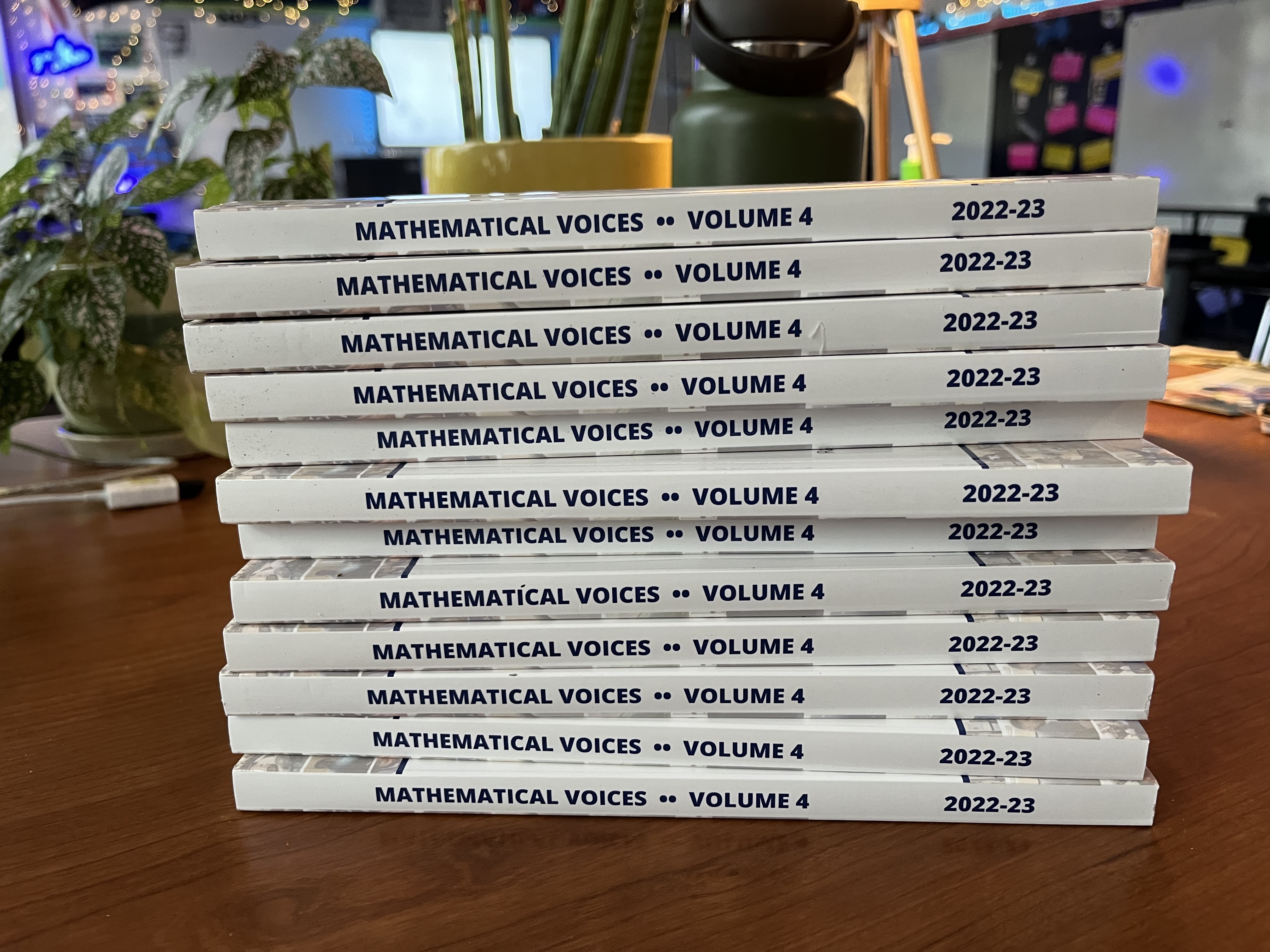
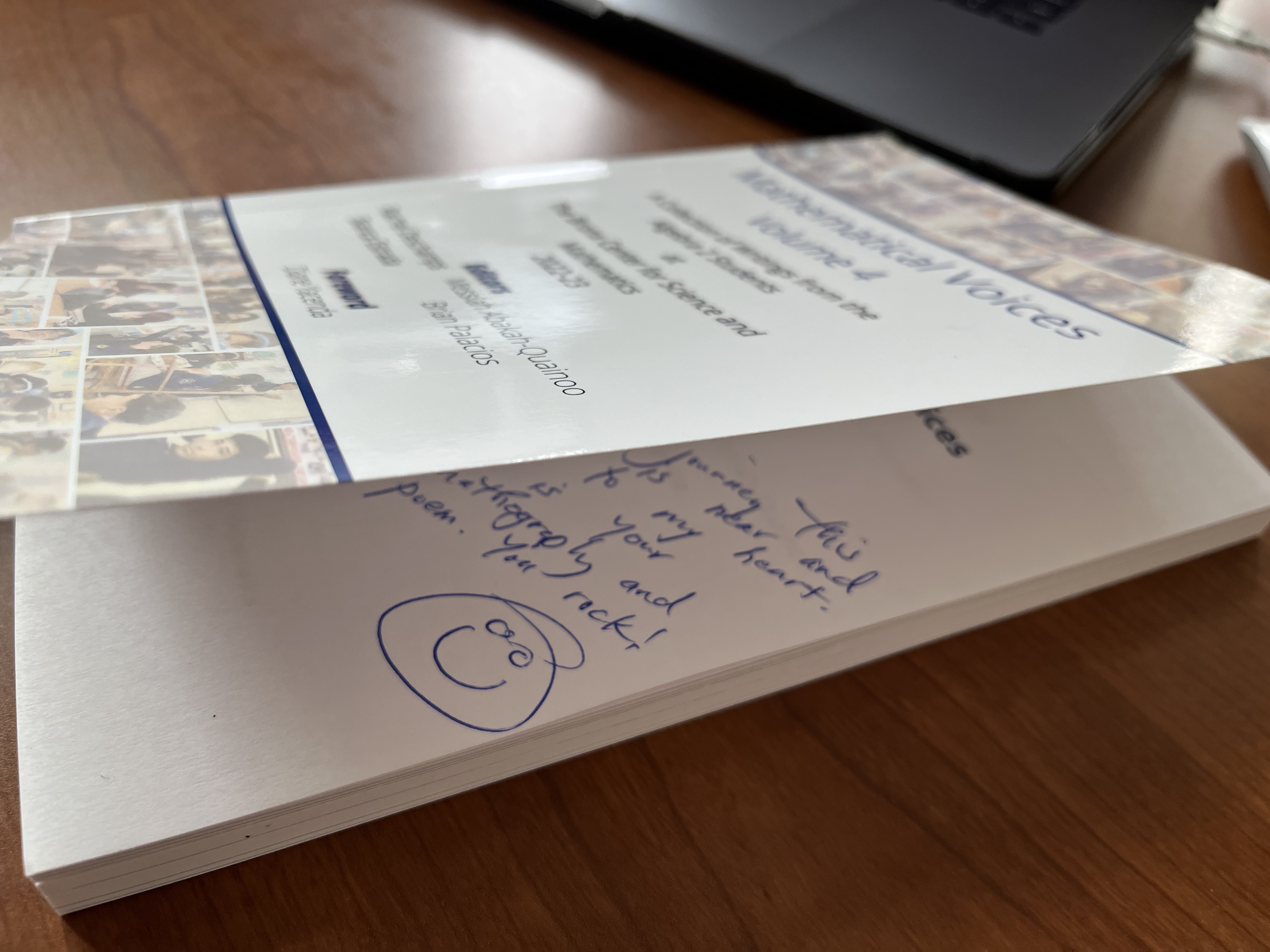
Thus, Mathematical Voices, Volume 4 continues the tradition of amplifying my students’ voices and telling the story of our school year. No doubt, it’s a complex story to tell. Not only does it play out over the course of 10 months, but there are many twists, turns, and unexpected events along the way. When immersed in a world of bettering oneself, like we are in a school setting, the human condition never fails to reveal itself. The people are complicated, the plot unpredictable. There is struggle and triumph. Joy and pain. Conflict and community.
Volume 4, like all volumes that came before it, audaciously showcases my students and their mathematical selves. Produced within a mile-high bureaucracy teetering to make sense of itself, this tiny book makes space for our greatest, most overlooked asset: students. They are the most precious and dynamic part of the story, but too often get reduced to Student IDs and test scores.
But Mathematical Voices pushes back. It boldly reveals the sweeping world of mathematics through the unique standpoint of 59 brilliant high school students in the Bronx. It tells of their pasts, presents, and futures. It highlights their ability to see and do mathematics in practical and ingenious ways. It’s personal and reflective. It shows how mathematics, often considered rigid and unmoving, can indeed be generative, lively, and fun when placed into the well-equipped hands of young people. Given an Algebra 2 curriculum that prioritizes facts and figures, Mathematical Voices proves that it is stories that matter, not statistics.
Volume 4 is the most voluminous iteration of Mathematical Voices to date, and our sum is richer and more representative as a result. All but four of the students who appear on my Regents-bound roster are present. Half have at least two pieces in this collection, and 9 students have three. One student, Genelly Liberato Gomez, has an unprecedented four pieces of writing. I’m proud that my students’ voices are louder and more vibrant than ever before.
For the second year in a row, I co-edited the Mathematical Voices with students. Its growth this year can be directly attributed to them. With their vision and willingness to read, select, and edit mounds of their peers’ writing, these young people ensured that Volume 4 was the biggest, baddest, and boldest version of itself. They are evidence that teachers must stop and take heed from students if they hope to accomplish anything worthwhile. Working alongside them gives me hope that teachers can persist in challenging traditional power dynamics and be more welcoming of the inherent gifts that students bring to our classrooms.
Vital to any story is its setting. This is why one of my favorite parts of Volume 4 — and the biggest change from earlier editions — is the many photos that can be found throughout the book. Most of these shots were taken unprompted throughout the year, giving readers visual context for what it was like to be in our class this year. The photos showcase our class culture and the conditions under which students’ writing developed. Several students from my classes served as class photographers. The photos are their observations of our time together.
In addition to establishing the setting of our story, the editing team also knew that the photos would be an important upgrade from previous editions of Mathematical Voices because of how they humanize the book and its authors. By pairing each piece of writing with a photograph of the author, we hope that readers can appreciate the author’s message even more. Interestingly, Volume 4 feels like an extension of our classroom since hundreds of these photos were printed and posted on the walls of room 227. The room experienced a renaissance this year, welcoming lounge chairs, whiteboard tables, relaxed lighting, surround sound, overhead space, calming scents, and even a sofa into the room. Of all the improvements, the photos were a defining element and what made being in the room every day so special. It was an unforgettable collage of mathematical humanity and community that manifested itself over the course of the school year. It was our story through photographs. I’m thankful that it lives on in Volume 4.
The relationships I build with students come and go. Students arrive abruptly in September and exit just as quickly in June. Our time together is temporary, a blimp on a timeline. It’s the nature of the work. For my students, I’m one teacher in a long line of many. A smiling face with good intentions and a lesson plan. Other, more capable teachers will come around in the years ahead and push the memory of me and our class to the background. To no fault of our own, our relationships will fade. We’ll move on. We must.
But though relationships fade, stories endure. They transcend time and space. They outlive school years and school buildings. Stories bottle up the moments, thoughts, feelings, and relationships that time steals away. Stories help us remember. The good ones want to be retold.
As mighty as it is, Mathematical Voices Volume 4 fails to tell the complete story of the Algebra 2 students during the 2022-23 school year. Teaching and learning are far too complex, and the book simply isn’t long enough. Despite this shortcoming, Volume 4 still does a wonderful job of preserving an important part of our story and gives it a chance to be told again, even if it is just to ourselves. It safeguards my students and our classroom community against the calamities of time and forgetfulness. This is why, through the years, Mathematical Voices has become so important to me.
My students and I will exist on those pages forever. Our story will wait resolutely for the next person to pick it up and discover (or rediscover) who we were and what we were about. I can think of no higher honor to offer my students.
As a teacher, to live on beside them in this way is the greatest privilege. No accolades or professional recognitions can compare to sharing space with my students on these pages. It’s a teacher’s dream. For their writings about mathematics reveal not only their world, but mine as well.
When last school year was ending, my students and I memorialized our time together with a piece of a broken chair. It was a keepsake. The chair came apart on one of the last days of the school and symbolized our long-awaited return to in-person learning. (Not because it came apart, but because it was a classroom chair, something we couldn’t use during remote learning.) All my students signed it. It’s been hanging in my room ever since.
In the final weeks of this school year, I started thinking about another keepsake. What physical object could symbolize our time together as a class? It had to be representative of the year, and my students had to be able to sign it. It also needed to be something I could take with me no matter where I teach.
With the help of a student, my search didn’t take long. The trademark of this year was the physical transformation of our classroom. To see it take shape piece-by-piece was special. Practically every day something new was introduced to the space, most of which came from the students themselves. Given all the interesting and varied objects that contributed to the room’s evolution, probably the most unique part was the sofa. It was brought in at the start of the spring semester. Not only did it provide comfort, but it gave the room a distinctive look and feel. I mean, how many classrooms have a sofa?
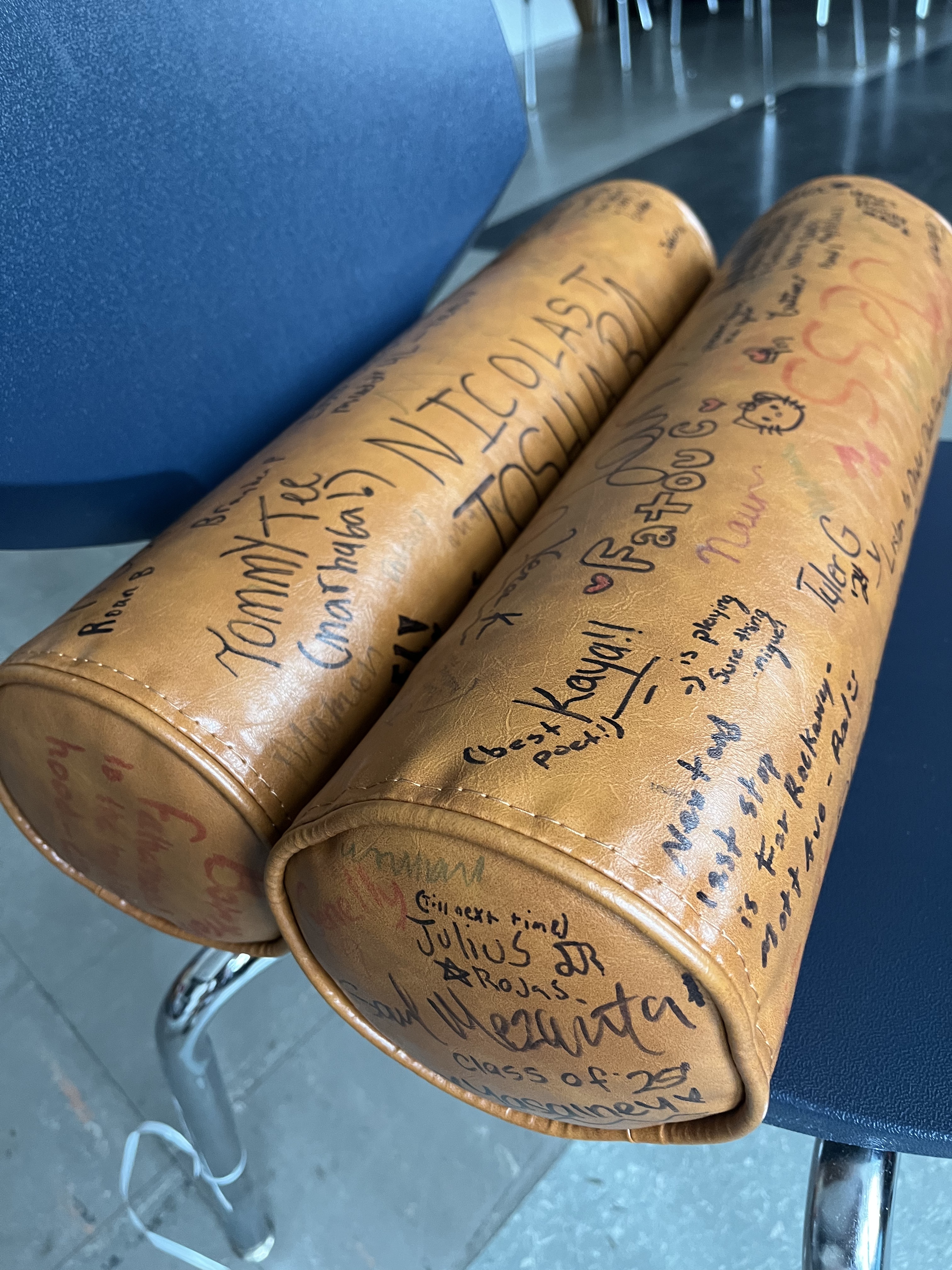
The sofa came with a pair of cylindrical pillows. They were decorative, vinyl, and totally signable. Our keepsake our born.
I don’t know if I’ll ever have a sofa in my room again, but I know I’ll have these pillows. I’ll display them with pride in the years that come. They will be a physical reminder of the students I taught in a classroom that experienced as much growth and transformation as those who inhabited it. The pillows are a relic of a classroom community that represented an important phase of my career. It was a phase that proved to me that the physical surroundings of a classroom deserve as much attention as the mental and emotional dimensions I care so much about.


 lazy 0ch0