Exploring the roots of quadratic functions

In my algebra 2/trigonometry class, I wanted to spend a day with them exploring quadratic functions, their roots, factors, and how everything is related. This is taught in algebra 1, but the students always seem forget all this after geometry. It’s a perfect intro to our quadratics unit.

Part 1. Building off Dan Meyer’s approach to factoring trinomials, I first had the students find all values that make quadratic expressions equal to 0.

find values

Most found this straightforward and doable, which was great because that was the point: accessibility. The third expression had one non-integer value as an answer, which I included on purpose to throw them off. A couple kids actually factored and used the zero-product property, which was ahead of the game…they actually remembered something from algebra 1!

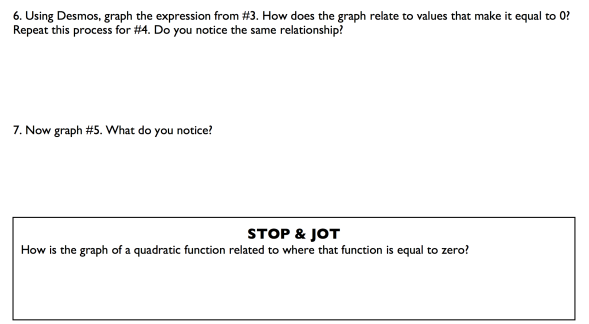
Part 2. I had them use Desmos to examine the graphs of the three functions and find a relationship between the graphs and the values they found that made each equal 0. It took several minutes, but there were definitely some ah-ha! moments when they saw the connection, which was cool.

Screen Shot 2015-12-02 at 4.35.50 PM

I then re-introduced them to be the term “roots” as a way of describing these magic numbers.

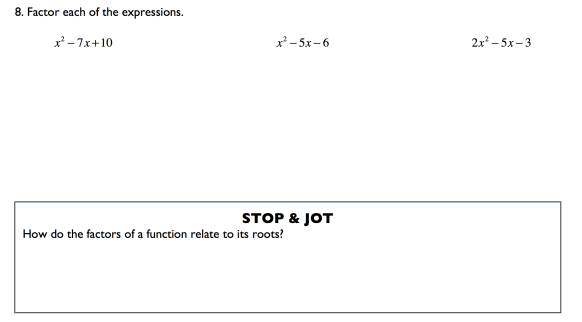
Part 3. I also wanted them explore the relationship between the factors and the roots. Because of time, we more or less did this together (instead of them working it out in groups). We first factored all the expressions. I then asked how the factors relate to the roots of each function. Most of the class realized that when each factor is set to 0, the roots result from these “mini” equations.

Screen Shot 2015-12-02 at 4.36.45 PM

Overall, the lesson was solid. I really liked that, other than imparting the term “root,” there was no need for me to lead any part of the lesson. I simply provided resources and asked the right questions that spurred deep thinking.

Exit slips showed their understanding of the connection between the roots and factors wasn’t strong. This was probably due to the fact that the lesson was a bit rushed at that point. The next lesson focuses strictly on finding roots by means of factoring quadratic equations, so hopefully that helps. I also felt the lesson flip-flopped around the term expression and function too much. Leaving the lesson, the difference between the two could have been unclear and may cause some confusion amongst the kiddos. Another thing I would have changed is not having all trinomials…the kids could possibly generalize that all quadratic functions are trinomials, which is obviously not true. Even if they don’t go that far, a variety quadratic functions still would have been better for them to explore.

Here is the document.


bp

New Desmos lesson(s)

Christopher's avatarOverthinking my teaching

You should seriously go check out Polygraph. Four versions of a delightful and challenging game:

  1. Lines
  2. Parabolas
  3. Rational functions
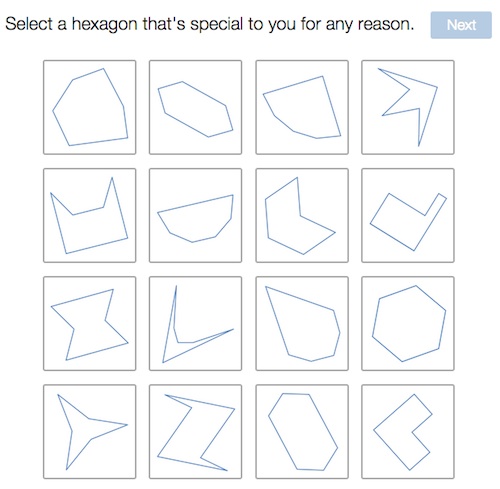
  4. Hexagons

The hexagons will be familiar to long-time readers of this blog.

Screen shot of hexagons

I have run the parabolas version in College Algebra, and the hexagons version in my Ed Tech course. It was a huge hit both times—lots of conversation happened both electronically and out loud in the classroom. It’s a ton of fun.

I am especially pleased with the rational functions version. It makes for challenging work—even among the mathematically astute Team Desmos in recent trial runs.

Read the Desmos blog post on the matter if you like.

View original post

The First Two Days

So the first two days of school year 2014-15 have now come and gone. Here’s what I did.

Day 1: I really try and get away from the whole class expectations, syllabus, parent information thing on the first day. I have never really liked it because I feel it doesn’t set the right tone for the classroom. First impressions are huge for students, so besides taking attendance and having whole group get-to-know you discussions, I decide to do some sort of fun competition on the first day. It usually is indirectly tied to math, but directly tied to problem solving. It helps set the tone for the year.

This year I did an activity that I experienced this past summer at a workshop. I don’t know the name, but I’ll describe it. If someone knows the name and has a link to it, please post it in a comment. I moved all my desks to the sides if the classroom and set up the chairs in two circles. Each circle had about 10-15 students. I gave one person in each circle a little ball and had them say their name and then throw it to a non-adjacent person in the circle. That person would then say their name and throw it to a different non-adjacent person. This continues until everyone has caught the ball. I point out that each student needs to remember who he/she threw the ball to. And herein lies the challenge: to repeat the same sequence as fast as possible while I time them. The only rule is that the sequence of how the ball travels must remain the same.

The hope is that each group finds an efficient way of getting the ball through the sequence of people. With a little bit of scaffolding, most groups throughout the day found a pretty good way of completing the task.

Day 2: This is when I hit the students with most of the expectations for my classroom. I discussed the grading policy, overall expectations, seating charts, and the like. I also introduced them to a couple of things that I absolutely love.

1. Math money. My students and I run a pretty robust classroom economy. I plan on posting about this eventually, but it includes students earning money and spending it on various things that I present to them. The kicker is that it also includes the student’s paying and filing taxes on their income. We also elect a class treasurer and the whole nine. The kids have a ball with this.

2. Friday letters. I got this idea from Rebecka at TMC14 and I am stoked about doing it this year. I’ll post about it in the coming weeks.

3. The impossible shot. This is just fun. I found this online this summer and thought it would be fun to implement in my classroom. I have a line on the floor on one side the room and I taped a box to the opposite wall close to the ceiling. One student per week will have a chance to make it. I’ve added a pretty sweet award to any student that can sink the shot, too. Talk about motivation! I allowed one student to take the shot and they were instantly hooked. (I also had several of my colleagues trying to make by the end of the day!)

Next year, I hope to be a little more “mathy” with first couple of days. Here’s a couple of ideas that I have found that I would like to try:

  1. #Mathis Tweet Strips
  2. Something with Tangrams or IQ Circles
  3. Lesson on fun facts about me and a “test” afterwards (from John Mahlstedt) (still not mathy, but really cool)
  4. There are others that I can’t find at the moment, but if I do, I will post them here…

Looking forward to an awesome year.


bp