We white teachers need to be better

I applaud the many rage-filled responses I’m hearing from white people — and white teachers specifically — about the injustices that surround the horrific murder of George Floyd. They’re appropriate and needed.

But I’m about to call out good-meaning white teachers across the country. This includes some of my closest colleagues — and myself.

As a white person in America right now, there is an expectation that I meet this moment with an empathic comment and open ears. It’s trendy. It’s what’s happening. I need to say things like, “Racism still exists, this is horrible” or “We white people must listen more.” If I don’t in some way affirm the rage that is sweeping across our nation, I’ll stick out like a sore thumb. So what do I do? As an educator with good intentions, I tweet about how upset I am and tell my friends and teacher colleagues how terrible this whole situation is. I donate money. I reply to emails expressing my support for a virtual Town Hall at my school. Although I may not have voluntarily brought up race with my students before, I acknowledge the validity the protests in my classes. I try to help students cope. This harrowing moment gives me the opportunity to talk about race openly and support anti-racist causes, and I jump all over it. I stand up for what’s right and make sure that others to see me standing up for what’s right. (For us white people, this last part is critical when it comes to race.)

The problem with all this well-timed rhetoric is that it’s too convenient for us white folks. Speaking out right now isn’t hard. Everyone is doing it so naturally we feel less vulnerable in doing it too. There’s little risk for us. We can be momentarily outraged, ask for deep reflection on the parts of ourselves and other white Americans, but our words and surface-level actions can be completely void of any deep introspection and ownership of our racist American culture and school system. Saying the right things right now means nothing for lasting change in ourselves and the implicit racism that we all carry with us.

While many of us of are engaged allies for our black and brown brothers and sisters, if yet another black man wasn’t killed in the midday sun by a white police officer, if there weren’t bold protests exerting their pressure on us to pay attention, if our white friends weren’t talking about it, then I’m convinced that we would still be sitting comfortably in our white privilege. We’d continue to say that we don’t see color. We’d continue to sit in workshops filled with only white teachers and not even realize it. We’d continue to fail to notice that our department is 80% white and 60% white male. We’d continue to view our curriculum as neutral. We’d continue to overlook the contributions of black and brown mathematicians. We’d continue not bring up our whiteness or race at faculty meetings and, of course, open up our laptop to check email whenever it’s brought up by someone else. We’d continue to remain invulnerable when it comes racial discomfort. We’d continue to be silent.

So, sadly, in three months time, when the protests have died down and the media decides that the appetite for social justice has been satisfied, I fear that we white teachers will think that the risk to speak up is too great. The safety and security of our whiteness will be far more inviting. We’d rather obsess over our Zoom settings and figuring the best question to ask during an EdPuzzle video. Instead of reading, listening, and doing work on ourselves to think courageously about how we are complicit in creating racialized schools, curriculum, and pedagogy, the summer will help us white people to forget about George Floyd. It will help us push Black Lives Matter further away from our minds and classrooms. The anti-racist affirmations from today and tomorrow will be long gone. Our classrooms and schools, however they may look, will not reflect a commitment to racial justice, like they are right now.

I hope I’m wrong. I hope that we white teachers can be better. We need to be better.


bp
On writing thank you’s to fellow teachers

As part of Math for America’s #MfAThankATeacher campaign, I spent a good chunk of time last weekend writing Thank You notes to MfA teachers. Having been buried in remote learning, I started writing them on a limb right after breakfast. I realized soon after I started that I couldn’t stop. By the time I finished the first one, I was reminded of someone else and that triggered a feeling of gratitude that I had to honor. And then the second note did the same. And on and on it went for an hour and a half. At that point, I had unexpectedly written a dozen or so paragraph-length notes to teachers that have touched my career in major ways that they probably never knew about.

Besides having warm, fuzzy feelings hold me down for the rest of the weekend, writing those notes brought to mind the staggering number of teachers that I’ve met through Math for America and the spiderweb-like threads that connect us. I thought of how ideas and projects move so fluidly between people in MfA and how those people bond and grow as a result. I am happily in debt to so many people in the community and it felt great to finally pay up.

I’m excited that MfA created and is promoting this teacher-thank-teacher campaign because, during these extraordinary times, it’s especially important that we teachers take time to appreciate one another. While I’m flattered anytime anyone gives me love because I’m a teacher, receiving the respect and appreciation from a fellow teacher — especially one that I admire — lands differently with me. It’s a no-strings-attached, we’re-literally-in-this-together compliment. Coming from another teacher, it’s totally unexpected and unsolicited. That may be the best part. Most of us feel that our teaching is horrible right now and that nothing is working. A personalized note of appreciation from a colleague is a pleasant surprise that can cut through our many layers of angst. And, these days, we teachers need as many pleasant surprises as we can get.


bp

Math Haiku

Last year, after chatting with some of my students about their poetry, I decided to attend a free poetry workshop at my local branch of the New York Public Library. The focus was haiku, a form of poetry that, despite not writing many, I’ve always found appealing ever since I was asked to write one in second grade.

Haiku is a succinct art form that forces you to be strategic in your decision-making. With 17 syllables to work with, there’s little wiggle room in a haiku. Because its syllabic nature is numerical (5-7-5), like math, it demands logic and efficiency. Carefully chosen words and phrases are the expectation, yet ideas must be surfaced and communicated with precision. Beautiful math is often considered elegant, and haiku mirrors this in its simplicity. Even then, because of its brevity, most haiku are open to multiple perspectives. It’s kind of hard to establish a context with 17 syllables.

After the workshop, with newly-discovered energy to unearth my inner-poet, I started writing my own haiku. It’s been quite fun. To have more of an appreciation for its Japenese roots, I’m reading about the history of haiku in On Haiku by Hiroaki Sato.

At any rate, around the same time as the workshop, I came across Patrick Honner’s post about math haiku. Wanting to enrich the writing that I’m doing in my students, all the while bring my budding interest of haiku to them, I followed up with Patrick about his post earlier this year. He didn’t disappoint. About two weeks ago, I asked my kids to write two math-themed haiku. Teenagers’ creativity never ceases to blow me away. Here is some of their haiku:


to find the inverse
we must flip the y and x
then we solve the rest


life, like factoring
grouping ourselves to fit in
to find we’re alone


one plus one is two
two times two plus one is five
five, my favorite


if you need some help
ask the mathematician
who’s that? look within


the missing value
was fading in confusion
after being solved


squares have sharp edges
but they have 90 degrees
it is like summer


it is an odd plot
for the positive function
to graph negative


between the sequence
lies a common ratio
use the equation


allow math inside
a stream of numbers and facts
filling the silence


math is made for whites
that is the common stigma
that idea should change


bp

Was I Going to Be Arrested? (crosspost)

This post was originally published in the Tiny Teaching Stories feature of Education Week. Special thanks to Catherine Gewertz for the opportunity.

As I ushered students out of my 5th period class, a police officer was waiting for me outside the door. My heartrate spiked. I sheepishly approached him. Was this really happening? Was I going to be arrested in front of my kids? What did I do? My career is over.

We locked eyes. He said, “Is the answer 13?” Startled, I paused. Huh?

Suddenly, relief fell over me. My anxiety lifted. I confidently replied, “No, there’s more. Keep at it.”

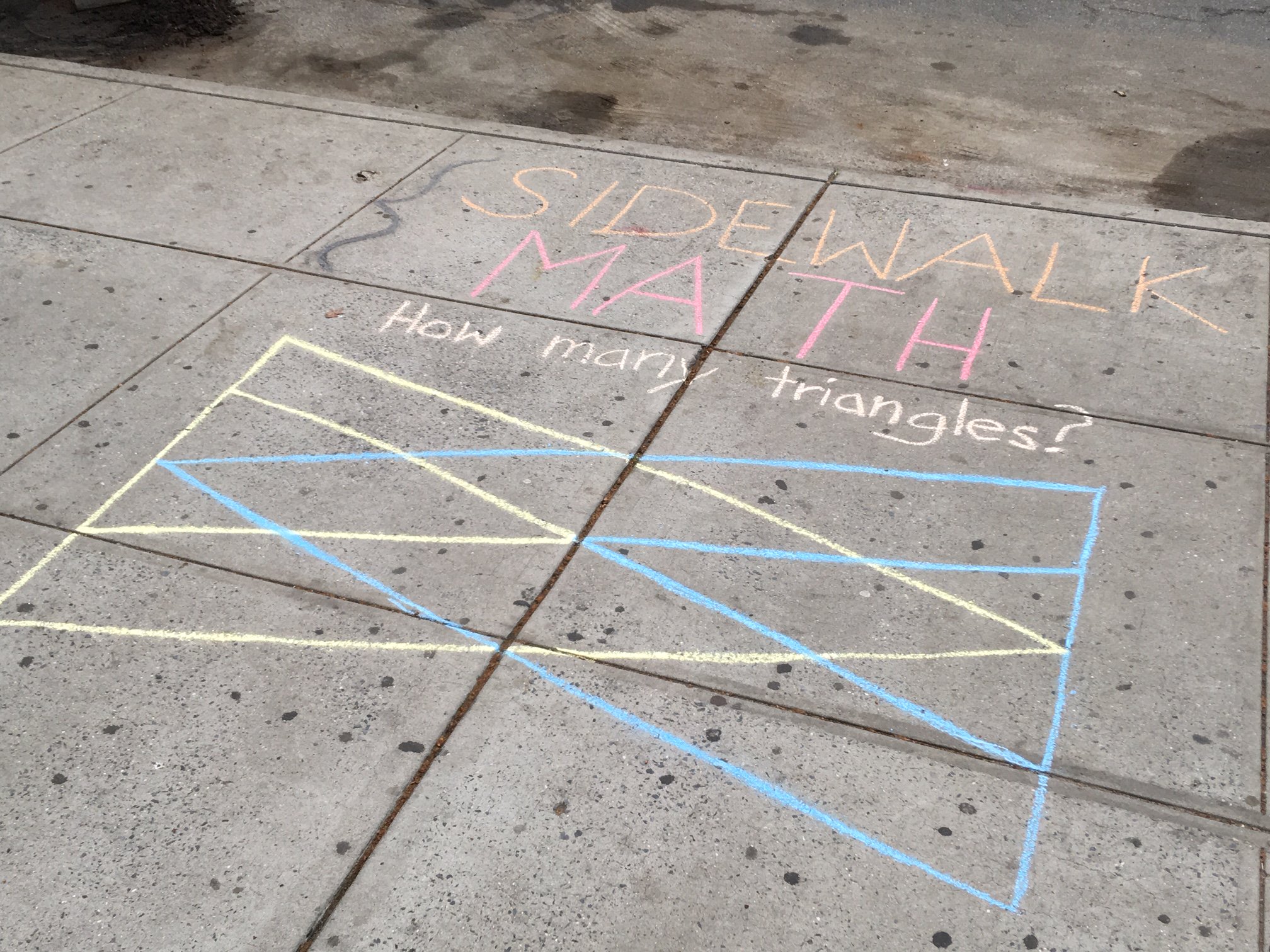
He was just checking his answer to the Sidewalk Math problem I created in front of the school. Whew.

D5juWKMX4AUqIA_


bp