The summer began with me thinking a lot about the question, What does antiracism look like in math class? It’s a broad question that guided much of my summer learnings and reflections. I attended workshops, had lots of conversations, and sparked an antiracist book club with colleagues. As the weeks passed, thinking about that question made me focus a lot on my Algebra 2 curriculum. I asked myself related questions like how can I change my curriculum to expose racism? and how can my curriculum be a lever that decenters Whiteness?
As the summer winds down, I think I was asking myself the wrong question. While my original question targets racism, it overlooks my White racial identity and the role it plays in fostering antiracism in my classroom. In other words, the question is colorblind. Because I am a White man who has avoided reckoning with his racial identity for his entire life, I find this aspect of the question deeply problematic. Understanding my White racial lens is vital to doing meaningful work in my classroom and spotlighting antiracism didn’t allow me do that; it kept me separate from the work, it protected me.
I realize now that the question I should have been asking all summer was, As a White man, what does it mean to teach Black and Brown students math? By racializing the question, I have to confront my Whiteness in order to respond to it. Of course, as a good meaning White person, this is something I would rather not do. Given 85 percent of my students are Black or Brown, this question is also far more personal and direct. It’s local. It recognizes the sharp racial disparity between myself and the students I serve and brings that to the fore. Unlike when I centered my question around antiracism, I can’t choose to answer this question abstractly, to detach myself from my response. Explicitly addressing antiracism in my wonderings, while important, allowed me to dance around my racial identity and the personal work I need to do as a White teacher who teaches students of color. The truth is, my new question triggers racial discomfort for me — which I need.
All this reminds me of James Baldwin, who once said “You and I are history.” It’s a simple saying, but holds so much. We have to know not only our story, but also the story of our people. For, whether we are aware of it or not, we are carrying all of this weight as move through the world. As a white teacher, it’s important to see myself, my pedagogy, and my curriculum not racially neutral because schooling in this country has never been racially neutral. In doing this work, I have to reject the individualist lie that who I am and what I do with my students is distinct from our country’s ugly history. That perspective is what got us here.
As a public school teacher serving students in New York City, there are a lot of mandates placed on me. These mandates are enforced and reinforced by a system that cares far more about a test score, school rating, and keeping White parents happy than it does for the liberation and racial healing for its dark students. As such, these mandates require me to enact a colorblind curricula and pedagogy. They encourage me to ask my students about tutoring before I ask them about how they’re doing. They urge my students to be themselves in a building without a gender-neutral bathroom. These mandates support the idea that teaching is apolitical. They make seeing a police officer outside my classroom normal. They entice me to manage dark bodies and their behavior. They expect me to focus strictly on content through the many traumas of a pandemic.
This summer I realized that that there are lots of different ways to protest. You can protest with your body. You can protest with your wallet. You can protest with your energy. After reading Christopher Emdin’s recent contribution to The Atlantic’s “On Teaching” project, I began to see how teaching can also be a form of protest.
I can protest by resisting classroom policies that limit when and how many times a student may use the bathroom. I can protest by refusing to adopt textbooks and content that centers the white, male, able-bodied experience. I can protest by not dishing out a detention to a student because they are wearing white socks instead of black. Or because their shirt isn’t tucked in. I can protest by not giving our full 45 minutes to the Common Core each day. I can protest by acting out against the idea that teaching math is about symbols and statistics and not stories. I can protest by prioritizing how I listen to my students — especially my black and brown students who are female, queer, or gender-nonconforming. I can protest by being on the committee that changes hiring practices. In the morning, I can protest by building camaraderie and playing basketball with my students at open gym instead of obsessing over my lessons. I can protest by acknowledging the politics of grades and working to ensure that, at least in my classroom, they don’t supersede my students’ intellectual and emotional well-being. I can protest by defiantly and outspokenly positioning myself as a colearner, not a teacher. With a school whose student body is 85 percent black and brown, I can protest by finding ways to make my curriculum and pedagogy honor, celebrate, and endorse Black, Latinx, and indigenous cultures and ways of being. I can protest by helping my school look in the mirror and face its ugly past.
Emdin sums this up perfectly:
A pedagogy of protest privileges dialogue with students even when the school schedule says there is no time for it. It creates space for youth to teach about their lives even when the curriculum says there is no space for it. It focuses on building community and family even when the school administration tells teachers not to express emotion with students. If teachers want to respond to racism as they’ve responded to the coronavirus pandemic, they can start here—in their own classrooms.
Framing teaching as an act resistance makes it harder to look the other way or say that the school system that keeps my students and I shackled to an unjust history is too big or too far-reaching to change. Though I may only be one teacher in a humble corner of the educational universe, I can resist. I can say no. I can give the system hell in my own way with antiracist lessons, cogenerative dialogues with students, and advocating for Black culture — and all of its intersections across gender, sexual orientation, ability, religion, and class — at faculty meetings. I can work to abolish teaching norms that stifles the intellects and erases the emotions of marginalized students. I can protest every day with my teaching by what I plan, what I say, and what I do.
I had this crazy idea the other day: mathematical penpals. Yeah, like old-school, pen-and-paper, drop-it-in-the-mailbox penpals. It’s a lost art that I think is worth reviving with our students.
The idea triggered many questions for me. Like, what would it actually be like for my students to be mathematical penpals with a group of students from another school — and possibly another city or country? What would it be like for students to write mathematically-themed letters to one another for an entire school year? Could it happen on a monthly or even semimonthly basis? In addition to some get-to-know-you stuff, what engaging and open-ended math prompts could the other teacher(s) and I come up with to ignite our students writing? How can we help elicit racial and social justice in their writing?
In addition to questions, I began thinking about the possibilities of an activity like this. I got even more excited. For starters, this penpal idea lifts up the frequently dismissed notion of formal writing in math class, humanizes it, and makes it a more interactive experience. Last year I created a book using my students’ math writings and I feel that some of these penpal letters would be great to feature in next year’s edition. Because the letters would be handwritten and delivered via snailmail, they would also add a suspenseful, yet fun, element to the class. When will the letters arrive? How will my penpal respond to what I wrote? What will they write? What did I learn about them this month?
All this, I think, also helps build connection and community across schools — especially if those schools are located in different cities or countries. The students will go from being complete strangers in September to using many personalized letters to get to know one another by June. Having a relationship evolve in that way is unique — and that’s not even considering the fact that we’re in the middle of a pandemic. Giving the historic circumstances that the Covid-19 pandemic presents us with, penpaling could provide our students a memorable way of documenting their school year. And what if we paired students of different races with each other? How could we use their letters to invite dialogue around racial justice? Maybe all their letters lead up to a big hoorah in June where we Zoom with each another and connect live for the first time. After receiving all these letters from someone you’ve never actually spoke to, what a magical moment that would be.
I’m dreaming here, I know. Sorry. But, worst case scenario, I think that having fun, one-on-one communications with a penpal might be a great way to relieve the mounds of anxiety that we all feel right now — teachers included. Plus, it’s socially distant by nature!
From a logistical standpoint, I don’t think it would take a lot of legwork to get going or maintain. The letters could be done outside of class or in a 20-minute block every two weeks or so. The students could (and should) help develop the math themes for each round of letters. Besides, they are the ones writing! And although we’d be physically mailing the letters, our schools would be paying for the postage. (This last point assumes that we are back in our buildings at least partially. If we aren’t, maybe there’s an alternative we can brainstorm.)
I know I probably sound desperate, but there’s got to be SOMEONE out there in the world of education who wants to do this with me. Despite all the uncertainty around the upcoming school year, if you’re interested and happen to read this, complete this form and let’s see if we can make math penpaling happen.
At the end of the school year, in addition to the standard feedback surveys, I had my kids complete an anonymous implicit bias survey on me. On the survey, I had three questions. For the first two, I listed every kid in the class and asked them:
Which three kids in the class do you think I favored the MOST?
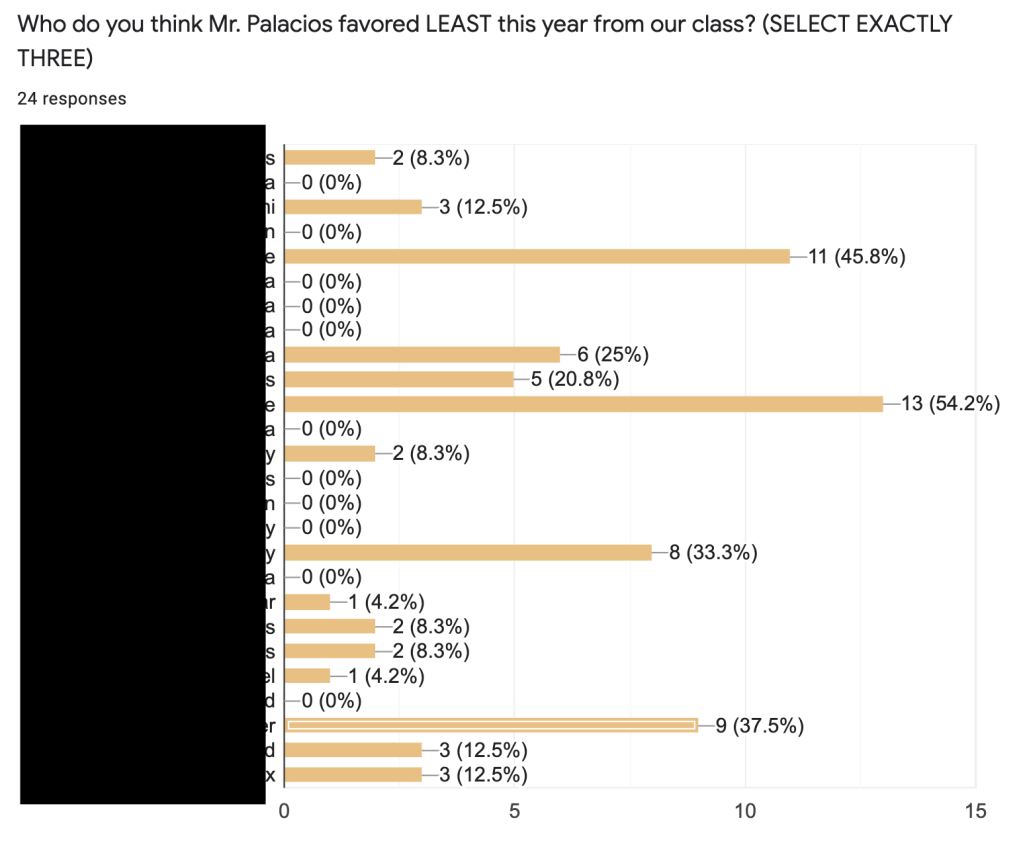
Which three kids in the class do you think I favored the LEAST?
For the third question, students had to identify what I do that gives them these impressions. This one was multiple choice with an “other: ____” option.
It’s important to note that students had to choose particular students; there was no “Mr. P is not biased” option for the first two questions. A colleague mentioned that this might make kids feel boxed in, especially if they truly felt I held no bias towards any student in the class. This was a fair concern, but my thinking was that if a large number of students felt that I was unbiased, and I still forced them to pick, then the data would simply capture my unbiased tendencies; my “favoritism” would be evenly distributed across everyone in the class. There would be no clear favorite or least favorite student since each kid in this group who thought I was unbiased would choose someone at random to simply answer the question. Full disclosure: I could be way off about this.
I also think that by forcing students to choose and not giving them an opt-out, I was asking them to question their own implicit biases when it comes to their teachers being unbiased. Teachers strive to serve students fairly and justly, but is this possible? Are their teachers really as unbiased as they say? On the surface, things may look unbiased and fair, but as their teacher, I’m confident that I have biases (e.g. what I get excited about or how I gravitate to a student’s previous experiences or who I tend to call on). My hope is that this survey could help them realize — in a small way — that implicit bias and its impact are both unintentional but still natural phenomena.
Another interesting aspect of this survey revolves around equity. Every kid in the class has a set of unique needs that require a unique response from me. I can’t treat everyone the same or I would have a bigger problem on my hands. A kid with autism, for example, might not respond well to eye contact, and so I might never give it. Or what if I know a student has lost a loved one, but no one else in the class does, and I elect to leave them be when they put their head down for the entire period? These sorts of scenarios play out every day in the classroom at various levels of severity, and students often never know why we teachers do what we do. Nonetheless, over the course of an entire school year, I wonder how the sum total of my decisions and actions in the classroom appear to students. How does what I do or say make them feelabout how I feel about other kids in the class? Does what I do (or not do) make students feel a certain way about who I favor or not favor? How does this impact how they feel in our class? Though they may not know why I’m doing what I do, how it appears to them matters. And I may be blind to that without asking them to identify it for me.
So, anyway, I gave the survey to four classes. Here are the responses from one class (names are blocked out):
I’ve looked over the results a couple of times and I’m still not sure how to interpret them. In all of the classes, I noticed that some of the kids who were ranked as my least favorite where all quieter, more reserved students. Did the majority of the class believe I am not biased, but instead of choosing some random person in the class (like I talked about above), chose peers who were less outwardly engaged during class? One student even commented, “I don’t particularly think you have a least favorite, but _____ was not in class for a large period of time because she took a trip so I put her down.” At the same time, it’s likely that I did favor these students less than I realized. Could I have been more public in my appreciation and validation of them? Besides, across all classes, the majority of kids selected “Who he calls on during class” as their reason for choosing the students that they did. Reflecting on the matter, while I try to remain balanced, I have a terrible habit of relying far too much on certain students, especially in certain scenarios. Interestingly, my quieter students also received far fewer votes for most favored.
The converse was also true: many of the more vocal, more participatory kids were voted as the students who I favored the most. This wasn’t always the case, but I certainly did see a trend. Surprisingly, a few students who I thought I favored more conspicuously than most didn’t get voted as most favored.
Another thought: I make it an absolute priority to create a personal bond with each and every student, whether it be a handshake, an ongoing joke, attending their games, or learning and remembering their passions. I do wonder how these small connections come off to students. For their rationale on the survey, two students mentioned that “he seems more interested in certain people than in others” and “the little ‘things’ he has with each person shows a lot. I feel like the ppl I put that he favored least never really had a ‘thing.’ ” I think being more systematic about these connections (e.g. tabulating them) could help me be better in this area.
Through all this haze, I can’t help but think that I’m seeing what I want to see in the data. Confirmation bias is no doubt alive and well in these reflections of mine. Planting a seed: It might be worth my while to have someone examine the data who knows nothing about my students and the relationships I have with them. Maybe a colleague and I could do this survey next year and interpret each other’s data?
I’m also wondering how else I might slice up the results. How can I complicate it? Take gender, for example. Would the survey results show a bias I have towards certain gender identities in the room? What about race and ethnicity? The overwhelmingly majority of my students are black and latinx with a low percentage of asian and white students. If I pursued it, what would that angle say about me? What about body type? What about students with special needs? What about grades? Do I appear to favor (or not favor) students with higher or lower averages? What if I somehow found a way to compare classes? What would that reveal about the biases I have for specific classes over others?
So many questions. So much to think about. While I’m leaving with few answers from a survey that I hoped would give me revelations, maybe that’s a good thing. To be continued.



 lazy 0ch0