During the 2021-22 school year I’m having weekly co-generative dialogues (or cogens) with my students. In an effort to help me process these talks and document progress, I summarize and write reflections after each cogen. This is the 23rd post in the series.
Potpourri Because of spring break, it’s been two weeks since we’ve met. Fearing that everyone would forget, a couple days ago I give my cogen students a soft reminder about our session today. All six confirmed they can make it, but I end up with only five because one of the students is absent today. I drape the tablecloth over the table, dump the snacks out, and we’re ready.
I open with three quick check-ins and updates: our recent poetry assignment, tomorrow’s pre-exam review, and Tuesday’s group exam.
Before spring break, I assigned my annual poetry task and I ask the kids for their feedback on how it went. The feelings towards it are generally warm, with one student — who made a math rap — saying it was really fun. Another student comments that he found it a little weird to be writing poetry in math class, but thought it was cool. That said, two students convince me that next year I need to use class time to model how to write the poems. Poetry in itself, for some students, is already a heavy lift. And now I’m asking students to use the medium to describe a math topic with no guidance? I can see why it would be hard to do.
For what it’s worth: Given the growing success of the poetry assignment these last two years, I actually had a goal to invest more time and energy into it this year. I wanted to pour myself into making a memorable experience for my students. But with the emergence of my farmer activity, I didn’t have the gas to go that far. Its development was placed on hold until next year.
Next, I inform the students that tomorrow I’m going to be implementing their recommendation from four weeks ago: pre-exam review handouts. I share my excitement for this and my hope that it will resonate with my classes. The cogen students nod in agreement, relishing (I hope) at their suggestion being put to action.
Lastly, I ask for tips on Tuesday’s group exam. I rarely do two of these in a single school year, but after doing one in the fall which my cogen helped me reflect on, I figured, why not? I’ve been meaning to revamp the experience using their feedback for months. This is the perfect opportunity before the year ends.
What can the current cogen offer me in terms of advice? They don’t add much, but do double down on what my fall group suggested: keep groups to 3 or 4 people — preferably 3 — and be mindful of how many problems I give. Deal.
Pre-teaching Today’s cogen really excites me because I get to “pre-teach” the students the topic that we will eventually coteach for what will be the third cogen-inspired lesson: rational exponents. The previous two lessons were game-based and not tied to any particular math topic like this one will be, so it’s an exciting challenge.
In preparation for today, I printed some Regents problems on the topic and made copies for each student. After our opening potpourri and my mini-lesson on how to convert between rational exponents and radicals, we use the problems as practice. We solve four problems and end up staying 10 minutes after our usual time. A few things stand out:
I underplan. It doesn’t take long to realize that I should have put more thought into the session. I hastily choose examples in the moment and stumble over certain parts of my explanations. I could have done a waaaay better job at sequencing and demoing. With just 5 students to teach in an empty, quiet room, I was too confident. I wonder how my instruction today will shape how my cogen students’ planning. (We will start that next week.)
Teaching teachers is different. Today was unique in that the students I teach will go on to teach our class. I know this going in, but my planning doesn’t take it into account. Discussing potential teacher moves while introducing the content would have been helpful and not out of the realm of possibility with these students. I miss the mark.
This is going to take longer than I thought. I should have known better than to think we could accomplish this in two 30-minute sessions. Considering that I want the kids to write a full-blown lesson plan with me, this process is going to take at least three weeks to plan, execute, and reflect on.
Making a difference. Job security. Lasting impact. Helping students achieve “ah-ha” moments. Summers off.
These are all benefits that come with being a teacher. The pandemic has caused many of us to question their existence these last two years, but they are significant reasons why many of us continue to teach.
All of those things resonate with me, but there’s yet another reason why I love teaching. It’s hidden beneath the surface, often overlooked, and deceptively important to my well-being. It’s not quantifiable like the two relaxing months of summer are or tangible like the warm-hearted embrace from a student at commencement.
What is this gift? What is this intangible dimension of teaching that I’ve come to view as one of its most valuable benefits?
The gift of youth.
Each day, I’m surrounded by teenagers. Eager, fearless, curious, bold, emotionally present, rebellious, unsophisticated, perceptive teenagers. By way of teaching, I walk into a building each morning and find myself immersed in their youthful worlds.
At the same time, each day I grow older. As a result, I move further away from what it means to be young. Sure, age brings its own blessings, but it also draws me away from those I serve. In this way, teaching is a paradox: I’m expected to reach today’s youth even as my body and mind naturally retreat from them.
And therein lies the gift my students offer me. They involuntarily surrender insights into youth culture, yes, but if I listen to them and observe closely, it goes much further than that: their youthfulness actually rubs off on me. My body might be aging year after year, but I’m unquestionably younger in mind and spirit because of them. They’re a big reason why I often forget how old I am.
Though many years their senior, I’ve learned a great deal about successful teaching and living a meaningful life from my students. I’m not saying that I do everything a teen would, but I have absorbed many of their finest assets. I constantly question myself, run towards risks, and embrace spontaneity. These and other qualities are transferred to me from my students in myriad ways — both in the classroom and out. It’s in their rebellious attitude and unapologetic creativity. It’s in how they audaciously seize the moment. It’s in their struggle to be understood.
I’ve never worked in any other field. If I did, having taught for 16 years, I’m confident that I would be a much older person than I am right now. I have my students to thank for that.
It’s incredibly easy for teachers to get caught up in student performance, in outcomes. This year, with the return of state exams, it’s even easier. Student performance is once again at the fore and so many of us are feeling the pressure to help our students earn a satisfactory mark.
I know next to nothing about the music industry, but as a growing J Cole fan, I can see a parallel between his take on the music industry in the above lyrics and my stance on teaching. Most schools, similar to music labels, obsess over the best possible outcomes. Schools and districts muted their chart-watching for the last two years, but it’s back. Students are once again being turned into abstract concepts, numbers organized meticulously by standard and test. How much can we make off of this artist? By when? How many students can I get to pass? By when? These are all questions rooted in the same premise that outcomes should be positioned ahead of the humans they’re designed to measure. If I align myself with such ideals, the hearts and minds of my students become secondary in my work. They are a means to an end.
J Cole is emphasizing the need to move beyond data and outcomes and focus on people and process. Similarly, instead of getting wrapped up in grades and student performance and achievement levels, I should carefully study my students — meet with them, listen to them, learn who they are. Like Cole, who “studied the shows” — a place where he engages with his fans — I find it invaluable to research my interactions with students. This means recording my lessons and the discussions with students and playing them back to help me discover my pedagogical strengths and weaknesses.
If I can do these things, or at least aim to do these things, my practice will prioritize those I serve. When that happens, the outcomes take care of themselves. As my students and I begin our arduous march towards the Regents and test-prep reigns supreme, I’ll do good to remember this.
This is the third post of a four-part series where I explore planning and implementing a social justice-themed activity in Algebra 2.In addition to traditional collaboration with colleagues, my use of three cogenerative dialogues to develop and reflect on the activity were critical to its design and execution.
Part 3: Post-Activity Reflections
The activity After my second cogen with the students, I gave my activity a facelift. I transformed what was a straightforward, task-oriented activity exposing injustice in the farming industry into an immersive and celebratory experience that turned my students into farmers of color and me into U.S. Secretary of Agriculture Tom Vilsack.
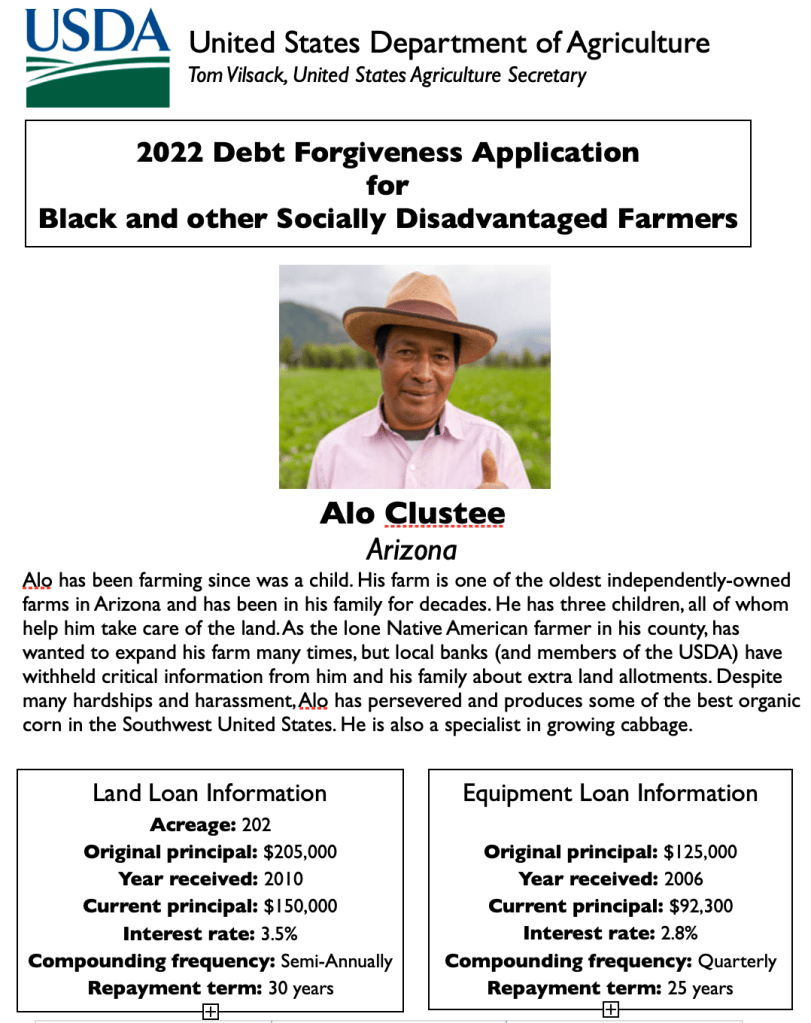
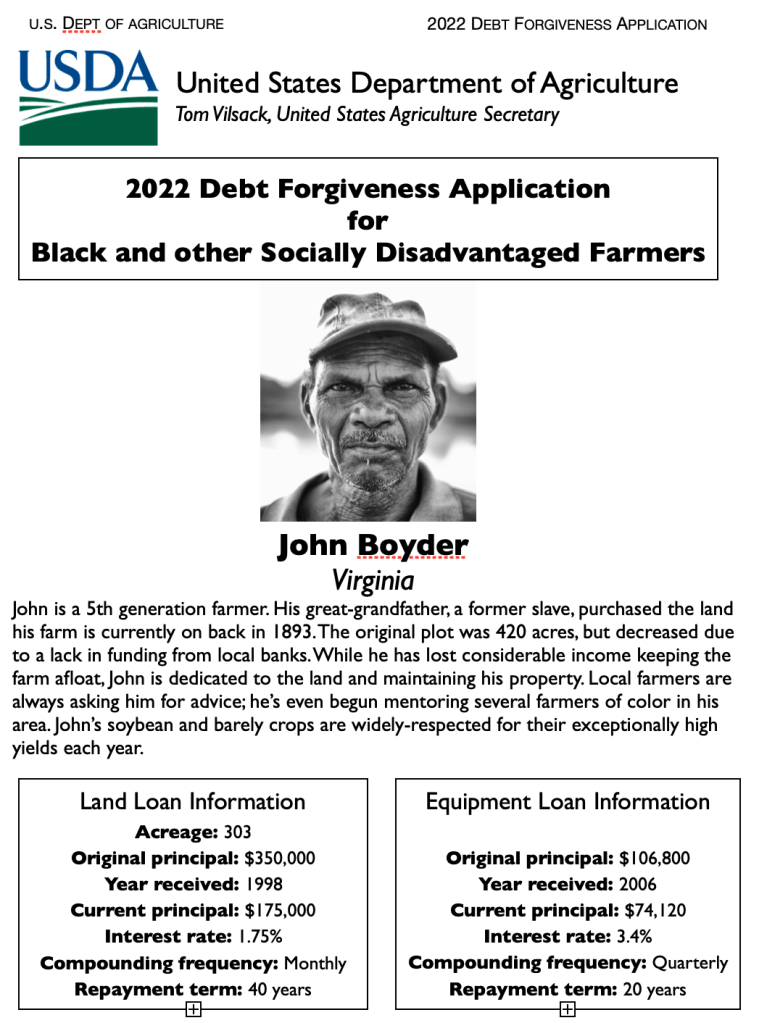
The farmers had been “invited” to Washington D.C. to complete a USDA debt-relief application. I wore a suit and tie, just like Secretary Vilsak would, and explained everything to them on day 1, which included summarizing several recent NYTimes articles on the issue and showing a video from ABC News. Groups of 3-4 students were assigned to one of seven fictional farmers of color. To get to know each other and add context, each farmer read their profile out loud to the class right before they started their applications.
I allotted a week for the students/farmers to complete their debt-relief application. The application itself hinged on what we’ve learned about compound interest and exponential regressions, but I also mixed in average rate of change. I owe the math department at my school lots of credit for helping me get all the math straightened out!
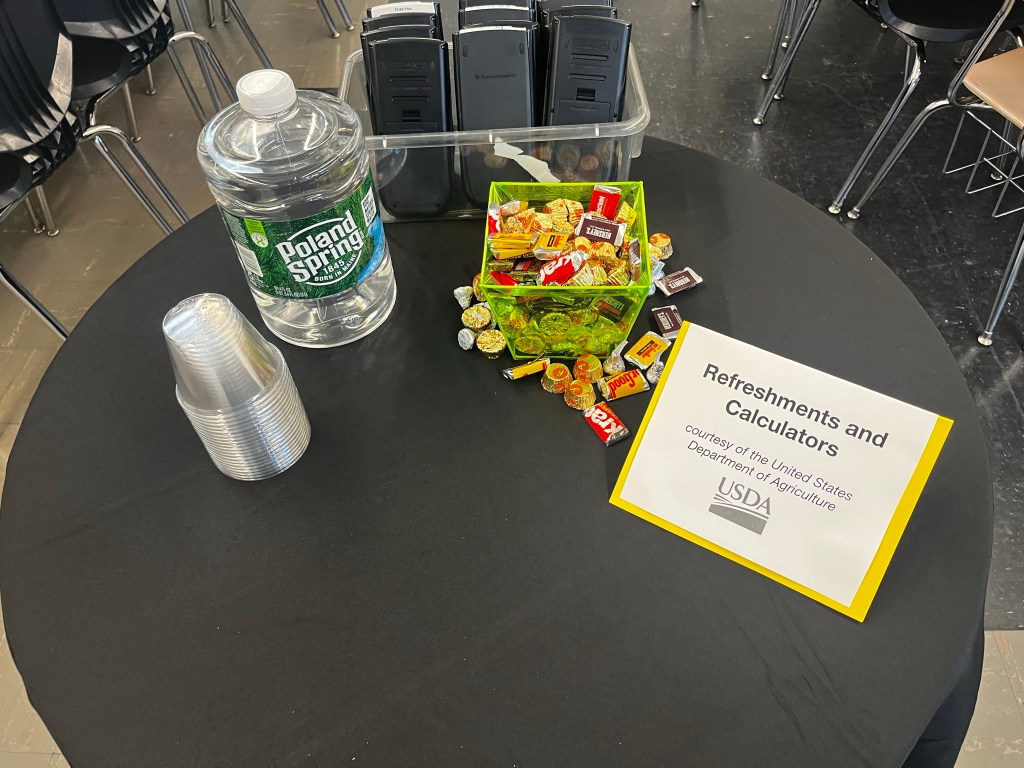
Embracing the performative nature of the activity, I asked the farmers/students to wear name tags each day and added a refreshments table that I kept stocked throughout the week with snacks and water.
Name tags that my students wore each day to identify them as one of seven fictional farmers of color
My USDA refreshments table, positioned in the middle of the room
In the end, the activity worked out pretty much how I envisioned it. The students/farmers spent a solid four days working through the application. As they worked, I walked around with an “APPROVED ✅” stamp to certify the various parts of their application as they got them correct. It felt official! The fifth and final day took on a more casual, celebratory tone, which included me giving each farmer/student a laminated check in the amount of their outstanding loan balances that they computed in their application. This was the cherry on top.
Laminated checks that each of my students/farmers received when they completed their debt-relief application
The only part that didn’t work out as I had planned was the final act: watching I’m Just a Layman in Pursuit of Justice: Black Farmers Fight Against the USDA. We watched 10 minutes of it on day 4 and another 30 minutes a week later on the day before spring break, but I wish the film could have played a bigger role in our work. This was bittersweet. Next year, I hope we can watch (at least portions) of the film earlier in order to bring in details of the featured farmers into the problems. This way, the film can be an integral part of the activity instead of a supplement. A huge shoutout goes out to filmmakers Shoun A. White and Waymon Hinson for giving me access to the film. It is awesome and speaks directly to the activity.
The feedback On the last day of the activity (today), I gathered the students together for one last cogen to reflect on it. Excluding my regular cogen who also helped me reflect on it, I met with a total of 9 students in two separate groups. All but one of the original 10 students were able to make it. Below is a synthesis of the students’ feedback from the cogen and a whole class survey I gave on day 5.
The group work worked. The students appreciated the size of the groups and how each group (and group member) werey all working on the same thing. My frequent check-ins and small group instruction enabled students to get their questions answered and helped keep their learning flowing. This made everything go better.
There was a nice balance between math and social justice. Both during the cogen and in the survey, the students reported that the math and social issue complemented each other well; each section of the application revealed a different aspect of the injustice and paired it with a different math concept. Several students said that they liked the variety of math topics the application required. Interestingly, one student told me that there was more math than she expected going in and that she appreciated this.
Isolating race allowed for a better understanding of the discrimination farmers faced. Students mentioned that because their Geometry project on farmers focused on so many factors (race, gender, education level, marital status, etc.), it become overly complicated and eventually took away from their understanding of the mistreatment of socially disadvantaged farmers. Because this activity took a simpler approach, students felt they learned more about the issue. Just 52% of students reported a connection between this activity and that one.
Choosing an alternative launching-off point was effective. Initially, I was going to use the Geometry project as a starting point for this activity (vertical alignment, yay!), but decided against it after the first cogen in the series. For these students (next year might be different), I’m convinced that this made a huge difference in how it landed with them. On day 5, when I did bring up what they did in Geometry, there were groans.
Role playing sparked joy and increased engagement. The lack of excitement during my second cogen caused me to find a dramatically new way of framing the activity: role playing. And it paid off! The students loved “being” the farmers and getting their loans paid off. Refreshingly, the cogen students sighed and grumbled when thinking about partaking in this activity any other way.
Students had a strong understanding of the mathematics and systemic discrimination in the farming industry. Before the activity, students feared that not knowing the math would prevent them from engaging with the social issue in a meaningful way. Both during the cogen and on the survey, students reported high levels of understanding of the math and the inequitable treatment of the farmers of color. Quiz scores on day 5 confirmed this. Teaching the required mathematics before starting the activity (as was recommended in the first cogen) was an important factor.
The problems could have been more clearly written. Students felt that several of the problems should be revised to elicit a clearer pathway of what they needed to do mathematically. Though the mathematics wasn’t new to them, it wasn’t clear when and how they had to apply it to the problems. The small group instruction helped me get over this hurdle, but students recommended doing an opening example at the start of class also.
Studying the farmers was worthwhile. Overwhelmingly, the students felt that studying the farmers in this way was an interesting and worthwhile use of class time. This was a pleasant surprise as I had serious concerns about the relevance the activity would have to urban youth. To elevate the activity and make it more relevant, one cogen student suggested that I find a local issue and integrate it with the farmers.
The takeaways
Curriculum change. Over the course of my career, I’ve tried to tackle issues of race, gender, and other forms of discrimination in several ways, but I’ve always failed at interrogating and modifying my curriculum. As the bedrock of my instruction, it has been the hardest to modify. How could I teach to the Regents and make the curriculum antiracist? This activity was a personal challenge to find that intersection and one of the biggest reasons why its success is so important for my growth as an educator.
Cultivating Genius. Gholdy Muhammad’s equity framework, as detailed in her book Cultivating Genius, was a driving force in how I designed this activity. Considering I never did it before, working through and applying the five pursuits of her framework, Identity, Skills, Intellect, Criticality, and Joy, was extremely valuable. My reflections on this dimension of the assignment deserve a separate post, which I hope to write soon.
Cogen impact. I knew the cogens would be important to the development of the activity, but I think I underestimated how much I would need them. The students provided guidance both by what they said and what they didn’t say. Employing cogens in this context (before and after a particular lesson/activity) provided me with another model for how they can used to improve the classroom.
Personal learning. I didn’t feel comfortable engaging with the systemic mistreatment of farmers of color without doing mounds of research beforehand. Like, a lot. Naturally, I learned so much about the issue. In this way, my students and I were at the edge of knowledge together for this activity. How refreshing.
SimulatingJustice. When my planning began, I saw this activity as being entirely informative. I wanted it to expose my students (and our school community) to a particular form of inequity. As my planning unfolded, however, my stance changed to be oriented more around justice. Instead of simply uncovering systemic racism, I wanted the activity to simulate justice and fairness. Though it transpired in a small corner of the universe located in a humble school in the Bronx, I wanted the activity to honor the love that farmers of color have for the land. Above all else, it had to celebrate their agricultural excellence and perseverance.





 lazy 0ch0