Lesson reflections using the comment feature in Word

Screen Shot 2016-02-10 at 1.20.02 PM

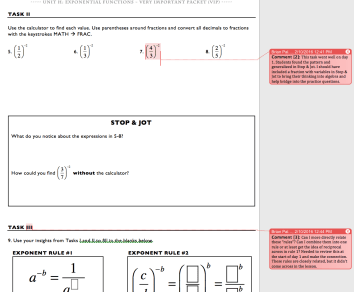
Today I realized an incredibly simple and efficient way to reflect on a lesson: the comment feature in Microsoft Word.

I’ve been meaning to do something like this for years. Capturing a lesson immediately after teaching it is so useful – and blogging about it isn’t always feasible or necessary. Sometimes a few lines about how things went can help immensely when looking at the lesson in a year. I’ve tried using Evernote, but I always need to go back to Evernote to read my reflection the next year…this is totally inconvenient and I always forget.

By using comments, I can seamlessly integrate my reflection into the lesson/handout. On the front end, it’s not quite as convenient as Evernote since Evernote can be accessed basically anywhere, but it’s much more efficient on the back end since all my notes are waiting for me when I open up the lesson the following year.  

Here’s to making improvement easier. 
bp

Mystery Prize Game

This simple game is fun on many levels. I play it a few times a year and it’s a hit every time. And, after reading this, if someone can give me a catchy name for it, thank you in advance.

I give every student a set of 8-10 problems. Usually review and stuff that can completed somewhat quickly. Most recently, it was using the discriminant to determine the nature of the roots of a quadratic equation. The kids are in groups of 2-4 and, since class is 43 minutes, I give them 20-25 minutes to complete the problems. I foreshadow and mention that their group may earn an awesome prize based on correct answers.

Here’s where the fun comes in, especially the first time we play it. After working out the problems, I reveal three prizes. They are written on index cards and sealed with staples inside a folded piece of paper; a poor man’s envelope.
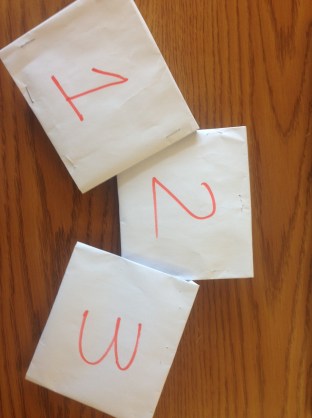
Prize Game Sealed Envelopes

For each round of the game, I use a random name picker to select a student. The selected student’s group gets an opportunity to answer a question from the handout. I usually go in sequential order. Correct answer = choice of prize. When choosing their prize, they have the right to any prize, even if that means stealing one from another group. We repeat this process for the remaining problems. To keep it fun for everyone, I limit the number of prizes per group to one, but groups can swap prizes with another group if they already have a prize. If a group gets a question wrong, we spin again to find another group. 

The game gets heated. I, of course, totally encourage stealing prizes from other groups. It’s fun and I love the instant rivalry that’s created when a prize is heartlessly taken. From a teacher’s point of view, this also provides high levels of motivation to earn correct answers!

With a few minutes left, we stop and the three sealed envelopes are opened by the groups that possess them. After a hard-fought game earning prizes, the anticipation behind opening them up is palpable. You would think it was Christmas morning. 

Here they are from the most recent game:

IMG_0198            IMG_0200

IMG_0199
The kids always go crazy. 

I suppose you could play this with “real” prizes like candy or bonus points, but the kids always get an extra special kick out of these types of prizes – especially after competing for it throughout the game. They are just as motivated the next time we play. It’s all about good-natured competition and the mystery behind the prizes that make it fun. 

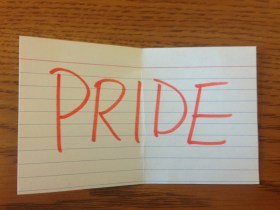
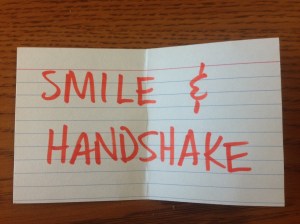
The prizes are different every game, but I usually stick with the Smile & Handshake each time we play. It’s become my trademark. 
bp

Token of Appreciation

I’m a huge fan of showing appreciation to others, especially for the simple, day-to-day things that often go overlooked. In an effort to promote this, I’ve started a new tradition in my class. It’s called a Token of Appreciation.

Each Friday, the Token, a small chunk of wood, will be given to someone in our class as a symbol of appreciation for something they did during the past week. The person giving the Token must identify someone that they think deserves it, shout them out, and give them the Token.

The recipient gets to keep the Token for the next week. They will make their “mark” on it by drawing their name, putting a sticker on it, or whatever else they feel will best represent them, possibly even carving into it. The following Friday, that person will recognize someone else and give the Token to them. And so on.

I kickstarted the tradition last week by giving the Token to a student in each algebra 2/trigonometry class. Here are the tokens:


A simple act of kindness. And little bit of kindness can go a long way.


bp

Knowledge Audits

Audit 1How can I know what my kids know?

I’ve been asking myself that question for a long time. In my Regents-obsessed school, I’m forced to ensure my students can perform well on end-of-year state exams. The typical learning flow in my class usually looks like this:

  1. Student learns X.
  2. Student demonstrates understanding of X.
  3. Student learns Y and forgets X.
  4. Student demonstrates understanding of Y and has no idea what X is.

Compile this over the course of a school year and you have students that understand nothing other than what they just learned. What does this mean for a comprehensive standardized exam? Disaster!

Sure, a lot of this has to do with pacing and students not diving deep into things they learn to make connections. That is a sad reality of too many teachers, including me. So given these constraints, how can I help kids build long-lasting understanding of things they learn and not forget everything other than what we’re doing right now?

In the past, I’ve “spiraled” homework and even put review questions on exams, but this never helped. There was no system to it and I never followed up. This year, I’m lagging both homework and exams, which does seem to be making a difference. But with the ginormous amount of standards that students are supposed to learn each year, I still feel this isn’t enough.

So, last week I began implementing Audits. These are exams that do not assess concepts from the current unit. The plan is to administer about one a month and because I lag my unit exams, I should have no trouble fitting them into the regular flow of things.

I’m choosing not to call them “Review Exams” or some other straightforward name in order to put a fresh spin on them and increase buy in. So far, so good.

The hope is to continually and systematically revisit older content to keep students actively recalling these standards. This should reinforce their learning and help to make it stick. On the teacher side of things, I get an updated snapshot of where they are and can plan accordingly. The SBG aspect is simple: the results from the Audit supersede any previous level of understanding.

  • If a student has not previously earned proficiency on a standard that is assessed on an Audit, he or she can earn proficiency. This alleviates the need to retest on their own.
  • If a student has previously earned proficiency on a standard, he or she must earn proficiency again or else lose credit for that standard. This would then require them to retest.

The first Audit resulted in a mix of students earning credit and losing credit for a set of standards. It was great. The proof is in the pudding. Knowledge isn’t static and my assessment practices must reflect this.


bp