MfA Summer Think Reflections

graphic-for-website

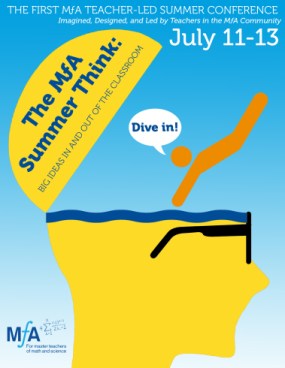
For two and a half days this week, I took part in the Math for America’s Summer Think conference. The experience was unforgettable on many levels.

Last summer, after having returned from Twitter Math Camp (which MfA funded), MfA asked me about possibly helping plan a summer conference with them for this summer. My initial reaction was Heck, yeah, let’s do this! A MfA summer conference! Woohoo! 

Reality set in on October 28. I received an email from MfA about starting the planning process. I had forgotten all about my enthusiastic reply back in July about making the conference a reality.  It was at that moment when I realized that I had no idea how to plan a conference.

I started putting out blasts trying to recruit people to help me plan. With a community of teachers like we have at MfA, it didn’t take long get lots of replies from those looking to get involved. While the average teacher wants to their summer to have nothing to do with school, the community at MfA is not full of average teachers. I knew there would be lots of interest. But 20 teachers can’t plan a conference for 75 teachers. MfA provided tons(!) of guidance, but one of the biggest hurdles was finding a core group of teachers to do the work that comes with the actual planning. Once Courtney, Matt, Carl, Diana, and Sony stood out from the crowd, it was all downhill from there.

After much deliberation, we landed on a theme of Big Ideas In and Out of the Classroom. Then came the call for proposals and ordering swag. We then sifted through proposals. (We received so many!) Next, we finalized the workshops and confirmed with facilitators. We developed a conference website and wiki. The last meaningful order of business was opening registration and watching the seats fill up with eager teachers. More here.

I must say that throughout this process, without the trust and backing of MfA (Leah and Courtney specifically) and the team I mentioned above, the conference would have only been a lofty idea that was brought up last summer after TMC. I would have never learned how to lead in this new, exciting way. I would have never learned so much about so many people. I would have never written these reflections.

For that, I’m deeply grateful.

So although I was a conference organizer, before the conference started I had full intentions of being an in-depth participant. That was always a primary goal. I wanted to be part of the conference just like everyone else, to learn and connect with others. Luckily for me, that’s exactly what happened.


Day 1 – Tuesday, July 11


  • The day begins with the planning committee making final preparations before attendees start arriving at 9am. Surprisingly, it’s not as hectic as I thought it would be. That’s all MfA right there.
  • At 9:30 we went with an icebreaker that Matt and I experienced at TMC16. It was tight spacing, but Matt pulled it off marvelously.
  • After Courtney formally welcomed everyone to the conference, I thought I would try having the attendees pass a Token of Appreciation throughout the conference. I kicked the process off by giving it to Leah from MfA for the oodles and oodles of support she gave the planning committee over last several months. Here’s a secret: this was probably the largest group of adults I had ever spoken in front of, no matter how briefly. Being rather introverted, I was deathly nervous.
  • I introduced our first featured speaker, Patrick Honner. Being a personal role model of mine, without hesitation I invited him to speak several months back. His talk centers on how he thinks about big ideas in and out of the classroom and how it has impacted his teaching. He kills it and frames the entire conference beautifully. Notes.
  • My first session is also with Patrick. It’s a follow-up to his opening talk. He provides a more detailed outline for thinking about big ideas, a template of sorts that he himself uses. I can get fairly disorganized when I begin thinking massive shifts in my teaching, so his session was exactly what I needed. Notes and handouts.
  • While randomly speaking to someone during lunch, I learn about Costa Rica’s national uniform policy and how any teacher can discipline any student at any time anywhere in the country. Mind blown.
  • The afternoon was my extended length session, what we called the “Deep Dive” session. It was focused on Design Thinking and how it can be used as an alternative means of assessment. The facilitator is great. After a while, I remember that she gave an MT^2 talk on her work with Design Challenges. After some struggles, I realize at the end of the session the goal for me is to leverage these challenges to open the door to the content I will be teaching – not to teach content outright. If I can keep that in mind, it’ll help me plan. Notes.
  • Before mingling at happy hour in the MfA lounge, I touch base with Marvin and his Designing and Teaching Scaffolds Deep Dive.  I really wanted to attend this one, but couldn’t so I pick his brain for 10 minutes about his approach to scaffolding. (The other session I loved was Winning Hearts and Minds.) Small but big takeaways: 1) scaffolding must be separate from the content and 2) I must always remember to gradually remove the scaffolding. He had a brief video of scaffolding being built (and taken down) around the Capital in Washington D.C. that hit home with me.


Day 2 – Wednesday, July 12


  • The day begins with John Ewing, the president of Math for America. He does a bunch of major things around the country around mathematics and education – and we were really fortunate for him to be able to speak to us. His talk about changing the conversation around education in America. He sees three trends in education today: teaching is viewed differently by the public than by teachers (like the double deficit model for teaching), our distrust with institutions (including schools), and our irrational belief in big data (like value added models). I feel awe-struck because in his talk he includes a quote from the post that Courtney and I wrote for MfA’s Teacher Voices. During lunch, he even comes up and personally thanks us for helping organize the conference. Unexpectedly, I think his talk inspired the direction I take my after-school commitment next year. Notes.
  • The first session of the day was the second part of the Deep Dive on Design Challenges. To start,  we move all the tables together for an opening reflection on the work we started yesterday. It helped frame the day and I really liked this. I could tell she was attuned to our struggles yesterday. I shared that I embraced the struggle from yesterday, but because I had nothing tangible yet I feared that I would forget all about Design Challenges after leaving the Summer Think. I also added that Design Challenges remind me of creating flow, a term explored in my current book Flow by Mihaly Csikszentmihalyi. After running through a protocol to explore our ideas further (mine was periodic functions since I was horrible in modeling them last year), we jump into storyboarding our Design Challenge. Mine was based on the tides and water damage to a house, but someone else presented one on tides when to best visit a beach, which I like much more. The jury is still out on the future of Design Challenges in my class, but I am in a much better place than I was yesterday.
  • After lunch, the Problem Solving Partners is up next. It opens with a great icebreaker: put your three favorite numbers on your name tag and share why you chose them with your partner. We learn about some norms for partnerships, similar to the group norms that I’ve always wanted to implement, but never really have. We go through three different protocols for problem solving with pairs of students, which were all very practical. I especially liked the Concept Attainment Protocol. In general, I was intrigued because I don’t think I’ve ever thought about using a protocol with students (they’re just something we use at teacher PDs). There is definitely stuff from this session that I’m using next year. Also, she mentioned a book where she got the problems; I should ask her about it. Handouts and notes.
  • The last formalized session of the day was Paper Folding with Gary Rubinstein. I know of Gary’s work, but I’ve never sat in one of his sessions. I’m glad I did! We used paper folding to solve quadratic equations. This is so fascinating. I definitely plan to use this next year in my mathematics elective, if not in algebra 2. He even has paper folding video tutorials. Handouts.
  • To close the day we took part in an Open Spaces session, which was powerful. The topic of the group I joined was segregation in NYC schools but branched off to talk about racism, bias, and what we can do as teachers to better the situation. The conversation was passionate and deliberate.


Day 3 – Thursday, July 13


  • We started the final day of the conference in our Deep Dives. We started with a neat reflection activity where we wrote our gains, strains, and questions on Post Its and went around the table reading them off one at a time. I would read one, then the person next to me would read one, and so on until it got back to when I would read my second one. That continued until we read all of our notes. We transitioned into the final activity, which was to create a trifold board that would share what we learned in our Deep Dive. This lead to a gallery walk with all the other Deep Dives. During the gallery walk, there was a palpable buzz in the MfA lounge. If I’m honest, at the end of this Deep Dive, I’m am uncertain whether I can see myself doing a design challenge in algebra 2. There are just too many unknowns for me right now. That said, things in my classroom rarely go the way I think they will, so I wouldn’t be surprised if I put one together for periodic functions unit.
  • We all reconvened to close out the conference. Megan Roberts, executive director of MfA, spoke and reminded us all why and how MfA does what it does. She joined MfA a couple years ago, but before that, she led at iZone, an NYCDOE outpost. A few years ago, she and I actually attended “iCamp,” a summer camp sponsored by iZone. Coincidently, during the camp, we got paired up for a design challenge and got to know each other pretty well. It was so special to reconnect with her at MfA and at the Summer Think this week. One big takeaway from her talk: the use of “PD” as noun instead of a verb.
  • After Megan’s remarks, I was asked to put a bow on the conference and close it out. I thanked everyone and briefly shared how the conference came to be and had everyone show some love to all of the workshop facilitators. I shared how hopeful I was that everyone found this conference a worthwhile investment of their well-deserved summer. It was the first one ever, so you just never know. I then went off script and decided to give some unexpected shoutouts to selected people who I met and connected with during the conference. I asked the audience clap once for each shoutout. It was a fun, lighthearted way to throw recognition back onto the attendees. They actually went for it – and I was relieved.
  • MfA graciously provides dumplings for lunch. I hang around and several folks came up and thanked me and commented how awesome the conference was. I couldn’t help but be more and more humbled with every conversation. The MfA team gives each member of the planning team a thank you gift. Just another earmark of this first-class organization. Smiles all around. We throw out some days of when we might be able to come in to review the survey results later this summer.
  • I hang around MfA until I’m the last person from the conference still there. After big events that I find exceptionally meaningful (the last day of school also comes to mind), I like to be the last one to leave. It’s cheesy, but it gives me a unique opportunity to reflect on that particular occasion that will never come again. I talk, mingle, and watch everyone head for the elevators. The planning committee says their goodbyes. Afterward, I sit in the back of the lounge, make of list of post-conference To Dos, and take it all in.


bp

End of the 2016-17 school year

img_1240

-2. I always enjoy writing my end of school year post. It’s a great way of wrapping my head around all that has happened during the last ten months.

-1. It’s the last day of school – what a difference a year makes! This time last June I was finishing off a ten-year tenure at my previous school, eager for a new beginning. Well, this year was eventful, to say the least. No lie, part of me is surprised that I actually survived it.

0.  I should start with how whiteboarding transformed my instruction this year. I’ve had small, desk-sized whiteboards for years, but usually only pulled them out for review. After Alex Overwijk’s session last year at TMC16, I knew that I had to use some VNPS and VRG this year. It only took until March, but I did. I dabbled with creating flow and it was  a game changer!

1. All the classrooms are shared at my school so this is a stretch, but I’m thinking of completely defronting my classroom next year. It probably won’t fly next year, but I want my desk in the middle of the room.

2. After I hit my groove with the large whiteboards, it was all downhill from there. We dry-erased ourselves to death. I was also lucky enough to have desks in my room that are dry-erase friendly. I also picked up these sheets, which came in handy while sketching trigonometric and polynomial functions.

3. Through all of this, I discovered the immense learning value and functionality in dry erase. Kids were far more willing to get an answer wrong, to take risks. They knew their work wasn’t permanent. In fact, not only was it easy to edit their work, it was downright fun at times. At a deeper level, they stopped caring so much about being wrong.

4. My standards-based grading ran into a wall this year. This deserves a post in and of itself. But to make a long story short: I made my SBG marks cumulative for the year. What a student learns (or doesn’t learn) in October is still reflected on their grade in June. This means that they had the opportunity retake any concept from any point during the year with no penalty. At the same time, they could also lose proficiency if they demonstrated a lack of understanding on a particular concept – even if they first learned in back in October, say. Most kids didn’t like the system, but I REALLY did. Hmm…

5. Three other bits about my SBG this year. First, as the year progressed, I began to drift away from SBG with my non-Regents (non-state tests) students. It got so hard to make their retakes a priority over my Regents students. This is a problem that I hope I address next year. Second, shortly after the year began, I started requiring students to reserve their seat ahead of time for retakes (instead of just showing up). Before this change, it was a mad house of 25 kids after school trying to retake their concepts. I limited it to 15 students and then it was ok. Lastly, I never found a way to for students who initially demonstrated proficiency to move up to mastery. My focus was on moving kids up from developing to proficiency. The solution may lie in not requiring them to tutor with me before retaking. We’ll see.

6. For the first time in my career, I wrote an end of year letter to my students. I write them all the time anyhow, so I figured why not end the year with one final letter. Each class got their own and it was almost two pages. I included a remark about every student in each class. It really hit home with the kids. One student even said that she was going to frame it.

7. I blame this on my first year blues, but I let too much go this year – especially with my first period class. They were off the wall for much of the year and I was pretty embarrassed by the lack of control I had. I gave them too much latitude early on and it came back to bite me. Across the board, I need to tighten things up next year.

8. Being naive, I attempted to have a parent newsletter. Just like last school year, it went strongly for three months and…flopped. Badly. I don’t want to give up on this idea, but it’s not looking good.

9. I need to call more parents. Maybe instead of a damn newsletter, I make an effort to call each and every parent at the start of the school year. And then follow up as necessary.

10. Being the first year that I’ve taught Common Core Algebra 2, I struggled in knowing what to exactly teach the kids. Let’s just say that I learned a lot of mathematics this year. And I was good until around December…and that’s when the pacing calendar went out the window. I was forced to omit two entire units.

11. For the past several years, I did my best to preplan entire units. I’m talking having detailed handouts for every lesson before the unit begins. Th goal was to think ahead and build strong connections between lessons and key ideas. Because of my struggles with the curriculum, I came to the realization that this practice actually causes me more harm than good. By trying to follow the road map that I constructed prior to the start of the unit, I didn’t leave room flexibility in my students’ thinking that naturally occurred as they learned new things. This whole situation makes me think of this nugget of wisdom that Patrick Honner dropped on me a couple of years ago.

12. My homework structure got better this year. Unit-based DeltaMath was good. Having students check the paper homework it was a success. I realized, though, that I gradually stopped lagging it. This may be related to the curricular issues, but found it hard to plan the homework each night. Next year, I might give the students homework on Friday and make it due the following Friday – with all lagged problems. Then again, I’m now toying with the idea of no homework at all.

13. My A.P. is outstanding. She was the breath of fresh air.

14. Dan Meyer was equally outstanding in his three-part PD series that I attended.

15. A huge professional accomplishment this year was submitting component 2 of my National Board Certification. Damn that thing was work. OMG. I just remembered that I have to submit two more of these next year.

16. Math for America honored me with a Renewal Master Teacher Fellowship. My growth during these last four years has much to do with their influence on my career, so I’m thoroughly pleased that I will be continuing to grow and lead through this dynamic community. On a semi-unrelated note, I co-authored a post on the MfA blog.

17. In March, I was named a Big Apple Award Finalist. Frankly, I don’t know how the hell this happened. I’m grateful though.

18. At the beginning of the school year, I had every student write me a letter introducing themselves. I gave loose guidelines of what I hoped they’d tell me and said that I would write each of them a personalized letter in return. Well, it’s June 28 and not only did I not write everyone back, but I didn’t even read many of the letters until last week. (Reading their letters after a year of getting to know them was pretty interesting, though.) Shame on me!

19. The Token of Appreciation was lost on two different occasions in two different classes this year. Nonetheless, it was still a great year in appreciating the small moments that exist between us.

20. As I stood outside my classroom door this year, I started dishing out high-fives to random students (and staff members) as they walked by me. It was spontaneous, fun, and a total mood-lifter. Also, my fifth-period class always gave me a round of applause at the start of class. I gave them an applause as they exited. It was strange – and totally unforgettable.

21. The estimation wall was a total hit. And thanks to the inspiration from Sara VanDerWerf, so were the random problems that I posted in the hallway. From students to staff, everyone was doing, and loving, mathematics. This is genius.

22. The Mathematicians Beyond White Dudes initiative was a huge success this year. At the end of the year, I even had a girl present a mathematician that she learned about on a school field trip.

23. I learned how far we need to go, as a school community, to deliberately address race and other social issues with students and staff. A lot goes ignored. Too much in fact. More to come.

24. I’m super excited for next year. I should be teaching the first ever mathematics elective at my school, which will be treat. It’ll probably be filled with kids that need a class and not because they’ve elected to be there, but I’m still eager to explore mathematics beyond Regents and A.P. exams, which is all they know. Also, I hope to kickstart either a mathematics or Educators Rising club next year. I’m on the fence about which it’ll be. The summer will help me decide.

25. The Day in the Life series that I wrote this year challenged my will at times, but I’m glad I stuck it out. It was a wonderful way to capture what was probably the most pivotal year of my career.

27. During a group quiz towards the end of the year, I took notes on student discussions and specific things that students did as they related to productive group work (explaining thinking, showing work, asking good questions, being helpful, etc). At the end of the quiz, I spent three minutes sharing one outstanding thing that I witnessed from each group. It helped push back against social status and helped show them what’s important…which isn’t to know lots of mathematics. I want to do more of this public acknowledgment of student thinking.

28. I learned a lot about my goals this year. Looking back at the goals I set back in September, I made reasonable progress on numbers 2, 4, 6, and 8. If I go ahead and say that I “achieved” those goals (which is pushing it), then that means I had a success rate of 4/10. Whatever. In the end, what I really take from all this is that my focus this year was far too broad. I wanted to change way too much.

29. If I’m honest, it’s the end of June and I’m bothered by the fact that I still don’t feel rooted in my school. While I feel the wheels turning in the right direction, right now I’m not completely invested in what’s happening here. I suppose this is normal given that I just finished my rookie year. But still.

30. Anyhow, year 11 is now in the books. Here’s to making 2017-18 great. See you next June.


bp

PD with Dan, modeling with mathematics

With the help of the NYCDOE, this past Wednesday was the third of three workshops that I’ve attended with Dan Meyer this school year. I’ve written about the first two, so why not cap off the trilogy? Read more here and here. In an effort to solidify my experience and have something to reflect upon at a later date, here’s a recap of the session.

The focus was on mathematical modeling. This is one of my weaknesses, so when I walked in and looked at the agenda, I was pretty happy. Teach me Dan! Things opened up with us sharing what we thought it meant for students to model with mathematics. The answers varied, but after feeling us out, Dan emphasized the difference between model the noun and model the verb. I had to catch myself here too as I hadn’t played close enough attention to this subtly. He used Desmos to collect our responses and our comfort level with mathematical modeling.

We then dove into the Penny Pyramid 3-Act. Dan worked his magic, as usual. During the debrief, he pulled from the CCSS and presented five actions that are necessary for students to be part of modeling experiences:

  • Identify variables
  • Formulate models
  • Perform operations
  • Interpret results
  • Validate conclusions

We talked about how the Penny Pyramid, while probably not ideal, works to get students to do all of these things. Our questions helped us to identify variables. Interestingly, Dan highlighted the vocabulary that we chose to represent the variables. This is important because, indirectly, he demanded precision and consistency from all of us when it came to describing key parts of the experience. Our tabular, algebraic, and physical representations of the pennies were the models, which we used to calculate the number of pennies in the pyramid. We spent time as a group discussing the meaning of our calculations and parts of our models – even those that weren’t correct. For example, one group landed on 22,140 pennies, which didn’t take into account that each stack was 13 pennies. Also: what does the 612 mean? The weakest part of our models was the validation. It’s not like we could actually count all the pennies. That said, we would compare outcomes of different models. There was also a newspaper article on the pyramid which helped with the actual count of pennies. Validation runs on a spectrum.

The afternoon was spent creating and improving some modeling tasks. We started with 25 billion apps and then went into a few graphing stories. We spent time thinking about how to structure modeling activities using these tasks. A great conversation occurred while exploring Distance from Camera. Someone brought up whether the graph should be piecewise linear or rounded periodic (like the solution). It was a great discussion, worthy of its own post. Dan remained vulnerable and eloquently showed us this ferris wheel Geogebra applet from the awesome John Golden. (Check out his full collection of Geogebra resources.)

We brainstormed how technology can help make our modeling dreams come true. The list was plentiful. Staying away from “textbook traps” topped the list. These include giving up numbers, tools, and other key information far too early in the modeling process. It’s also ironic that, because of technology, Dan was behind a desk for extended periods of time while we worked (he was typing our insights and using Desmos). Without technology, this teacher move is frowned upon.

The culminating task had us dig into several different versions of Barbie Bungee. Having never actually done this modeling activity, I learned not only about how to do, but also what not to do. Truth be told, if I would have looked at the activities before the workshop that day, I wouldn’t have suggested any changes. I would have been excited to implement them as is. But after purposefully rethinking modeling with mathematics with Dan for five hours, I felt very different.

Takeaways:

  • The Penny Pyramid task would serve as a great introduction to summation notation.
  • Dan: “When there’s a great classroom experience, I ask myself: how could I have ruined this?
  • Not every aspect of modeling needs to every lesson. The goal is to feed students a healthy diet of modeling verbs.
  • Focus on broad questions. These will lead to more specific, granular questions. Avoid the reverse.
  • Seeing every teacher move I make as an investment into the lesson. Which moves are worth their investment? Which aren’t? This reflects the gravity that every decision we make. I need to be more deliberate.
  • Depending on what info we give kids, the level of modeling that they do could be very different. Don’t do the modeling for them! Give them procedural stuff.
  • It’s not if to give a handout, but when. This outcome was directly tied to Dan’s first session back in December, which helped things come full circle.
  • Once again, I was impressed with how Dan managed the audience. There were so many slick teaching moves (see notes).
  • I loved catching up with Sahar during lunch. We talked about her experiences visiting students homes with her school. She also gave me a tip about taking photos while students are working during the first couple of days of school to showcase how mathematical discussions should happen amongst students.
  • This wonderful periodic modeling Desmos activity.
  • If I ever do Barbie Bungee, I need to use Dan’s intro video.
  • Be mindful when moving between the real and math worlds. Don’t get lost on your travels.

Dan’s Google Doc for the session.

bp

On my journey and the mathematicians beyond white dudes initiative

At the end of last school year, I did a lot of soul-searching. In the midst of finalizing where I was going to teach beginning this year, I found myself reevaluating many of the core values that I held as a teacher. A huge dilemma for me was reflecting how I address identity and representation in my classroom. Race and ethnicity were of specific interest. Thanks to Claude M. Steele, so was stereotype threat. I thought about al this frequently, but it wasn’t something that I gave focused attention to over the previous ten years of my career.

I thought about all of this regularly over the previous ten years of my career, but I never gave it focused attention.

Inspired, over the last several months I’ve begun to evolve. I decided that I wanted my teaching to better serve the underserved population of students that I encounter every day. Located in the poorest congressional district in America, 90 percent of the students at my school are of color. My previous school was of a similar demographic. It was time to deliberately integrate these statistics into my practice.

Over this time, I’ve learned a lot. I’ve realized that as a white male, I have inherit privileges in our society. Privileges that almost all of my students know nothing about. Although my ignorance prevented me from openly accepting this earlier in my teaching career, I now see that I must do my best to understand my whitenes in order to best serve my students and school community. It’s not enough to simply ignore race and try to teach above it, like I’ve done in the past. I cannot assume that my lessons and the mathematics I teach need not address the racism that my students face every day.

I’ve read works by Jose Vilson, Monique Morris, Claude Steele, Robert Moses, and Stuart Buck. After sparking conversations colleagues, I’ve absorbed a great deal from those who are addressing race and equity far better than I. I’ve attended workshops where I’ve publicly confronted my own biases. I’ve made myself vulnerable by opening dialogue with my students about their take on things. I’m learning directly from them.

This brings me to the Mathematicians Beyond White Dudes initiative that I started this year with my students.

C7tREjRX0AAH7mV

I got the idea from Annie Perkins. Back at TMC16, I attended her workshop where she shared her approach of profiling outstanding mathematicians that weren’t male and weren’t white. I was immediately hooked. I knew that I had to bring this to my kids. Read more about Annie’s outstanding work.

I’m not going to go into the worthiness of this project, because Annie has done that so eloquently already. Instead, I’ll just share how I’ve implemented it.

So far this year I’ve featured a different mathematician for each unit. (Next year I hope to do it more often.) I pull from the list of mathematicians from Annie’s post and piece together a one paragraph biography that highlights each mathematician’s life, achievements, and contributions to the mathematics community. I formally present each mathematician at the start of each unit. The conversation doesn’t usually last longer than 5 minutes. I print and copy the bio of the mathematician on the cover of the unit packet that students receive. I also post the bio of each mathematician in the classroom. Link to the doc containing the posters.

My students have really enjoyed it. They look forward to the big reveal of the next mathematician. Rounds of applause for the mathematicians are not unusual. Other teachers have even seen the posters in my classroom and commented about how they like the idea.

Now I’m not going to sit here and say that all of a sudden I’m doing an excellent job at addressing representation in my classroom, because I’m not. Gosh no. I’m still struggling and haven’t done anything to address the curriculum I teach. I’m just trying harder to be more aware of my own ignorance on the matter and teaching towards it. This is just one small way that I feel I’m accomplishing that. There’s still a long, long way to go.

Becoming an anti-racist teacher is my goal, I think. My students enter my classroom each day with the hopes of becoming better students of mathematics, better people. This is their parents’ hope too. I owe it to them to ensure that my instruction addresses and embraces who they are, really. We all do.

bp