The video club 

OLYMPUS DIGITAL CAMERA

This is the follow up to my post last summer that outlined my anticipation of a research-based, video-based professional development that I was to facilitate with the math department at my school. We coined the name of the PD “The Video Club.” So, with the extended arm of Math for America, I was lent a HD camera, omnidirectional microphone, and a tripod. The goal: analyze, interpret, and get better at responding to student thinking.

Here are some takeaways from the experience:

  • The entire department felt the PD was worthwhile and would love to do it again. Everyone was highly engaged throughout and over 80% of the group felt that this PD helped them gain key insights into student thinking. This was a relief. I believe in and value the work, I just hoped they would also find it worthwhile – which they did. Plus, I’ve never headed an initiative like this before, so I’m glad it was a source of growth…and not utter failure.
  • The department felt that the experience made us more conscious of the words and terms we use with students. For example, the use of the word “cancel” was recognized as something to rethink. We discovered that many students infer, for instance, that the common factors in the numerator and denominator of a fraction “cancel” out, when in fact they are a form of 1. “Cancel” made our students feel as if the factors just disappeared. This is subtle and a direct result of our utilization of the word in class. On a related note, a colleague mentioned that students’ mathematical abilities are a reflection of our teaching and that she witnessed her own shortcomings embedded in their thinking. Interesting.
  • The experience helped us develop better questions – or at least to habitually reassess the quality of questions that we ask our students. Questions should anticipate and clarify student thinking all the while pushing kids to make connections. There were instances where we spent all of 15 minutes debating a 7-second student discussion. This deliberate focus on the details of student thinking allowed us craft questions that addressed very specific areas of student understanding.
  • We realized that the more analysis we did of student thinking via the video club, the more we valued the process of analyzing student thinking. This lead us to create more opportunities for our students to discuss mathematics during class so that, in turn, we could analyze their thinking. This may have been the result of the tangible improvements in our planning and teaching that we made after each of the sessions.
  • Many teachers are mandated to analyze student work. It hit me early in the year that recording student discussions around a task was actually an elevated form of this. We weren’t interpreting written work to get at student thinking. Instead, we were watching and listening to them explain their thoughts, which is a much more sophisticated way of understanding student thinking.
  • This seems somewhat counterintuitive, but I learned a great deal about mathematics. Specifically, I learned more about how mathematical relationships and ideas are viewed through the eyes of my students. For example, I explored why it is so common for students to reference the Pythagorean Theorem when they see a triangle labeled with sides a, b, and c – no matter what the problem is asking. (Our dependency on those arbitrary letters may have something to do with it.) This type of perspective taking has proved to be incredibly powerful when it comes to developing impactful learning opportunities for my kids.
  • I came to embrace the openness of each session. I prepared prompts and questions beforehand, but insights from the team really led the way. Over time, instead of being a “facilitator,” I was just another member of the group who helped push the conversation forward. I learned that the uncertainly involved with this work is a good thing.
  • When I initially dove into this project, I was concerned about the amount of prep time required – especially since we were dealing with video. Anyone who has dealt with video knows that the editing process can be discouraging and straight-up unbearable. I was elated to find out that, from beginning to end, the process requires no editing. Sustainability!
  • Lastly, this experience afforded me an opportunity to lead my colleagues. I was empowered. And I’ve taken on other leadership roles in the building, but for reasons that I cannot seem to pinpoint, this one felt different. It may stem from my own personal belief about how this work provides exceptional hands-on improvement for teachers – and how rare this is.

I’m enthused to continue this work next year. MfA has been an invaluable partner and I’m pleased to know that I have their continued support!


bp
Close of the 2015-16 school year

CLassroom 2015-16

-1. It’s that time of year again. The last day of school. Time to get decompress, reflect, and wonder where the hell the year went.

0. Last year proved to be eventful, but this year actually doubled up on that. Whew. Another change in administration. Another roller coaster ride.

1. Probably my biggest takeaway from this year was what I learned about leadership. A huge part of this was my participation in the Learning Partners program and my role as a Model teacher. Visiting other schools and spearheading change in my school made me realize where I am in my career and expectations that I should have for those around me.

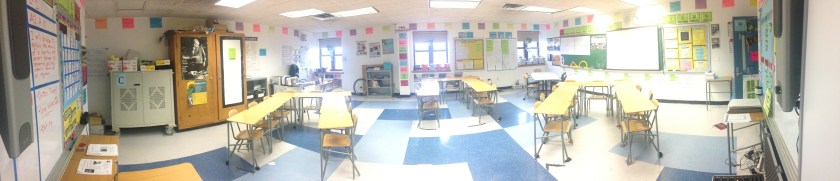
2. I loved my classroom set up this year, especially the U-shaped group structure. It allowed me to efficiently assess student understanding. Also, the desks could easily be pushed together for a more intimate group setting. Next year: systematically establishing interdependency by making group work the norm. This will be huge.

3. Game changer: the video-based professional development that I facilitated this year. I experienced so much growth related to this. A more detailed post coming soon.

4. Over the years my parental outreach has been dismal. This year I was proud that I began  sending out a monthly “newsletter” via email that contained upcoming events, class announcements, etc. But about three months in, I fell off. Next year, I want to use MailChimp or a similar service to help with this. This is a must do!

5. I promoted far more inquiry in my lessons this year. I had students doing more – more sense making, more investigating relationships – not just paying attention to procedures. I have a long way to go, but I made significant progress.

6. My homework policy this year drifted into nothingness. I started the year strong and slowly, over time, stopped checking it. It was disappointing. I love the idea of lagging it, but I want to greatly simplify the homework experience. Possibly include a reflection (which I want to heavily promote next year) question followed by 2-5 mathematical problems, 1-2 of which are lagged. I may also go with one weekly homework assignment where concepts aren’t indicated for each problem – similar to an exam.

7. As a means of promoting introspection, I chose to compose one deeply reflective tweet per day during the #MTBoS30 challenge in May. I forced myself, every day, to think earnestly about an aspect of my teaching in a concerted manner. I was pushed out of my comfort zone and it was awesome.

8. Lagging my unit exams was a great experience. I just need to ensure that I don’t fall too far behind, which happened this year. I also liked the audits as a means of keeping student knowledge, and records of their knowledge, current. I’m definitely going to stick with both of these assessment structures moving forward.

9. This year I officially began the process of becoming National Board Certified. It will no doubt be a long, arduous process, but a welcomed one.

10. My interest in robotics declined this year. Instead, I’ve rediscovered and rekindled my long-lasting love for mathematics. Although I’ve taught mathematics my entire career – my wholehearted dedication towards perfecting how I teach the content hasn’t always been there. Things are different now.

11. After a couple of years planning, I kickstarted an after-school bicycle club. Moving on two wheels has long been a passion of mine, so sharing this love with students was special.

12. Reflecting on the goals I set for the year, what didn’t I accomplish? Conferencing with students didn’t happen…like, at all. A complete waste of an awesome table I set up in my room. Earning highly effective. Eh. Thankfully, I’ve moved beyond the whole rating thing this year. The retakes culture in my classroom improved this year, but I still need to do better at promoting/mandating this growth mindset structure. There were many after-school sessions where every student was working on a different concept. It was beautiful. I’ve also raised my expectations for students, but I’m still not where I need to be. I did seek student feedback, but more so at the end of the year. I tried, but still couldn’t manage to have my students effectively answer “why am I doing this?” during lessons.

13. My end-of-year algebra 2/trigonometry state exam results were much better this year. I’m proud (read: disappointed) that I’m getting better at teaching my students how to be better test takers of mathematics.

14. Starting in October, every Friday I sent a Reflections email to my colleagues in the mathematics department. It was always an impromptu collection of highlights and interesting happenings from the week we experienced. It was a way of digesting the week in a positive, motivating way. It allowed me to connect with my department on a personal level and they seemed to enjoy it. I’m so proud of this.

15. My standards-based grading was more focused and worthwhile this year. I am thinking of a shift that puts more emphasis on depth of understanding within the domains of mathematics (and not assess concepts in isolation). I was able to use the performance data to drive instruction and remediation strategies, like tutoring. I also began emailing progress reports to students and parents on a weekly basis, which was a big step forward. Although, the layout of the email could be improved.

16. The Token. I just love this. It created a warm atmosphere that went beyond mathematics and injected a good dose of humanity into us all. There were multiple Fridays when I forgot to initiate the passing, which I’m not happy about. That said, the kids took upon themselves to pass it without me many times. Next year, I want a small, simple poster that displays the current holder of the token.

17. I created a class calendar in my room using whiteboard paper. This was simple, but meaningful. I will make it larger next year. I need to post student birthdays!

18. I got far fewer Friday letters this year. Maybe I should get into the habit of placing the box near the front of the room on Fridays so that we all can be reminded? At the same time, I wrote my students a lot this year – especially while they took exams.

19. I have been highly critical of those making excuses this year, including myself. If something doesn’t happen, it’s because that thing wasn’t a priority. And that’s not necessarily a bad thing. Discover what matters and pour everything you have into it. Don’t look back.

20. This year was a crossroads for me. The 2016-17 school year will bring dramatic changes to my career and school family. I’ve never been more ready for the sunrise that I’ll witness in September 2016. Here’s to writing the next chapter.


bp

When am I ever going to use this in the real world?

Oh yeah. The question.

Undoubtedly, it has been asked to all teachers of mathematics. When you earn your teaching license, you accept this fate.

When I think about this question, the first thing that enters my mind is not how to reply. I’ve realized that no answer I provide, regardless of how sensible it is, will satisfy their need to question the relevancy of mathematics. I can convey its importance to engineers, accountants, and architects, but it won’t matter. I could talk with them about how mathematics is a vehicle for developing problem solving and sense-making, but that’s far too abstract to gain any traction. I could also indicate that Homer’s Iliad won’t connect explicitly to any real world decision that they will need to make, but they’re still required to read and analyze it. That too, although true, will not be an adequate response for them.

So what do I do when I’m asked the question?

Well, I ask myself a question: how can I make this lesson, and all lessons, more engaging?

You see, if a student is fully immersed in my lesson, if they’re experiencing my lesson and not just getting through it, there won’t be a need to ask the question. They’ll be so connected to what I planned for them that it won’t even enter their minds. If I find my students asking me when they’re ever going to use what they’re learning in the real world, I’ve already lost.

Besides, I don’t think most students even care where mathematics applies to the real world. By asking, they’re just trying to fill a void. A void that has been created by a lack of engagement and meaning within my lesson. In other words, when a student asks me the question, what they’re really asking is, “Mister, how can you make this more engaging?”

And the answer to that question exists largely within me and my teaching. Not the real world.

bp

When we’re afraid of results 

Is it possible that a teacher could be subconsciously afraid of what formative assessment could reveal about student understanding and, as a result, not do it?

I know I’m guilty of this. Especially early in my career.

Looking in the mirror is hard. After hours of planning I’m supposed to accept the fact that my thinking was flawed or incomplete?  I’m supposed to realize that my students have not met the objective(s) of the lesson? I’m supposed to openly accept that  it’s back the drawing board? For reflective teachers, the answers to these questions are welcomed as a means for growth, but still not always easy to accept.

To this end, it’s easier to get a “feel” for the learning happening in the classroom rather than to strategically measure it. We subconsciously fear that crushing moment when the lack of learning is exposed, so we evade it. We fear a reality that harshly contradicts with our own expectations. We fear what these humbling results echo about our planning and teaching.

I also find that the need to formatively assess is at times disguised by a belief that students should understand the lesson objective(s) based on previous experience or other factors. This, then, somehow equates to implicitly thinking that students are reaching objectives.

This idea came to while speaking to an instructional coach recently and I feel that it happens more often than we think. If we don’t embrace the uncertainty related to students not meeting expectations, if we’re not highly critical of our own practice and willing to accept unfavorable outcomes, then we save face. Things go “well.” We feel comfortable and all of our hard work is justified.

What a tragedy.


bp