Close of the 2015-16 school year

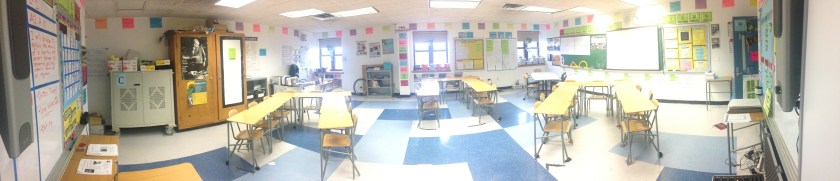
CLassroom 2015-16

-1. It’s that time of year again. The last day of school. Time to get decompress, reflect, and wonder where the hell the year went.

0. Last year proved to be eventful, but this year actually doubled up on that. Whew. Another change in administration. Another roller coaster ride.

1. Probably my biggest takeaway from this year was what I learned about leadership. A huge part of this was my participation in the Learning Partners program and my role as a Model teacher. Visiting other schools and spearheading change in my school made me realize where I am in my career and expectations that I should have for those around me.

2. I loved my classroom set up this year, especially the U-shaped group structure. It allowed me to efficiently assess student understanding. Also, the desks could easily be pushed together for a more intimate group setting. Next year: systematically establishing interdependency by making group work the norm. This will be huge.

3. Game changer: the video-based professional development that I facilitated this year. I experienced so much growth related to this. A more detailed post coming soon.

4. Over the years my parental outreach has been dismal. This year I was proud that I began  sending out a monthly “newsletter” via email that contained upcoming events, class announcements, etc. But about three months in, I fell off. Next year, I want to use MailChimp or a similar service to help with this. This is a must do!

5. I promoted far more inquiry in my lessons this year. I had students doing more – more sense making, more investigating relationships – not just paying attention to procedures. I have a long way to go, but I made significant progress.

6. My homework policy this year drifted into nothingness. I started the year strong and slowly, over time, stopped checking it. It was disappointing. I love the idea of lagging it, but I want to greatly simplify the homework experience. Possibly include a reflection (which I want to heavily promote next year) question followed by 2-5 mathematical problems, 1-2 of which are lagged. I may also go with one weekly homework assignment where concepts aren’t indicated for each problem – similar to an exam.

7. As a means of promoting introspection, I chose to compose one deeply reflective tweet per day during the #MTBoS30 challenge in May. I forced myself, every day, to think earnestly about an aspect of my teaching in a concerted manner. I was pushed out of my comfort zone and it was awesome.

8. Lagging my unit exams was a great experience. I just need to ensure that I don’t fall too far behind, which happened this year. I also liked the audits as a means of keeping student knowledge, and records of their knowledge, current. I’m definitely going to stick with both of these assessment structures moving forward.

9. This year I officially began the process of becoming National Board Certified. It will no doubt be a long, arduous process, but a welcomed one.

10. My interest in robotics declined this year. Instead, I’ve rediscovered and rekindled my long-lasting love for mathematics. Although I’ve taught mathematics my entire career – my wholehearted dedication towards perfecting how I teach the content hasn’t always been there. Things are different now.

11. After a couple of years planning, I kickstarted an after-school bicycle club. Moving on two wheels has long been a passion of mine, so sharing this love with students was special.

12. Reflecting on the goals I set for the year, what didn’t I accomplish? Conferencing with students didn’t happen…like, at all. A complete waste of an awesome table I set up in my room. Earning highly effective. Eh. Thankfully, I’ve moved beyond the whole rating thing this year. The retakes culture in my classroom improved this year, but I still need to do better at promoting/mandating this growth mindset structure. There were many after-school sessions where every student was working on a different concept. It was beautiful. I’ve also raised my expectations for students, but I’m still not where I need to be. I did seek student feedback, but more so at the end of the year. I tried, but still couldn’t manage to have my students effectively answer “why am I doing this?” during lessons.

13. My end-of-year algebra 2/trigonometry state exam results were much better this year. I’m proud (read: disappointed) that I’m getting better at teaching my students how to be better test takers of mathematics.

14. Starting in October, every Friday I sent a Reflections email to my colleagues in the mathematics department. It was always an impromptu collection of highlights and interesting happenings from the week we experienced. It was a way of digesting the week in a positive, motivating way. It allowed me to connect with my department on a personal level and they seemed to enjoy it. I’m so proud of this.

15. My standards-based grading was more focused and worthwhile this year. I am thinking of a shift that puts more emphasis on depth of understanding within the domains of mathematics (and not assess concepts in isolation). I was able to use the performance data to drive instruction and remediation strategies, like tutoring. I also began emailing progress reports to students and parents on a weekly basis, which was a big step forward. Although, the layout of the email could be improved.

16. The Token. I just love this. It created a warm atmosphere that went beyond mathematics and injected a good dose of humanity into us all. There were multiple Fridays when I forgot to initiate the passing, which I’m not happy about. That said, the kids took upon themselves to pass it without me many times. Next year, I want a small, simple poster that displays the current holder of the token.

17. I created a class calendar in my room using whiteboard paper. This was simple, but meaningful. I will make it larger next year. I need to post student birthdays!

18. I got far fewer Friday letters this year. Maybe I should get into the habit of placing the box near the front of the room on Fridays so that we all can be reminded? At the same time, I wrote my students a lot this year – especially while they took exams.

19. I have been highly critical of those making excuses this year, including myself. If something doesn’t happen, it’s because that thing wasn’t a priority. And that’s not necessarily a bad thing. Discover what matters and pour everything you have into it. Don’t look back.

20. This year was a crossroads for me. The 2016-17 school year will bring dramatic changes to my career and school family. I’ve never been more ready for the sunrise that I’ll witness in September 2016. Here’s to writing the next chapter.


bp

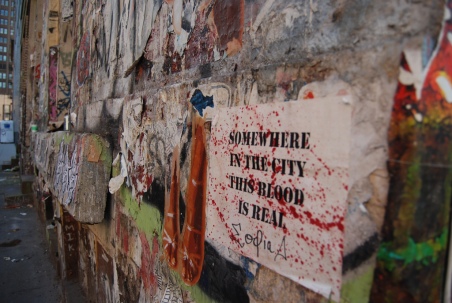
The concrete jungle

3714235795_66d70a8478_b

I recently finished This is Not a Test by Jose Luis Vilson. It resonated with me on several levels and got me thinking about my place as a teacher of underserved, inner-city youth.

I haven’t given the notion a lot of concentrated thought throughout my career – as the New York City Department of Education has a perverted way of distancing you from your core beliefs. The system is a monster. It’ll swallow you whole if you’re not careful.

Nevertheless, teaching at an urban school is a calling that has roots in my own childhood. Being born and raised in inner-city Cleveland, attending public schools, I can relate deeply to the daily grind of my students. Things like the reliance on public transportation, overbearing congestion anywhere you go, blaring sirens at all hours of the night, a single-parent household, gangs, bodegas, and the negative stereotype of inner-city youth were all a reality for me growing up. Interestingly, as a white male, I was the overwhelming minority in classrooms and in the neighborhood in which I lived growing up. Today, I still am.

This is not to say that I’ve been through everything that my students have, because I haven’t. My students face struggles that no teenager should ever have to deal with and are well beyond what I’ve experienced. But I do have a great deal of empathy and respect for their culture – our culture – and the circumstances that come along with it. I identify with them. It’s foundational to who I am as a man. And this helps me reach them through mathematics. As Vilson states:

“These are the variables that determine the type of teacher you become. And of course, the teacher you become is an extension of the person you are at that moment. It is also an extension of your own time as a student.”

This relationship I have with the urban lifestyle has been the backbone of my teaching since my preservice days. Thinking back, all of my peers in college preferred to teach in the suburbs. I get why. And I’m not judging anyone for their preferences. But it disturbed me, even as a 22-year-old, naive, no-nothing, that these aspiring educators readily dismissed this demographic of students because of the unique set of challenges associated with them. Did they not understand that these students needed them the most? Did they not understand that life-altering inequities persist because of these types of decisions? Indeed, they had their heart set on what they thought was the path of least resistance. Not ironically, it was around this time in my life that I decided who and where I wanted to serve as a teacher. I’ve never looked back.

What does this mean? It means that teaching at an urban public school that serves unscreened students from low-status neighborhoods is the most natural thing I can do as an educator. My entire teaching philosophy is centered on this fact. It drives where and how I teach. I’m responsible for recycling the gifts that I’ve been given back through the concrete jungle to students that desperately need them. Besides, it’s home.

Am I claiming the stereotypical white teacher role from movies that “saves” students from the inner-city? Hell no. The idea that inner-city kids need to be saved or fixed is ludicrous and makes me cringe. It only feeds the fire of negative generalities and is damaging for everyone involved. The passion I have for my students was born by experiencing the same demanding conditions that they live through every day. I also believe this demographic and their parents deserve teachers that are learners first, obsessed with getting better. They need someone that isn’t going to pass the buck. I claim nothing else.

Furthermore, being a white male, I’m keenly aware that my status as a role model at a school that is 91% Black and Latino is inherently limited. My positive influence is strong, but my students desperately need more teachers of color. That’s a troubling issue that I’ll save for another post.


bp

When am I ever going to use this in the real world?

Oh yeah. The question.

Undoubtedly, it has been asked to all teachers of mathematics. When you earn your teaching license, you accept this fate.

When I think about this question, the first thing that enters my mind is not how to reply. I’ve realized that no answer I provide, regardless of how sensible it is, will satisfy their need to question the relevancy of mathematics. I can convey its importance to engineers, accountants, and architects, but it won’t matter. I could talk with them about how mathematics is a vehicle for developing problem solving and sense-making, but that’s far too abstract to gain any traction. I could also indicate that Homer’s Iliad won’t connect explicitly to any real world decision that they will need to make, but they’re still required to read and analyze it. That too, although true, will not be an adequate response for them.

So what do I do when I’m asked the question?

Well, I ask myself a question: how can I make this lesson, and all lessons, more engaging?

You see, if a student is fully immersed in my lesson, if they’re experiencing my lesson and not just getting through it, there won’t be a need to ask the question. They’ll be so connected to what I planned for them that it won’t even enter their minds. If I find my students asking me when they’re ever going to use what they’re learning in the real world, I’ve already lost.

Besides, I don’t think most students even care where mathematics applies to the real world. By asking, they’re just trying to fill a void. A void that has been created by a lack of engagement and meaning within my lesson. In other words, when a student asks me the question, what they’re really asking is, “Mister, how can you make this more engaging?”

And the answer to that question exists largely within me and my teaching. Not the real world.

bp

When we’re afraid of results 

Is it possible that a teacher could be subconsciously afraid of what formative assessment could reveal about student understanding and, as a result, not do it?

I know I’m guilty of this. Especially early in my career.

Looking in the mirror is hard. After hours of planning I’m supposed to accept the fact that my thinking was flawed or incomplete?  I’m supposed to realize that my students have not met the objective(s) of the lesson? I’m supposed to openly accept that  it’s back the drawing board? For reflective teachers, the answers to these questions are welcomed as a means for growth, but still not always easy to accept.

To this end, it’s easier to get a “feel” for the learning happening in the classroom rather than to strategically measure it. We subconsciously fear that crushing moment when the lack of learning is exposed, so we evade it. We fear a reality that harshly contradicts with our own expectations. We fear what these humbling results echo about our planning and teaching.

I also find that the need to formatively assess is at times disguised by a belief that students should understand the lesson objective(s) based on previous experience or other factors. This, then, somehow equates to implicitly thinking that students are reaching objectives.

This idea came to while speaking to an instructional coach recently and I feel that it happens more often than we think. If we don’t embrace the uncertainty related to students not meeting expectations, if we’re not highly critical of our own practice and willing to accept unfavorable outcomes, then we save face. Things go “well.” We feel comfortable and all of our hard work is justified.

What a tragedy.


bp