“The students must drive you crazy”

Dear Person I Met in the Elevator,

“Wow. Bless you. The students must drive you crazy.”

That’s a direct quote from you. The remark — filled with aghast — came immediately after I explained that I was a high school teacher. Judging by your reaction, I think you confused teaching with swimming with sharks. You weren’t in disbelief as much as you were concerned for my well-being.

What struck me about the comment, and why I bring it up here, isn’t because your reaction was in any way unique or special. It’s the opposite: Practically everyone I meet reacts the same way you did. Your reply was memorable only because it was so predictable.

It’s an absolute shame that people observe a subway-surfing teen or a few knuckleheads at the mall and pass judgment on every teenager alive. Thinking that this extremely small subgroup of teens is in any way representative of the students in my (or any) classroom is both shallow and hurtful. No offense.

You have to excuse my strong recoil from our brief interaction that day. At the moment, I said none of this. I didn’t fully understand what I was feeling, although I knew you triggered something within me. Maybe it’s because I’m approaching the last third of my teaching career, and I feel the need to defend all my time spent in the classroom, but I find comments like yours increasingly bothersome. They disrespect my students, none of whom you have ever met.

As someone who works hard to support and serve young people, I am hurt to have my kids so pointedly dismissed as problematic. My students are wonderful. Let me repeat: my students are wonderful. Of course, they have their moments. I’ll get the occasional cheater or copier. And some, for the life of me, can’t arrive on time for first period.

But they are still well-mannered, trustworthy, and insanely smart. They deserve better. If you visited my classroom I’m confident you would feel the same.

So please don’t be concerned about my well-being. I’m doing just fine. My students ensure this.

Sincerely,
Brian, your fellow elevator rider


bp

My 2023 in Books

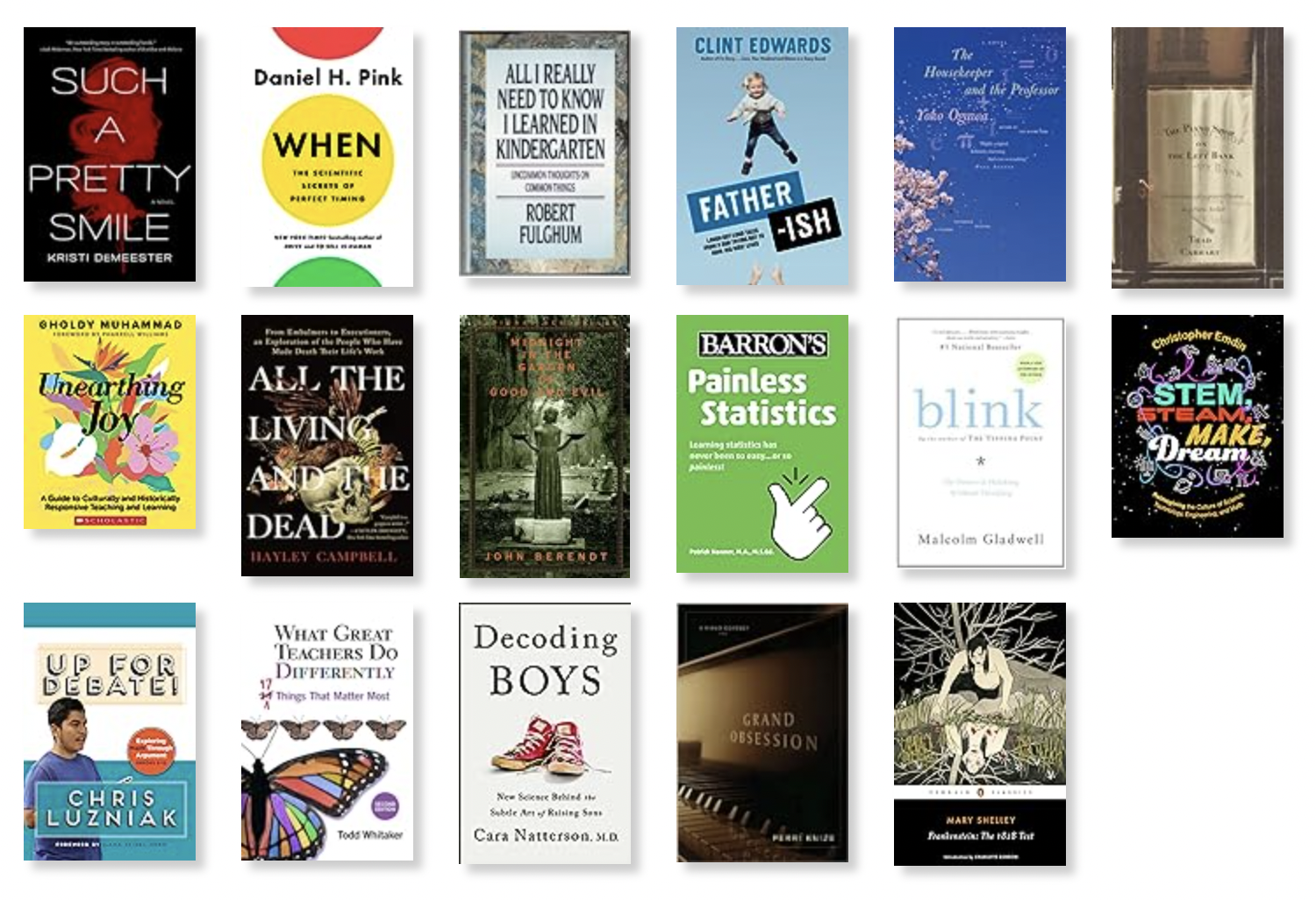
The best part of reading books for me is doing it in community with others. That said, one might think that I join book clubs. I don’t. What happens often is that I read books that others recommend to me and then follow up with that person as I’m reading. It’s a great way to discover new stories, ideas, and authors from people I admire. The best part about this is that I often recommend these same books to others down the road. It’s a virtuous circle!

Of the 17 books I read this year, several were recommended to me. Father-ish by Clint Edwards, offered by a family member, was quirky and funny. It reminded me not to take my many father-failures to heart. Such a Pretty Smile by Kristi Demeester was referred to me by a few students. While the genre (horror) is not my cup of tea, we read it simultaneously and had some good conversations about it. I read Gholdy Muhammad’s Unearthing Joy with a push from a colleague. It was a great follow-up to her first book, which I really enjoyed. Decoding Boys by Cara Netterson, which I read after a family member, was a fascinating look into boyhood. If there’s one piece of advice that I learned from this book, it is this: As boys age and begin to pull away, do everything you can to stay close to them, even if they despise you for it. The Housekeeper and the Professor by Yoko Ogawa was recommended to me by my assistant principal and was standout from the year. It brought compassion, human connection, childhood, and math all under one roof. Painless Statistics by fellow math teacher Patrick Honner was an outstanding way to brush up on my stats. While I didn’t read this book alongside anyone, and it wasn’t recommended, I know Patrick personally. It felt like I was in conversation with him as I read.

Another theme in my reading this year emerged from pursuing a newfound passion: learning piano. I’ve wanted to learn to play for most of my life. As I gained momentum in my playing, my practice took away from the time I would have probably spent reading books. It was a sacrifice I gladly made. Over the course of the year, playing piano stirred in me a growing interest to learn more about the instrument itself (I know very little) and people who love it. Thad Carhart’s The Piano Shop on the Left Bank was a homey memoir of a one man’s relationship with a neighborhood piano shop and the many learnings that result from it. Grand Obsession by Perri Knize, about the author’s unwavering search for and maintenance of her grand piano, stayed with me long after I put it down.

This year, I have two honorable mentions: All the Living and the Dead by Hayley Campbell and Frankenstein by Mary Shelley. All the Living was unusually gripping because it featured profiles of individuals who make it their job to handle and care for the dead. The writing was superb. I’ve never read Frankenstein before, but I picked it up, on a limb around Halloween and never put it down. Bizarre and unexpectedly touching, I loved every bit of it.

bp

Quality PD

School-based professional development is one of those things that a lot of teachers dread. If they don’t dread it, they often don’t see a ton of value in it.

The truth is, I can’t blame them. At the school level, PD is often unorganized and poorly planned. As someone who frequently volunteers to be part of the PD committee, I often engage in the uphill battle of helping PD be meaningful. This requires me to convince colleagues that PD is worth their time and shouldn’t be experienced as a chore. This is true for both teachers attending the PD and the administrators who support it.

Part of the reason why it sucks, I think, is because the goals of high-quality professional development run counter to how we’re expected to teach.

As a public school teacher whose course is served with a standardized curriculum ending in a state exam, I’m constantly asking my students for deliverables. Each day, I need to squeeze artifacts out of them that demonstrate learning. I must conduct non-stop monitoring of their understanding. I need to have checklists and direct evidence. Always evidence. In the age of big data, my administrators expect me to manifest proof of student understanding every 10 minutes (let alone every class period). Otherwise, what I do is pointless.

Many teachers approach PD this way, too. Because we are expected to ask students to continuously manufacture a representation of their learning, we inherently think PD should work the same way. If PD is going to be worthwhile, there needs to be immediate tangible benefits. On top of that, takeaways must be able to be used in our classroom tomorrow, of course. If teachers don’t leave a PD with some immediate change they can implement with students, the experience is usually considered a failure. Just like how student learning is assessed, immediacy drives how we rate the quality of PD.

Recently at my school, the PD committee (which I’m on) debated how to design a series of four, 40-minute sessions on curriculum mapping. The staff was broken up into three interdisciplinary groups. Two of the groups offered the PD as “work time” for teachers to develop their curriculum maps. This meant that teachers would work mainly in isolation on their maps at each session, with facilitators checking in periodically to support their progress. The goal was a completed map (or at least a more complete one). It was tangible and direct.

The third group took a different route. Instead of individual work time, the group structured each session as a conversation. At each session, 1-2 teachers presented a unit they wanted to improve. Using a loose protocol, the other members of the group asked questions and offered warm and cool feedback. The last word was saved for the presenter to reflect on what they heard. Other than the discussion and active engagement, there was no concrete goal.

These are two very different ways of approaching PD. One aims to elicit something concrete from participants, while the other hopes to promote critical conversations about our practice. One aligns with the evidence-based teaching that feels natural to us because of how we’re forced to teach. The other aligns with meaningful professional learning and trust.

Before the PD, most teachers requested the “work time” model. Afterward, however, the conversation model yielded the strongest reviews from teachers. They enjoyed being heard. They liked being able to learn from one another in an authentic context. Although there was no “work time,” they appreciated the back-and-forth of ideas. Ultimately, because of the feedback we received, the committee used the conversation model to design our next series of PD sessions.

I understand the importance of having concrete benefits of a PD. We all want to improve right now. At the same time, it is important to remember that professional learning, like any form of learning, is complex. Progress isn’t always on-the-spot and visible in the moment. As takers and designers of PD, we should put a pause on some of the habits we’ve inherited from the classroom.

Immediate takeaways have their place. But they are overrated. A productive conversation is enough.

bp

Mister, I’ll get that 90 for you.

“Mister, I’ll get that 90 for you. I got you.”

I was in conversation with a former student turned mentee. I asked about her grades and encouraged her to work harder to bring them up, especially in math.

“Don’t do it for me. Get that 90 for yourself,” I said assuredly.

She pushed back. “But, mister, you have to understand. I don’t really like school. I’m not going to get good grades for myself. But I will do it for someone else. It’s my motivation.”

Her reply made me uncomfortable. My goal as a teacher is to help young people be intrinsically motivated. I don’t want them to work hard for me. They should be doing it for themselves.

We chatted some more. She mentioned her parents and how she has jumped through so many hoops because of them. She doesn’t see this as a bad thing. She’s smarter and knows the value of hard work because of their high expectations. She’s grateful that they asked her to do things she wouldn’t have done on her own.

As I listened, I thought of my own kids and the expectations I have for them. My son would watch TV and eat junk food all day if he were allowed to. He isn’t always self-motivated to do the right thing (and often doesn’t know how). He does it so that I will be proud of him — or at least not disappointed. I am his chief motivator.

Our conversation lasted all of 10 minutes, but by the end, my outlook on motivation was more nuanced and complete, I think. My job as a teacher is to foster self-motivation in students, but for those who aren’t there yet, it’s alright to embrace their willingness to please me. At this stage in life, that’s what they need.

Time will tell if she earns that 90. But knowing her, I’ll bet she does. And when it happens, I’ll be proud of her improvement. I’ll also know she did it not for herself, but for me. I’ll be ok with that.

bp