I am documenting my 2022-23 school year through photography. Each day, I take a photograph and include it in a weekly post here on my blog. The goal is to create a compilation of photos that tells the story of my year and challenges me to go beyond the written word. This is the 19th post in the series.
Monday, January 9
A student updating our “Quote of the Moment”
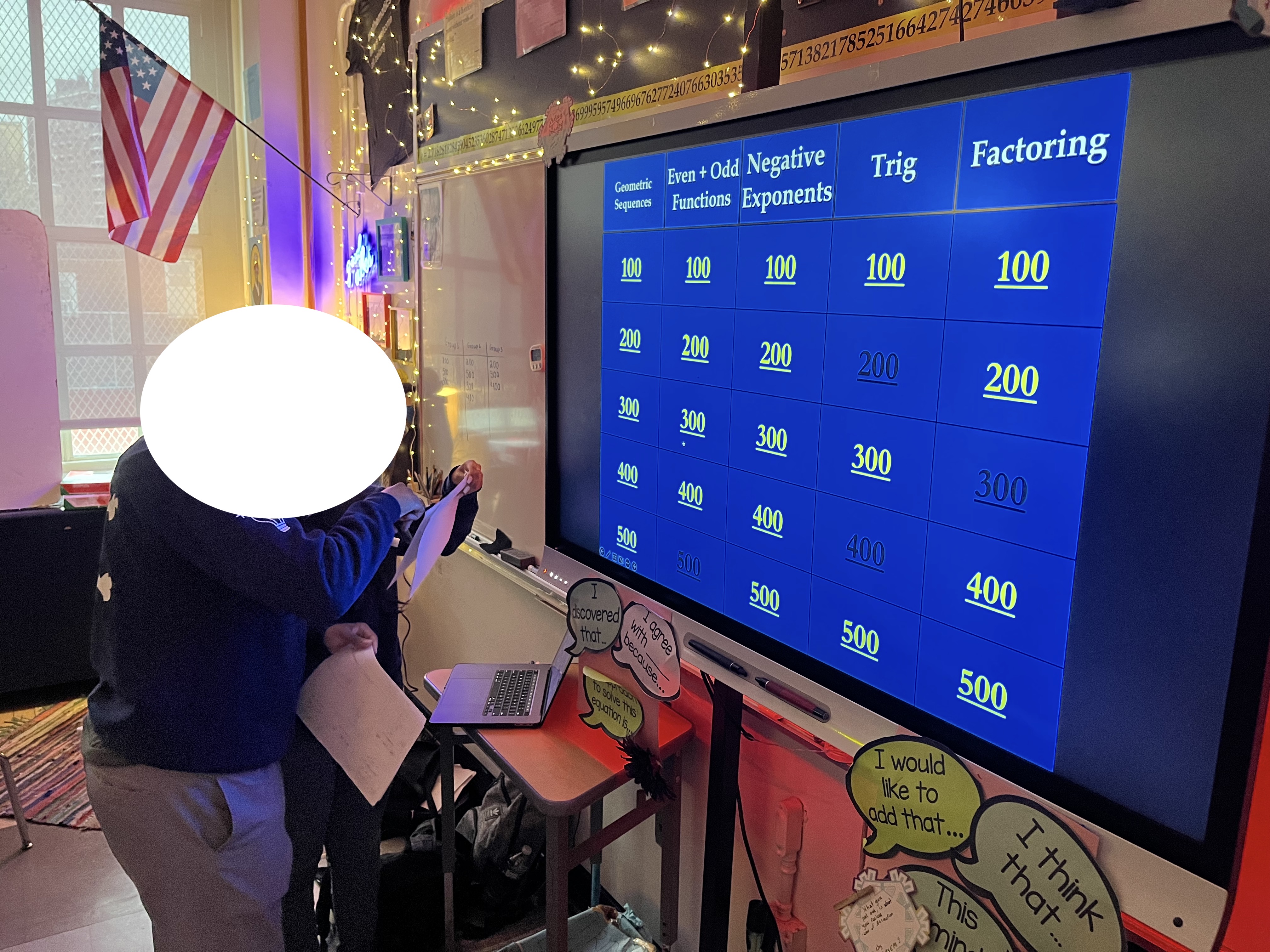
Tuesday, January 10
Two of my cogen students leading the class through Jeopardy
Wednesday, January 11
Hung up a cool new message board outside my room (gifted to me by a colleague)
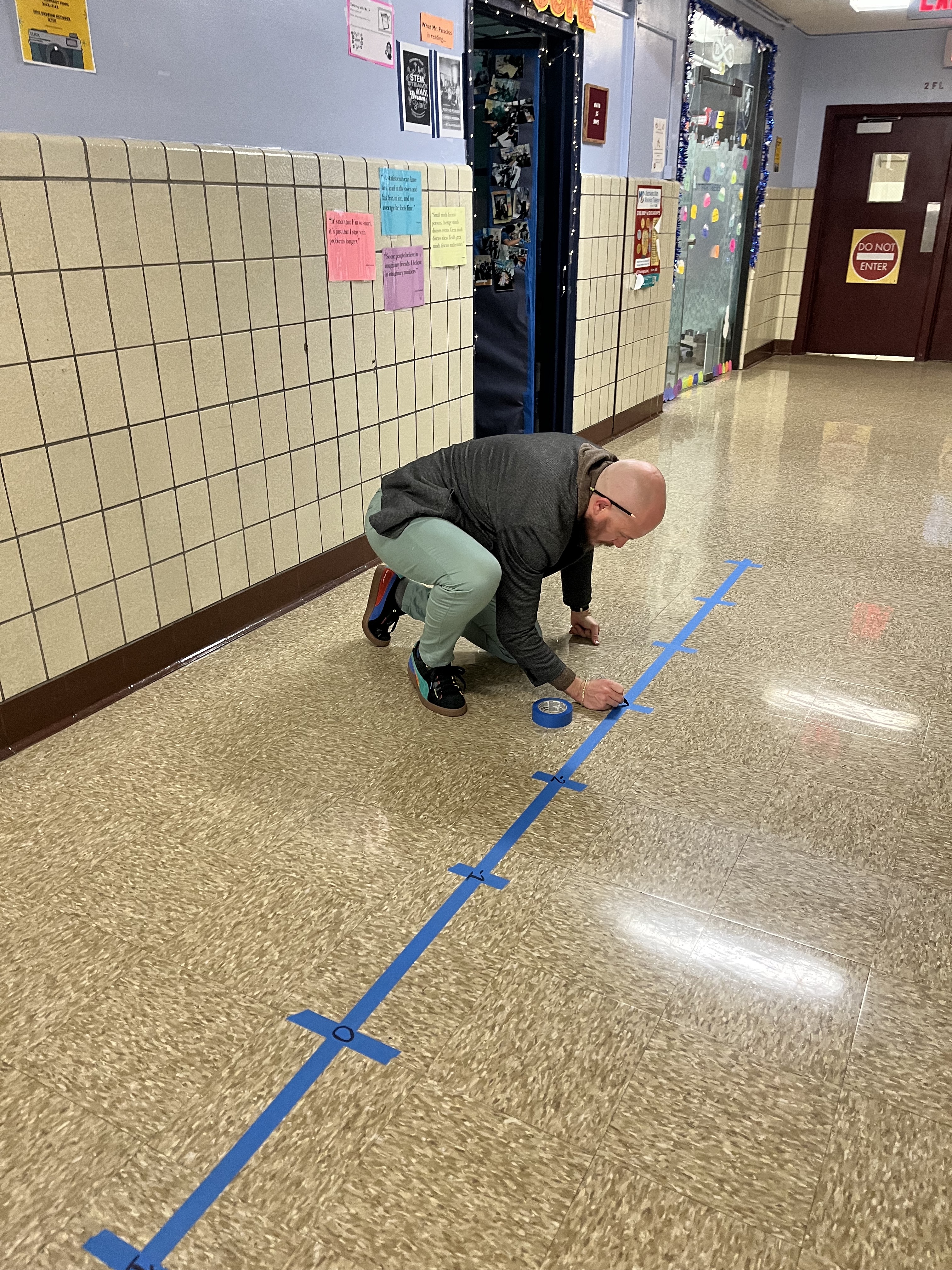
Thursday, January 12
Taping a number line in the hallway for our study of complex numbers!
Friday, January 13
A student made me a new Friday Letters box (I had my original for 8+ years)
In the spirit of the new year, when we came from winter break I had my students write math affirmations. I never did this before, but was inspired to try by a colleague and some recent readings I’ve done. I defined math affirmation for my students as a statement of worth about their mathematical selves. These statements are reflections of the principles, self-beliefs, and/or ideals that people want to manifest when they’re doing or thinking about math.
To start them on the journey of writing a math affirmation, I showed them this video:
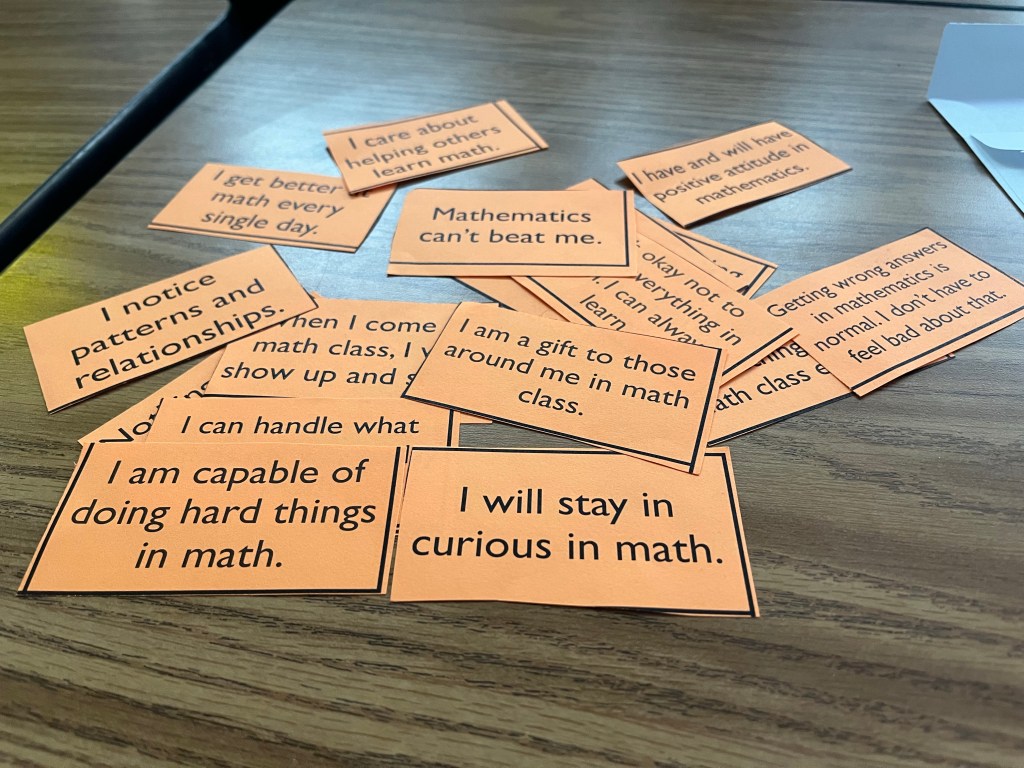
After, I told them that it was their turn to write at least one math affirmation for themselves. Figuring that some students might have a hard time coming up with an affirmation on their own, I created a bunch of sample affirmations to help them. If they couldn’t come up with an original affirmation, I invited them to adopt one from my collection.
Sample math affirmations that I offered my students
I wanted their affirmations live publicly in the classroom, so after they determined of their affirmation, I asked them to write it down on a half-sheet of paper. I borrowed markers from another teacher so they could personalize them and make them fun.
I printed off a bunch of these on colorful paper for my students to write their affirmations
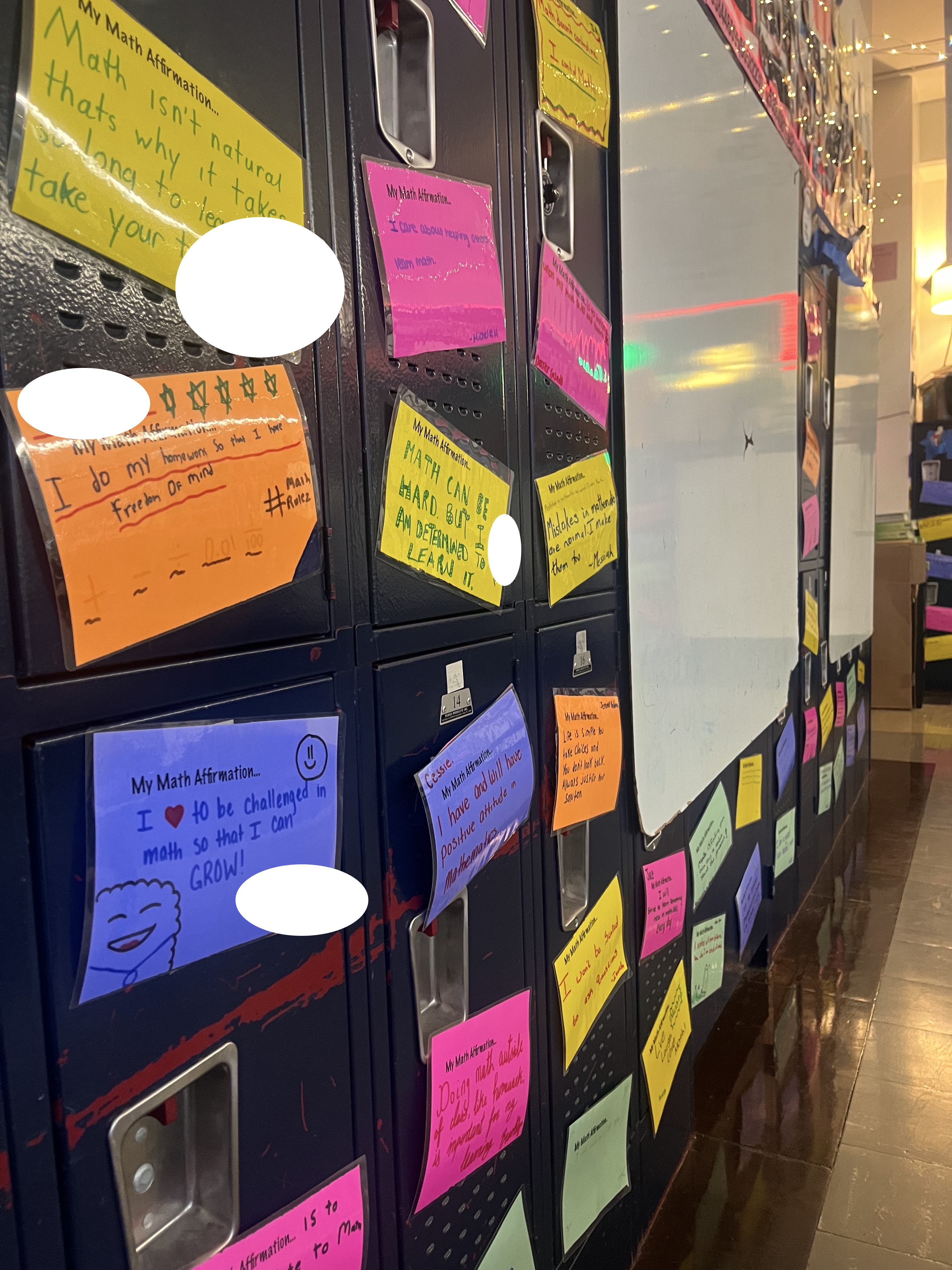
Now that I had all these fantastic affirmations, where to put them? A neat suggestion from first period: hang them up on the lockers around the room.
The walls/lockers are adorned with student math affirmations
What a great idea. At the end of the day, after I lamented a few of the affirmations and hung them up, the student who offered the locker suggestion came into the classroom and saw them. She beamed and said pridefully, “I told you they would look good!” She was right. We now have a bright, colorful, and inspirational touch on what was a boring part of our room. It’s comforting to know that while my students are working on our whiteboards, the affirmations will keep them company, waiting to provide encouragement whenever they may need it.
The whole point of an affirmation is that you read and say it often — or at least whenever you need a boost of positivity. To help accomplish this, I had students write their affirmations on a small piece of paper and tape it into or onto their math notebook. Beyond the lockers, I hope this helps them see their affirmation often.
Student notebooks with their math affirmations
It wouldn’t feel right if I had students write math affirmations and I didn’t write one myself. Thus, after my kids wrote their personal affirmations, I revealed our class affirmation:
We will grow through mathematics
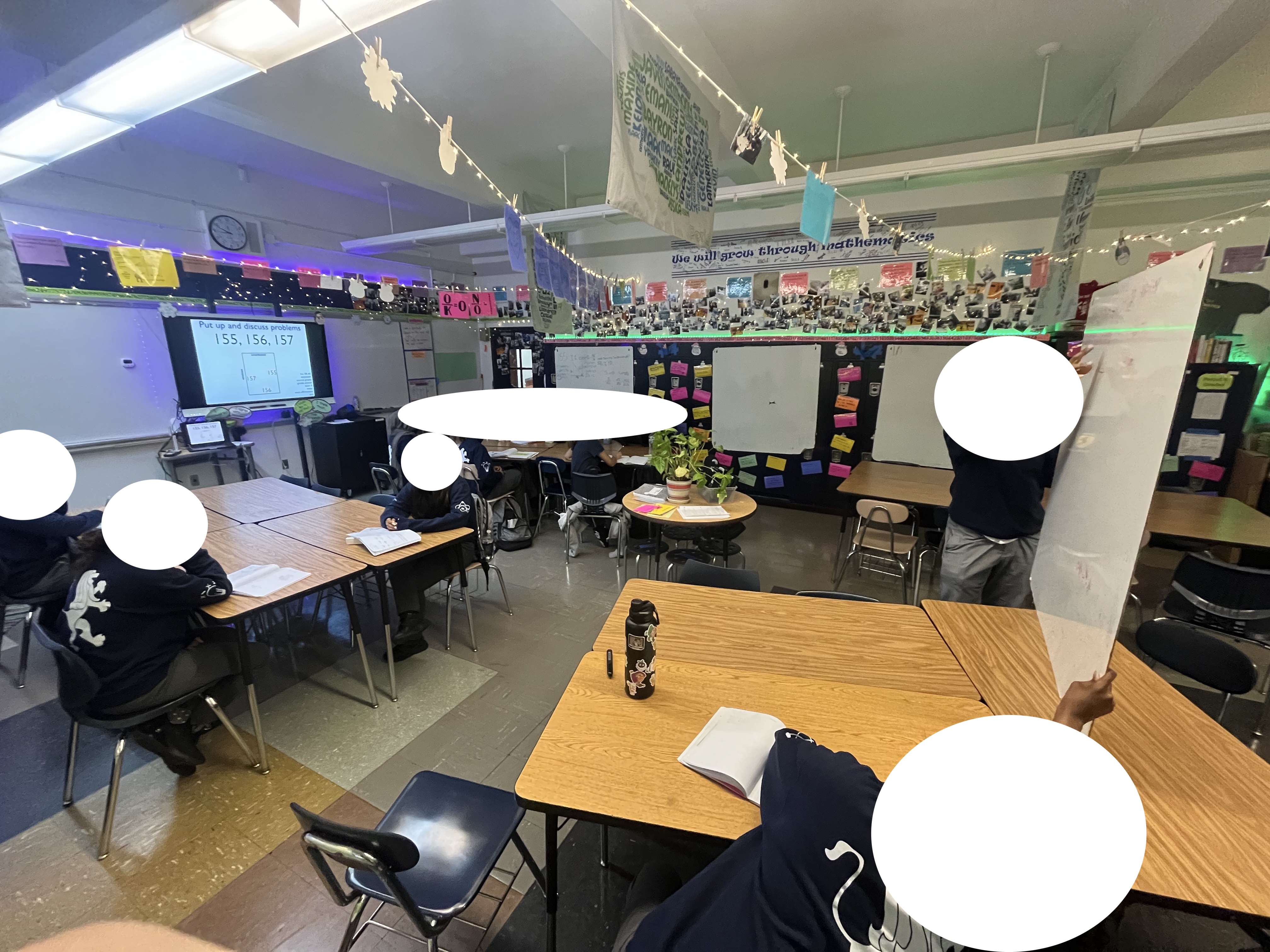
Luckily for me, my school has a banner printer. This enabled me to blow up our class affirmation, have all the kids sign it (some even wrote their affirmations on it), and then put it up in the room. It looks wonderful.
Our class affirmation banner
The finishing touch is one I’m really excited about. Each day for the next few months I’m choosing one student’s affirmation to help ignite each lesson. The affirmation will be featured in the slides for the day and we’ll read it aloud via a lively call-and-response at the start of class. This, I hope, will keep the affirmations alive and well in the hearts and minds of my students. It will also help us all start each class on a positive note.
I am documenting my 2022-23 school year through photography. Each day, I take a photograph and include it in a weekly post here on my blog. The goal is to create a compilation of photos that tells the story of my year and challenges me to go beyond the written word. This is the 18th post in the series.
Monday, January 2 — No Classes • New Year’s Day (Observed) —
Tuesday, January 3
On the first day back from break…jury duty!
Wednesday, January 4
In the spirit of the new year, the students wrote math affirmations that I hung up around the room
Thursday, January 5
After a break in the action yesterday, jury duty day 2!
When I look back at my reading habits this year, I feel torn. On the one hand, I discovered several juicy titles that challenged me and made me think and feel in new ways in 2022. On the other hand, I read noticeably fewer books than I have in years past — just 18. This is largely because I spent so much more time writing this year. Whether it was renewing my National Board certification or my weekly Meditations on a Cogen series, I found myself tapping away at my keyboard more than I found myself turning the pages of a book. This isn’t necessarily a bad thing, it just is. That said, I do find that my writing suffers when I’m not reading as much (this is also true for my thinking, in general). Throughout the year, my input influences my output a great deal.
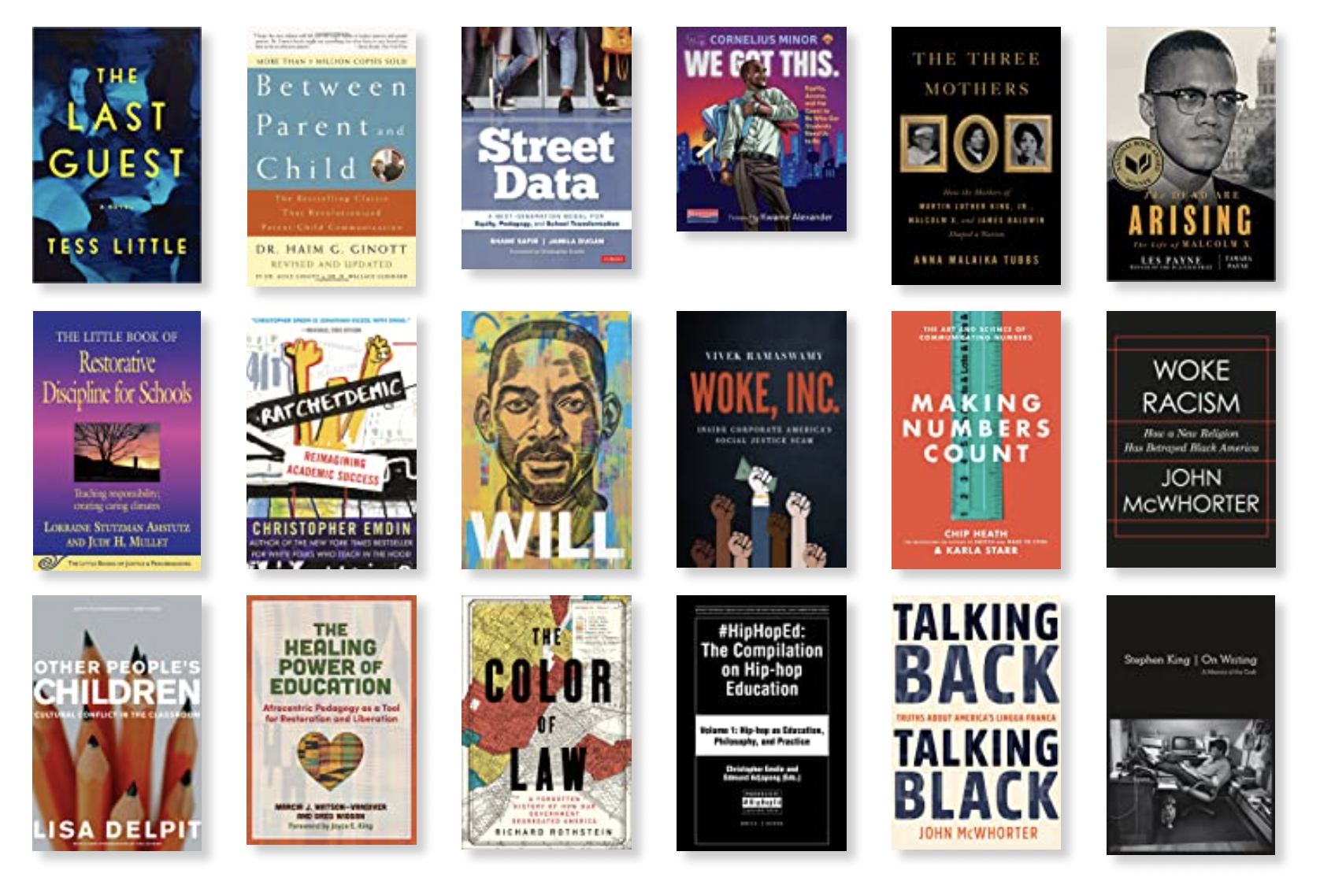
Of all the books I read this year, four of them were biographies/memoirs: The Dead are Arising by Les Payne, The Three Mothers by Anna Malaika Tubbs, On Writing by Stephen King, and Will by Will Smith and Mark Manson. The Dead are Arising is phenomenal and serves as a perfect companion to Malcolm’s autobiography. The Three Mothers is informative and exciting, but I think the context and history that Tubbs offers of Black mothers outshine her three centerpieces (the mothers of Malcolm X, MLK, and James Baldwin). On Writing is great, but having never read any of King’s books, I don’t think I can appreciate it as much as others have. Having revered Will Smith since my childhood, his memoir doesn’t disappoint. It is outstanding, full of fun and wisdom. Given the slap heard ’round the world, his book gave me a deeper, fuller picture of him and his life.
In addition to those biographies, John McWhorter’s Talking Back Talking Blackand Woke Racism are also standouts. I’ve long been fascinated by and adopted many parts of Black English, and Talking Back Talking Black is a fascinating introduction to understanding it better. McWhorter uses concrete examples to explain the inner workings of linguistics to a non-linguist, all while uplifting Black English from the lowbrow culture society places it in. As for Woke Racism, while I don’t subscribe to McWhorter’s condemnation of today’s antiracist movement, I appreciate how he complicates the matter. The book is pretentious and convoluted at times, but there are nuggets of truth in his message that have helped me see antiracism from another perspective.
There were a couple of teacher-y books that are worth highlighting. The first is We Got This by Cornelius Minor. With heavy comic-book vibes, the book’s design is stunning. Its colorful and vibrant curb appeal is equaled by Minor’s wordplay and his message to educators everywhere: find the poetry of every student. I’m not sure why it took me so long to read Other People’s Children by Lisa Delpit, but I’m so glad I did this year. I see why it has become a classic in the field. The Little Book of Restorative Discipline for Schools by Lorraine Stutzman Amstutz and Judy Mellett is small but mighty. It came up big for me during my restorative circles training in the spring.
Three more honorable mentions that don’t fall into any particular category: Making Numbers Count by Chip Heath and Karla Starr, The Color of Law by Richard Rothstein, and Between Parent and Child by Haim G. Ginott. Leading with intuition and appealing to the masses about alluring statistics, Making Numbers Count was an utter delight to read and learn from. The Color of Law is expertly researched and full of facts about important government policy as it relates to de jure and de facto segregation. Despite this, it doesn’t feel weighty or dense. I ended the year with Between Parent and Child, which felt a lot like a parental therapy session. You can tell some of the content is dated, but much of the advice Ginott dishes out is timeless.







 lazy 0ch0