Blind Trust

I attended Math for America’s Master Teachers on Teaching event last night. If you’re not familiar with it, it’s essentially a Ted-ED style event where math teachers give presentations on topics that they are passionate about. One of my biggest takeaways had to deal with technology and how I address how my students use it.

There were some awesome presentations and one that stood out to me was Patrick Honner’s talk about the shortcomings of technology as it relates to teaching and learning. A couple examples that Patrick pointed out were the TI-84’s inability to accurately represent continuity (asymptotes) and Desmos’s failure in representing holes in polynomial functions. Normally, technology allows beautiful, helpful representations of mathematics, but in all of these instances technology utterly fails to do this. Patrick encouraged the audience to embrace these types of pitfalls as teachable moments that could enable deeper understanding of the concepts.

This whole discussion reminded me of something that happened in my class a while back. Once during an exam, I witnessed a (precalculus) student enter “1 + 2” into their calculator as they solved a problem. In the moment, I almost laughed out loud (and afterwards I did). The next day when I handed back the exam, I brought my observation up to the class. The guilty student openly took ownership of the act and said:
“Mr. P, on an exam, you never know!

This example is slightly different than the ones Patrick highlighted, but it nonetheless brings attention to my students’ increasing dependency on technology. This connects with what was Patrick’s concluding point: our students blindly and inherently trust most all technologies they use – more so than they trust their own intuition. Combining this with technology’s pitfalls, and I see a recipe for disaster: students wholeheartedly trusting a flawed tool.

This means that I have a crucial responsibility to transform student reliance on technology into teachable moments that enable deeper understanding. It also means that if my students blindly trust technology and all it’s shortcomings and fail as a result, I have also failed.

bp

For a long time

For a long time, I taught my students in a way that I thought was effective.

During the last couple of years, I’ve now discovered that I was all wrong. I actually made this revelation two years ago while “flipping” my classroom.

Student learning is best when it comes from complex, indefinite situations and then, after contemplation, taken to broader ideas and concrete generalizations. When learning begins, students should be confused and perplexed, or at least unsure about what is going to happen during a lesson. The problem comes first and the solution/generalization later. I think this really stems from how we, as humans, learn on an everyday basis.

Let’s say I’m confronted with a problem, like back pain. When my back starts to hurt, I immediately begin thinking about why. I’ll probably ask myself many questions and if I injured myself during that dunk I had over Lebron James. Or was it Carmelo? Either way, I’ll try various solutions like adjusting my sleep patterns, changing my exercise routine (no dunks), and using my knees more instead of my back – all to try and alleviate the pain. Let’s say that I struggle for a while and nothing seems to work.

Over time, I begin to realize a pattern. I notice that every day I wear my old, worn out sneakers, my back hurts at the end of the day. And on days when I don’t wear them, I feel fine. So I conclude that my sneakers are the problem (and not my dunking). They seemed to have caused my joints misalign causing a chain reaction to my back. I toss them and get a new pair and my back pain goes away. Also, I learned that moving forward I should replace my sneakers more than once every 7 years.

That was a weird example, but whatever. It still sort of frames how “normal” learning happens.

When confronted with a problem we use our inherit problem solving abilities to find solutions. It’s natural to be perplexed initially and to later understand. In no way is someone going to come along and immediately present a solution for my back pain. Similarly, neither should I, as a teacher, initially provide clear theorems or concepts to students as solutions to problems I will soon give them on an exam. In a math class, we should have them identifying problems and use problem solving abilities to find solutions and generalize ideas. This doesn’t necessary mean real-world problems, just critical thinking situations overall.

I didn’t approach teaching and learning in my classroom like this for a long time. Sometimes now, even though I value the approach, it’s still hard to for a bunch of reasons. But now I try to do everything I can to teach discovery-based, problem-based lessons.

Oh, and I DID dunk on Lebron. Once. Then I woke up.

bp

The Quotient ~ 11.14.14

Whew.

What an incredible few weeks it has been. A school year of four preps, among other things, has finally caught up to me. Yes, four preps. Here are the things that having running around in my head over the last several weeks.

1. Student questions. When I get a lot of them, I’m pleased because I know my students mind’s are stimulated. But how to handle all those questions can be a challenge at times. What about when there are no questions?

2. Checking for student understanding during the lesson and adjusting on the fly. Basing the direction of my lesson on their level of mastery on any given day.

3. Relations with administrators, new and old. I’m learning a great deal about this dynamic and it’s impact on me and the overall school community.

4. Listening is a very underrated skill.

5. Including the proper scaffolding into each lesson. Specifically, having multiple entry points for students at the onset of learning.

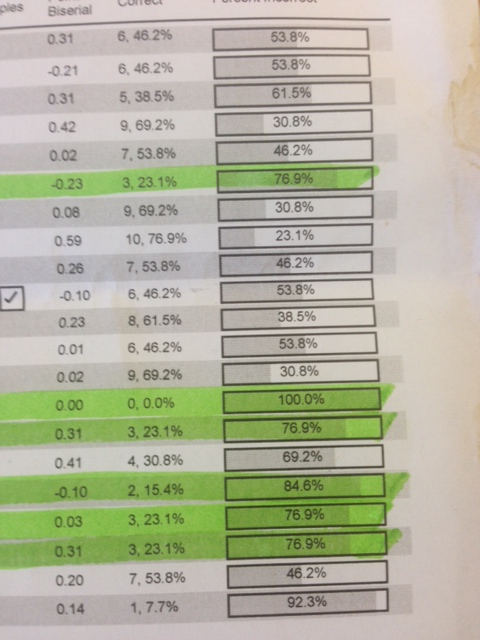
6. After an assessment, the value of data analysis. Numbers never lie. Also, how structured analysis (time and protocol) can really help reveal the story behind the numbers.

7. Related to above: point biserial.

8. Always remember that kids are kids. Relate to them, laugh with them, have fun. They’ll enjoy your lessons a lot more – and work harder for you too.

9. I let one of my students borrow one of my ties to wear at his interview with Harvard University. Very cool. Awesome kid.

10. How much my use of Desmos has increased. I’m literally using it every day.

11. Reflect as much as possible. You’ll grow in ways that you otherwise cannot. Even just 10-15 minutes of concentrated reflection is substantial.

bp

Simplified Probability Bingo

I teach an Algebra 1 course and the other day we were studying experimental and theoretical probability. I saw a Probability Bingo activity on Dave Ferris’s and Sarah Hagan’s blogs and wanted to try it. The problem was I saw it the day of the lesson and didn’t really have a bunch of prep time. In fact, I had about 15 minutes. (I changed my previous plans at the last moment.)

What do teachers do? We adapt at the last second. Here’s what I did and it took about 10 minutes of prep.

I colored several pieces of paper in different colors.photo 1

I also created 2×2 squares in Word and printed them out on 1/3 sheets of paper. During the lesson, I put all of the colored paper in a small cup. I told the students I was going to pull out two pieces or paper, one at a time. I asked the students to predict what I was going to pull out by filling in their tables by putting two colors in each corner of the table.

Prob Bingo

I proceeded to pull out the pieces of paper from the cup. If the combination they wrote down was pulled from the cup, they crossed it out. The first student to have their  2×2 grid entirely crossed out wins.

We played twice. Afterwards, we discussed the probabilities of choosing each combination of colors. They then dived into some practice problems on probability. It was great because the formal “learning” about probability took place after I had them engaged in the activity and not the other way around.

I found that the students thoroughly enjoyed the activity. It was a simple game and they didn’t even care what they won (which was nothing). They just wanted their colors pulled from the cup. Plus, it was an awesome hook into basic probability….especially since it only took 10 minutes of actual prep time. Next time, I may try and go with full-blown bingo.


bp